
TAG Heuer Monaco Split-Seconds Chronograph Watch Review
The TAG Heuer Monaco Split-Seconds Chronograph is equipped with the ultimate expression of chronograph ownership, the ‘rattrapante’. A high complication often associated with Haute Horlogerie’s old guard, this avant-garde creation serves to illustrate how far watchmaking has progressed in the last 50 years.

Piquerez watch case
Days that change history begin like any other. On one of them in 1968, on a bedside table in the Jura, a watch alarm sounded. For a local representative of casemaker Piquerez, it signalled the start of another day. I like to think it was a Memovox from JLC, a client of the firm, in one of its Supercompressor cases, that awoke the representative that morning.
I don’t know if he was the sort of chap to ignore it, turn over and get a few more minutes sleep, or spring out of bed, ready to take on the day. Perhaps he filled his coffee maker before setting it on the stove for his morning espresso. There might have been a breakfast croissant or two, carefully watched by the family dog, ever hopeful for dropped crumbs. A quick, final check of the samples in his briefcase and into the car for the first meeting of the day at one of his regulars.
Walking through the doors of Heuer, he knew he had something – a patented square, but waterproof, case mockup – that would interest the firm. Jack Heuer himself takes up the story.
We immediately knew this was something special because until then square cases were used only for dress watches because it was impossible to make a square case fully water-resistant. At Heuer, a decision had been taken around 1941 to produce only water-resistant chronographs because any water penetrating a chronograph’s case and reaching the movement causes serious damage that is very costly to repair. We immediately took a liking to the special square shape and were able to negotiate a deal with Piquerez that secured us exclusive use of the case design for chronographs.’

The inaugural Heuer Monaco released in 1969
And, with that meeting, the Monaco, housing the new automatic Calibre 11 movement, was born and watch history changed.
Add McQueen’s advocacy of the new watch in the 1970 film Le Mans and the Monaco quickly became an icon of cool. Since then it’s been through more incarnations than Doctor Who. There have been different movements and dial designs, from the minimalism of the ‘Re-edition’ CS2110 to the belt-drive V4 in 2004, but the square case has stayed. However, until now, there has never been a ‘rattrapante’ – split second – complication.
TAG Heuer rattrapante
On a digital watch (sorry, Boss) a split second is entirely controlled by the programming of the watch and all the cleverness is silicon and circuitry-based. On a mechanical, it’s a great deal more physically complicated. Underneath the chrono seconds hand is a split seconds chrono hand and, until you push the pusher, the two hands move in unison. Once you depress the pusher, the chrono seconds carries on ticking while the split seconds hand stops, giving you, for example, a lap time.
Usually, with a complication like a rattrapante, the watch is all about the movement. The case and dial are not the main event. Not so here. And, despite the Monaco being – and for once it’s not hyperbole – iconic, this watch takes the basic principles and updates them in terms of tech, finishing and design. It’s a little like Monaco meets Blake’s 7 Orac but with a great deal less perspex.
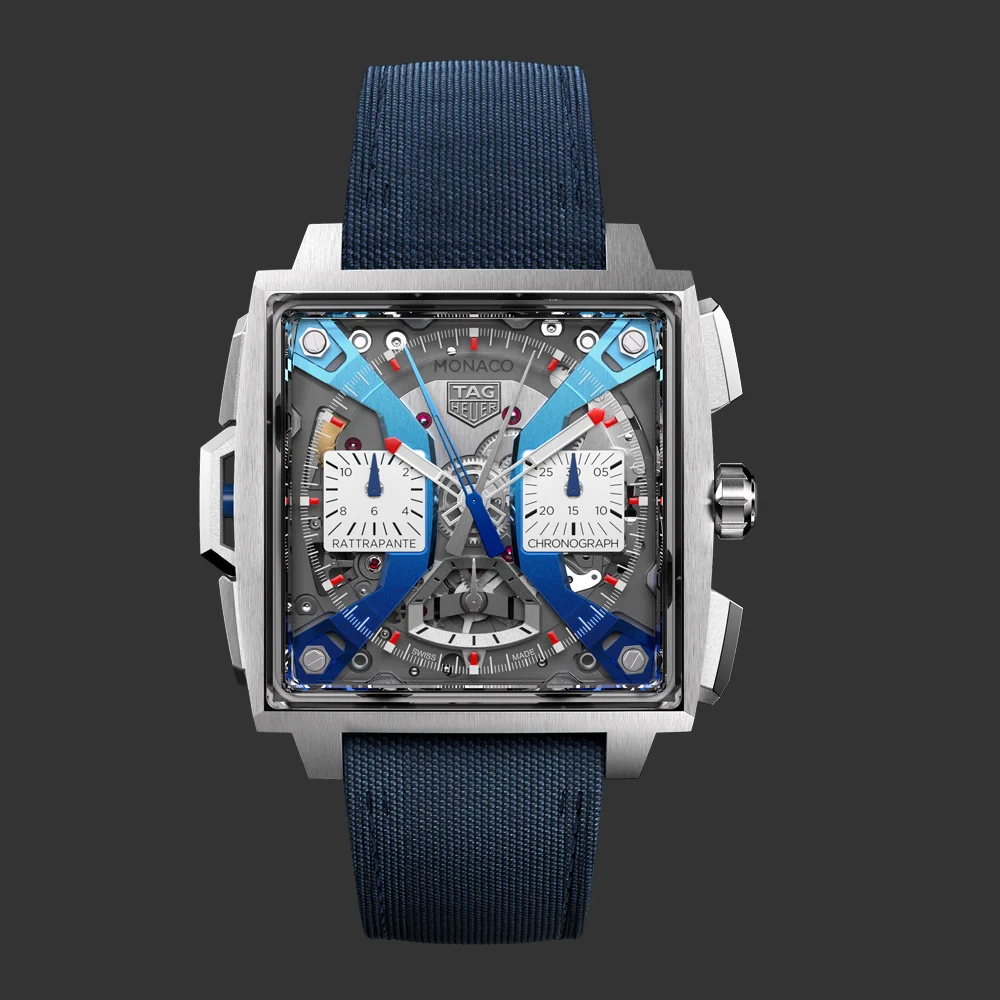
Although it’s pure TAG Heuer, with its design and £121,000 price tag, it does rather park a tank on Richard Mille’s lawn. A smaller, rather less shouty tank, but it’s there all the same, engine ticking as it cools; that exposed, layered components aesthetic, the bolted titanium dial arches, the transparent case components….
TAG Heuer Monaco Split-Seconds Chronograph – red or blue
That said, it’s inaccurate to talk about ‘the’ Monaco Split Seconds – there are two. And despite being identical in terms of technology and complications, they’re two visually different watches. The red example feels closer to the original Monaco whereas the blue seems to push the design a bit further.

A lot of this comes down to the finishing process of the arches. The red watch has fine brushed surfaces and black DLC coating, while the blue goes full-on tech with anodised gradient arches. TAG Heuer explains, “This intricate color gradient is achieved through a delicate anodizing process. This precise technique necessitates the application of varying voltages at different stages of the treatment.”
Those arches bracket and hold – at least visually – the chrono minutes and chrono hours subdials. Appropriately, the blue watch uses blue hands for the chrono functions with red for the… you get the idea.
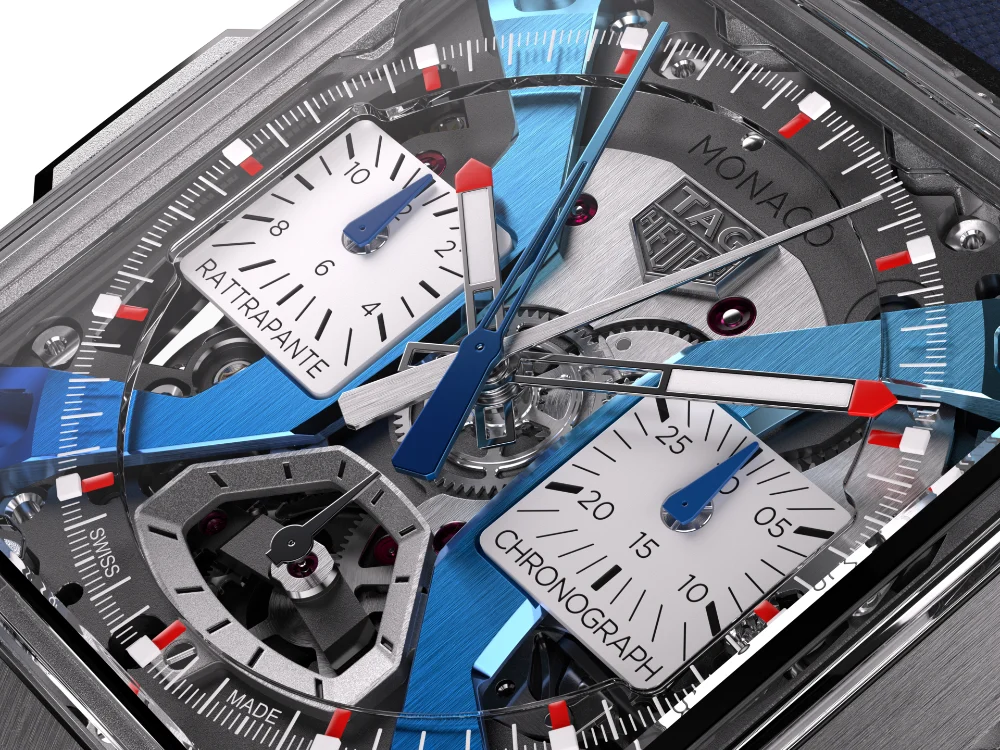
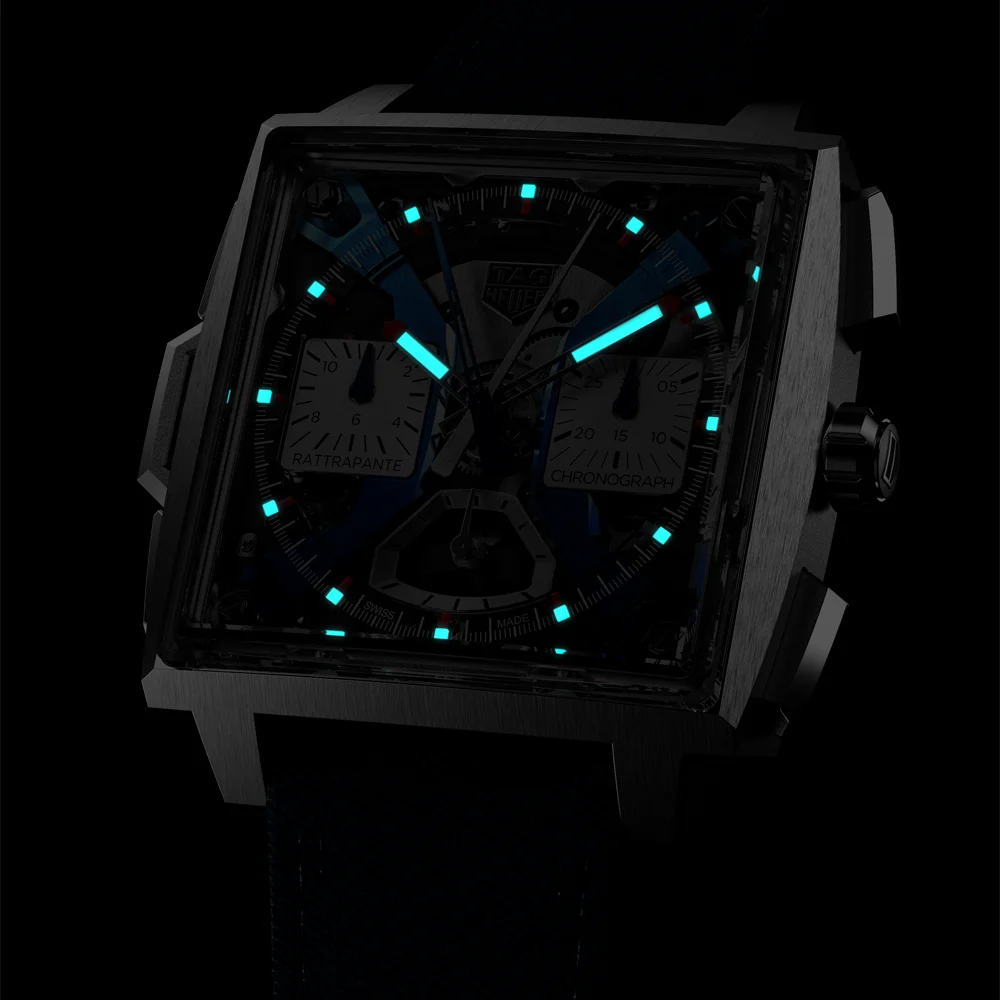
There’s a lovely nod to the past with the red-tipped hour and minute hands, even though these incorporate Super-LumiNova now rather than tritium of the past. They’re just what you’d find on your $88-and-a-packet-of-gaspers Autavia 1163V Viceroy, not to mention the original Monacos and plenty of others. Heuer was all about reduce, reuse, recycle way before it went all scoldy and fashionable.
It’s also a bit of a challenge to talk about ‘the dial’ on this Monaco. That’s because you’ve got a crystal top dial with a painted minute track and hour markers, but then separate inset chrono subdials, those dial arches, a silver running seconds subdial and the dialside movement bridge carrying the TAG Heuer shield. The whole thing could have looked like an exploding parts tin, but it’s a testament to the designers of both the movement and case that the watch has a proper unity.
TAG Heuer Monaco Split-Seconds Chronograph cases
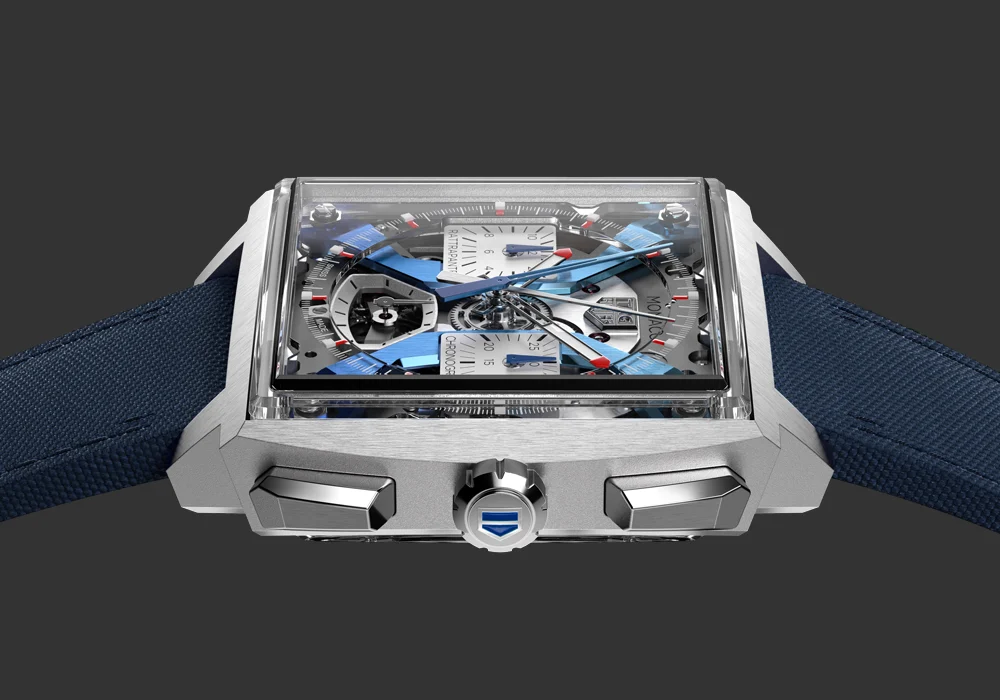
Look from the side though and even though there are significant changes from the original, this couldn’t be anything but a Monaco. Square 41 mm case (so thankfully not a sardine can – surely monster cases have had their day?), heavy square pushers, square block, bevelled and domed crystal. It’s a hair over 15 mm thick, but a Monaco is supposed to make a statement, so nothing wrong with that. But rather than stainless steel, this one comes in either black DLC titanium (for the red dial) or a non-DLC titanium (for blue). Both cases have a mix of fine brushing, sandblasting and polishing. There’s an extra pusher at 9 o’clock that looks after the rattrapante complication. A neat touch – it matches the colour of the rattrapante hand. The pushers and crown follow the case finishing and you still get 30 m of water resistance. The full display sapphire caseback is held with a screw in each corner (with polished heads, of course).
TAG Heuer Calibre TH81-00
So what about the movement behind all this? Designed and made along with Vaucher Manufacture Fleurier, it’s an automatic (you’ve spotted that rotor already – Heuer shield shape included) and beats at 36,000 vph (5Hz). It’ll do that for 65 hours if you’re not playing with the chronograph and 55 hours if you are. That’s a decent reserve for a watch this size. The higher cadence makes the movement more shock-resistant when it comes to the real world – a 5Hz balance will cope far better with vibration and shock than calibre beating at a lower frequency.
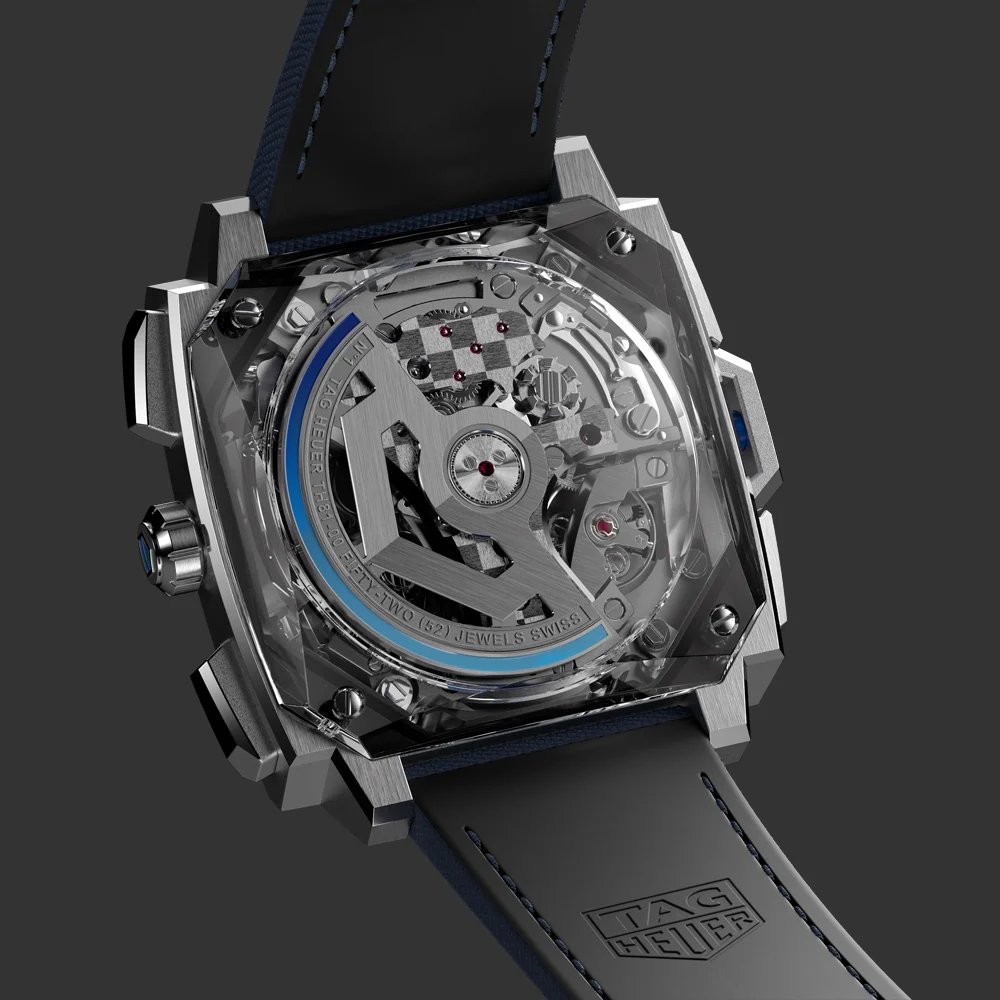
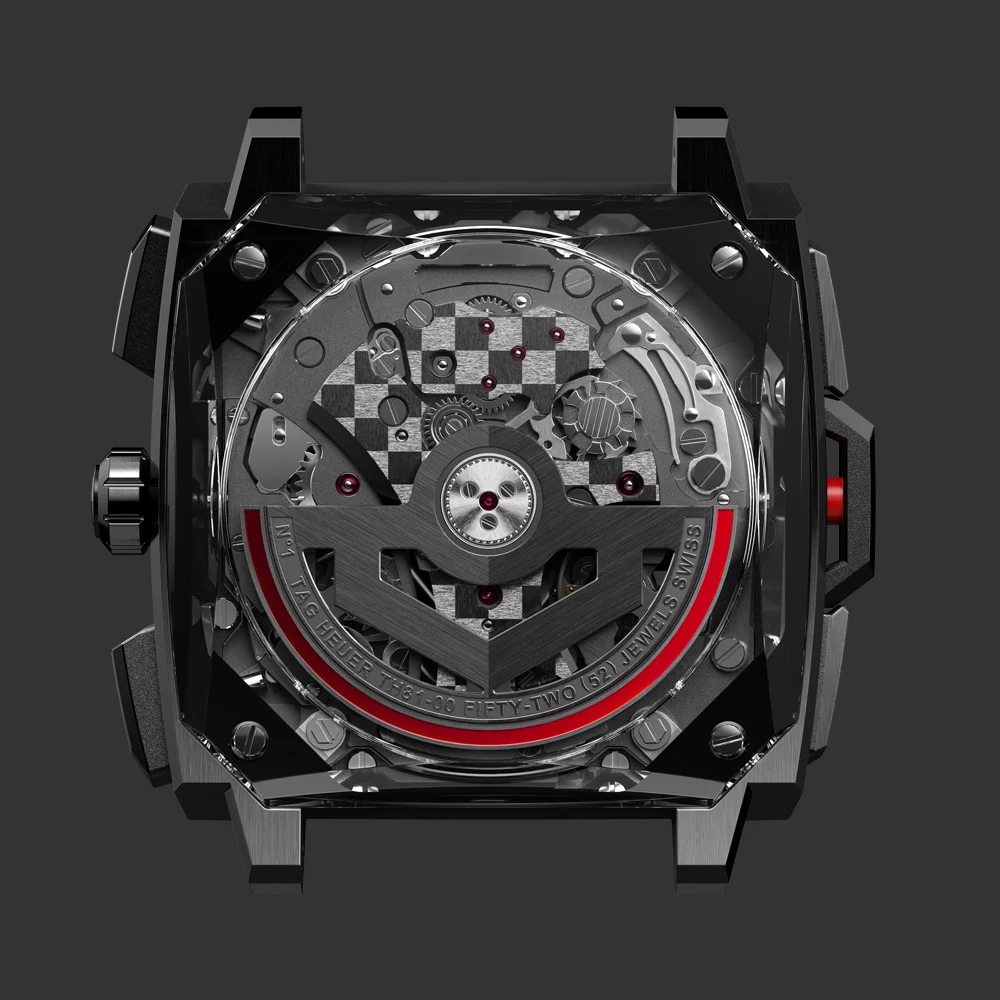
The movement finishing is, as you’d expect for a price in Haute-Horlogerieland, seriously impressive. There’s an alternating brushed chequered flag design on the bridges, fine brushing, anglage and polished screws abound. Even the pusher contact points are polished. The whole thing weighs in at only 85 grammes with the movement alone accounting for just 30 grammes. That’s because plates and bridges are all titanium, a remarkable feat considering the challenges involved in machining the metal.
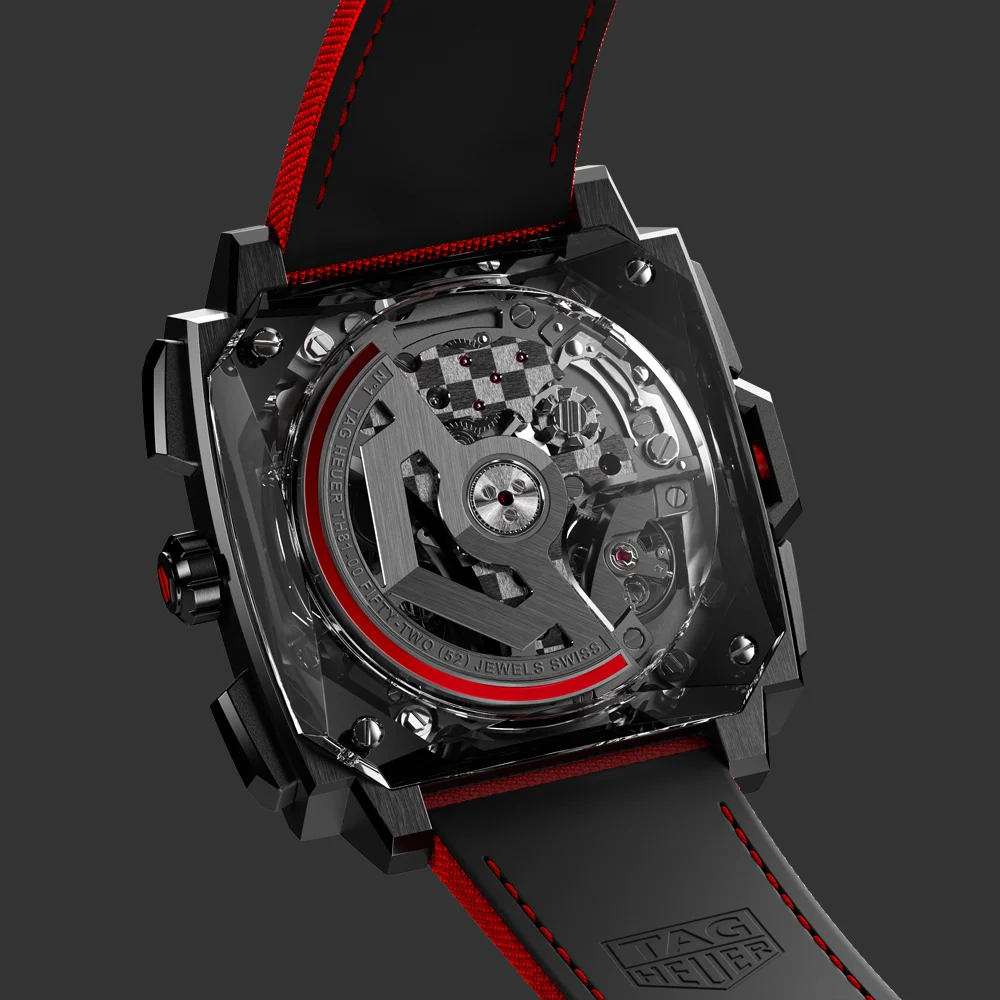
It’s a column wheel chronograph and I’m taking a guess that the movement runs a vertical clutch with the fourth wheel powering the running seconds down at 6 – but only because that was how the Calibre Heuer 02 operates. Given the 02’s red-topped column wheel, I wondered if I’d get one here too, but it’s polished and grained instead.

As you’d probably expect for a robust, grr sort of motorsport watch, the balance bridge is held at either end and the balance is free-sprung with micro-adjustable weights. It’s good to see a multi-bearing rotor with a jewelled centre bearing too, providing better durability and shock absorption. After all, the more bearings, the less individual wear on each one. I’ve not managed to get a close look at the movement out of the case, so feel free to tell me I’m wrong and what you’ve done instead, TAG Heuer! Tech detail is always appreciated around here.
TAG Heuer Monaco Split-Seconds Chronograph – horological advancement
Contrasting the original Monaco of 1969 with this new watch illustrates the rapid progress of the Swiss watch industry in terms of tech, materials and design. The original Calibre 11 movement – impressive as it was for its time – was far from pretty. It had no need to be – there were probably only about six people in the entire Watchworld who cared what it looked like and the Monaco had a closed caseback anyway. Asking the question would have been like asking Mercedes if they could make their M100 V8 better-looking. There was no need to faff about polishing screw heads or graining plates. Why bother? Like the M100, the Calibre 11 was there to do a job, not be decorative. Now look at the Calibre TH81-00. The contrast in finishing and materials couldn’t be more marked.
Likewise, the move from a steel to a titanium case – unthought of at the end of the 1960s – makes this latest Monaco both lighter and easier to wear. And today’s case seals will keep water and dust out far longer than the seals of 1969, simply because the material they’re made from lasts longer and is more robust.
This is not to say that the original Monaco was a poor option – far from it. It was ahead of its time in terms of movement design, case construction, sealing and accuracy of timing. I mention it to simply to show how far the industry has come in the intervening 55 years.
TAG Heuer Monaco Split-Seconds Chronograph – clearly a Monaco
As different as it is though, this new watch is clearly a Monaco. And it shows how, despite some detractors voicing concern back in the late 60s, the design of that Piquerez case was absolutely right. You have to wonder if the salesman ever realised what he’d set in motion back on that morning in 1968. And it’ll be interesting to see where the Maison takes the TH81 next.
Further reading
Technical specifications
- Model: TAG Heuer Monaco Split-Seconds Chronograph
- Reference: CBW2181.FC8322 (red – black DLC fine brushed, sandblasted and polished titanium case)
- Reference: CBW2182.FC8339 (blue – fine brushed, sandblasted and polished titanium case)
- Case: diameter 41 mm, height 15.2 mm, water resistance 3 ATM (30 metres); sapphire crystal to the front and exhibition caseback
- Functions: hours, minutes, seconds, chronograph, split seconds function
- Movement: Calibre TH81-00, automatic, frequency 36,000 vph (5 Hz), power reserve 65 hours (chrono off) / 55 hours (chrono on)
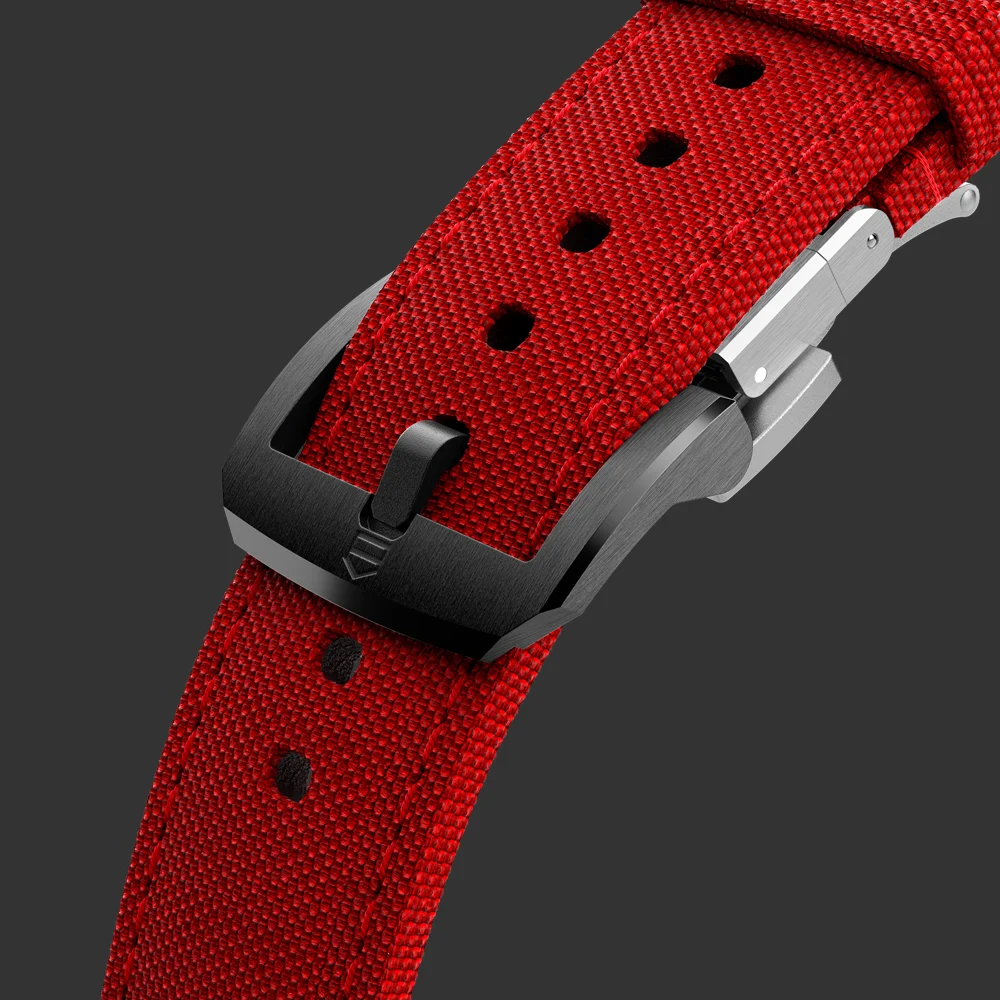
- Strap: colour coordinating hand-stitched calfskin strap embossed with a fabric pattern. Black DLC / fine-brushed titanium (dependent on model) butterfly folding clasp with pin buckle, safety push-buttons, and fine adjustment link.
- Price: £121,000 (RRP as of 29.6.2024)