
Louis Vuitton Voyager Skeleton
The Louis Vuitton Voyager Skeleton features an openworked automatic movement, incorporating a micro-rotor, and is housed in a luxurious platinum case. Hallmarked with the prestigious Poinçon de Genève seal, this contemporary timepiece dwells in the rarefied heights of Haute Horlogerie. US-based Meehna Goldsmith shares her thoughts on this remarkable horological creation.

Louis Vuitton (1821 – 1892)
Louis Vuitton, the gentleman who started what is now a powerhouse brand, had an adventurous spirit and a penchant for travel. In 1834, he set off on foot from Anchay to Paris, a journey that took two years. Even more remarkable, he was barely a teen, aged just 13 and reputedly walked barefoot! His destination: the workshop of the eminent trunk maker and packer Romain Maréchal. At that time baggage wasn’t handled too carefully, so the well-to-do hired craftsmen to design trunks to protect their belongings. In addition, the purchase came with a packing service. That sounds so decadent, but considering the art of packing has, to this point, eluded me, I wouldn’t mind having a professional do the job.

Trunk maker
Upon arrival in the City of Lights, Vuitton began his apprenticeship with Maréchal and studied under the master for 17 years until he opened his own workshop in 1854. From the very first trunk produced, the Louis Vuitton brand gained a reputation for luxury, style and practicality. Though not often mentioned, Vuitton was also an innovator. Trunks at the time were made with round tops so water would run-off, but that prevented stacking and the optimisation of storage space. In 1858, Vuitton solved the problem with a flat top made of Trianon canvas, which was lightweight and airtight.

Louis Vuitton logo
Practically anyone living on this planet knows the name Louis Vuitton, if not its LV-patterned logo that shows up on the brand’s fashion, jewellery, perfume, luggage and other leather goods. These categories seem an obvious extension of the Louis Vuitton brand, a Maison with nearly 170 years of history. But watches that a horophile would deign to consider? In fact, yes.

Louis Vuitton watches
How do you gain credibility in the world of horology? In the past 20-25 years there’s been an obsession with in-house movements. Since many clients place much value on Manufacture movements, many brands have developed their in-house expertise, investing tens of millions of dollars to stake the claim. Whether the ultimate quality is better than the traditional parts-supplier model is debatable. And, just because a movement is produced in-house, doesn’t automatically make it superior to one with outsourced parts. However, that’s a different discussion.
In 2002, Louis Vuitton came out swinging with the debut of the Tambour. While this was not the first occasion LV had waded into the timepiece pool, the Tambour gave LV some serious street cred within the watch space. It was not only a commercial success, it attracted much critical acclaim too. If you reach into the history books, you’ll find that LV released the quirky and very rare Monterey 1 in 1988. A complicated watch driven by a quartz movement, it was designed by a female, the renowned Italian architect, Gae Aulenti, and realised by IWC.
After the Monterey 1, LV’s watchmaking division appeared to go into an extended period of hibernation. Then came a surprise nearly 25 years later: the Tambour. True to its French namesake, the Tambour’s case resembled a drum and had distinct, short lugs in a unique style, a bit like a latch on one of the Louis Vuitton cases. Just as there are 12 hours marked on the dial, there are 12 letters in the brand name Louis Vuitton. It’s a rather serendipitous coincidence that the designers took advantage of it. Etched into the case, each letter that spells out the brand coincided with the hour markers round the case: starting at 12 o’clock and moving counterclockwise.
La Fabrique du Temps
The Tambour was and remains a great watch, but LV had grander plans still. It wanted to compete in the upper echelons of watchmaking and create stunning examples of Haute Horlogerie. To assist in the quest, LV partnered with La Fabrique du Temps, an elite movement manufacturer responsible for the Jacob & Co. Cyclone Tourbillon, Ralph Lauren’s first tourbillon and Speake-Marin’s Renaissance Tourbillon Minute Repeater. It also worked with Laurent Ferrier on the Classic Traveler Magnetic Green, which happens to be one of my favourite watches.

Poinçon de Genève
LV recognised the talent at La Fabrique du Temps and partnered with the company in 2007 on their watches. Showing its intent to become a serious player, LV announced the purchase and integration of the Manufacture into the company in 2011. From these workshops came exceptional creations, including open-worked movements such as the Tambour Curve Flying Tourbillon and Voyager Flying Tourbillon, both of which carry the prestigious Poinçon de Genève.
LV60 movement
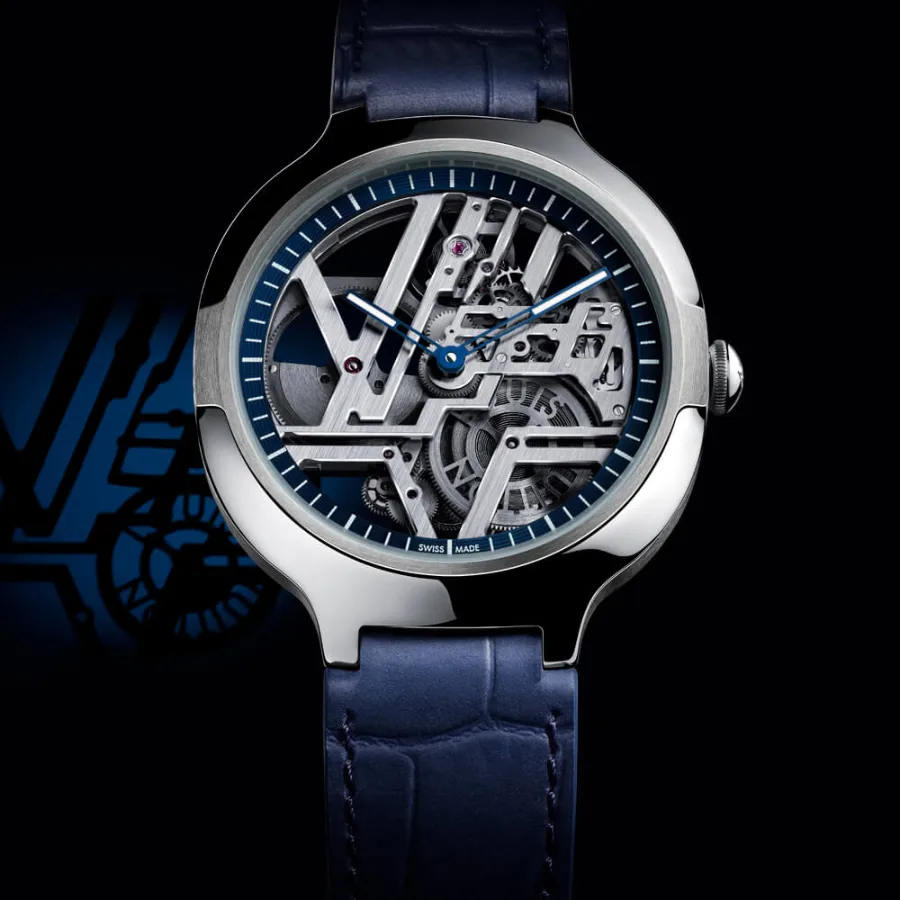
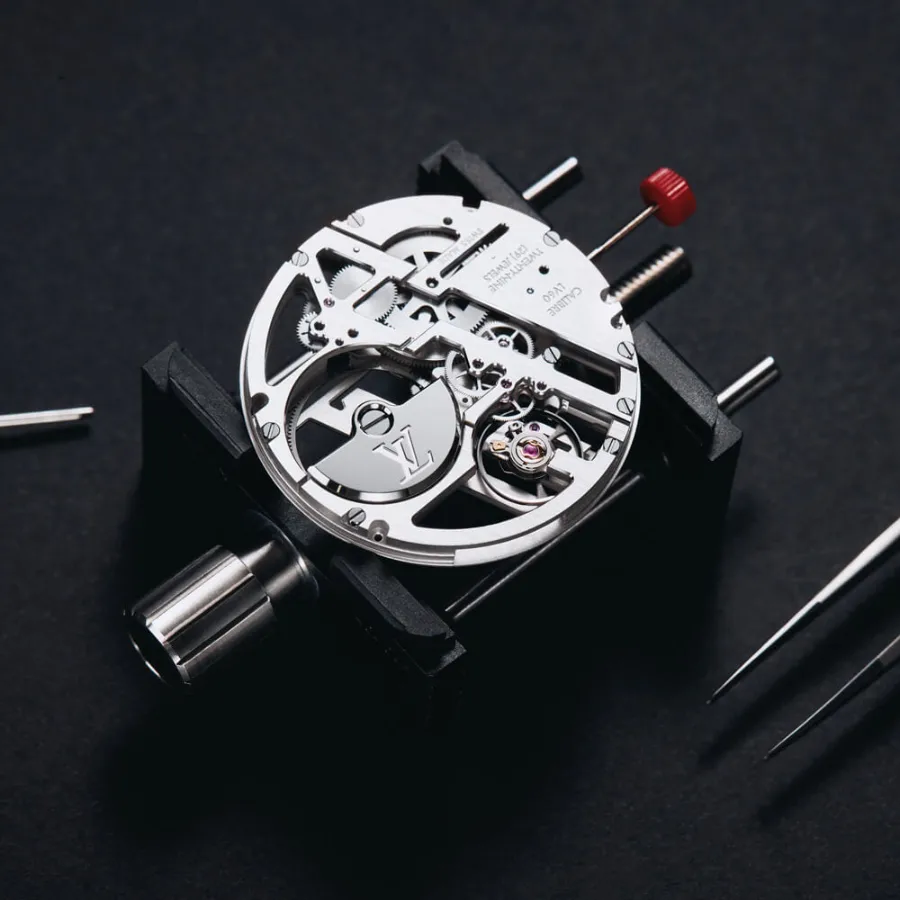
The Louis Vuitton Voyager skeleton continues the openworked tradition. Although many skeletonised watches begin with an already produced movement, the Voyager Skeleton was conceived from the ground up. The LV60 movement is a stunning architectural beauty of geometric lines, constructed to emulate Louis Vuitton’s flagship stores and the Fondation Louis Vuitton, designed by famed architect Frank Gehry.
I confess I’m not one for overt branding. Louis Vuitton leans into its monogram, placing it prominently on a lot of its products. The Louis Vuitton Voyager Skeleton upholds the practice but fuses the branding in a subtle way that is integral to the design as well as the mechanics. If you don’t know where to look, you could almost miss the LV shape of the Voyager Skeleton bridges.
Obscured by the rotor bridge is the barrel ratchet wheel, which has been openworked also to spell out the name ‘Louis Vuitton’, but it’s done tastefully. Since the barrel is transparent, this feature also acts as a power reserve, revealing the mainspring as it unwinds. In fact, the layout of the movement allows for a view of how the watch functions: the power flows from the mainspring located at 5 o’clock and then through the gears, crossing the finish line with the balance wheel and escapement positioned at 12 o’clock.

The LV bridges get the full-blown spa treatment, with fine linear graining up top and chamfered edges, while the undersides gets a sandblasted finish. To keep the monochrome, sleek vision, the movement components are rhodium-plated. Through the sapphire case back, a tungsten, bi-directional micro-rotor with a ‘white gold rhodium plated plate’ featuring the LV monogram, keeps the movement juiced up.
Platinum case
Set against this backdrop, a snailed, deep blue ring marks the minutes, while partially lume-filled blue hands show the time. To complete the vision, the Louis Vuitton Voyager Skeleton comes in a platinum Voyager case, a shape reserved for the brand’s Haute Horlogerie timepieces. The case further stands out with a monocoque construction. Instead of the case middle and bezel being put together as separate pieces, this design combines the case middle and bezel into one. Mirror polished on top, from the lugs to the sides, the case completes the composition with matte, brushed planes at 3 and 9 o’clock.

Louis Vuitton Voyager Skeleton
A limited edition of 150 pieces, the Voyager Skeleton fits to the wrist with an accompanying navy blue, alligator leather strap secured with a platinum ardillon buckle. The watch also comes with an additional strap made of taurillon leather. I’ve never been drawn to Louis Vuitton watches before, but with the Voyager Skeleton I think I’ve been converted into a fan.

Further reading
Technical specifications
- Model: Louis Vuitton Voyager Skeleton
- References: Q7EN1K
- Case: sapphire case, diameter 41mm, height 9mm, water resistance 5ATM (50m), sapphire crystal to the front and exhibition case back.
- Functions: hours, minutes
- Movement: LV 60 Calibre, hand-wound movement, frequency 28,800 vph (4Hz), 29 jewels, 48 hour power reserve, 120 components
- Strap: blue alligator strap paired with a platinum ardillon buckle. Also comes with an additional strap made of taurillon leather.
- Price: €48,000 excluding taxes (RRP as of 1.6.2023)