
NOMOS Glashütte Club automatic Olive
Angus Davies spent a few days wearing the NOMOS Glashütte Club automatic Olive. His ‘hands-on’ experience reminded him of why he holds the brand in high esteem. Most notably, this new model demonstrates how NOMOS has never been afraid to go its own way.

In my formative years, I lived in a Lancashire mill town where industrial buildings, once hives of commercial activity had been abandoned and stood quiet. Walls and windows were dressed in black, a metaphor for the area’s economic decline. Indeed, beneath the grey inclement skies, everything seemed dark and drab. At the time, I only saw the world through a monochrome lens.
After completing my education, I began working for a bank in Manchester. Like the rest of my colleagues, I wore the obligatory grey suit and black Oxford lace-ups. There was little opportunity for flamboyance, professional convention dictated my attire.

However, despite once being an industrial hub, Manchester was in the midst of a renaissance. Indeed, it continues to flourish to this day. An increasing number of the buildings were sharply dressed and there was no hint of grime as I perused the shop windows of fashionable King Street. In fact, once away from the restrictive world of bank life, Manchester introduced me to a new palette of colours. Vibrant yellows sat cheek by jowl with vermilion hues, turquoise tones and Baltic blues. Optimism was omnipresent.
My reasoning for mentioning this period from my former life is that colour has the potential to enliven the soul and bestow a sense of joy. Most watch brands employ shades such as black, blue and white, all hues that I like. However, these brands seem to limit their creativity to a restricted palette of colours. NOMOS Glashütte has repeatedly shown it does not subscribe to convention. For example, it remains one of the few brands to offer a square watch, the supremely stylish Tetra. Likewise, in terms of colour, the company has not been afraid to veer off the horological autobahn and explore new shades.
The NOMOS Glashütte Club automatic Olive is one of three limited-edition models that have been produced to celebrate 175 years of watchmaking in Glashütte. The prospective purchaser can choose from onyx, navy and, my personal favourite, olive. Quite simply, it’s not a colour I am accustomed to seeing, hence when I was provided with an opportunity to get ‘hands-on’ with one of the three limited-edition models, I made a beeline for the Club automatic Olive.
The dial
The olive green dial sidesteps unduly flamboyant, garish tones; its mid-green vista is slightly understated, seemly and elegant. This shade of green lends itself to both casual and formal attire.
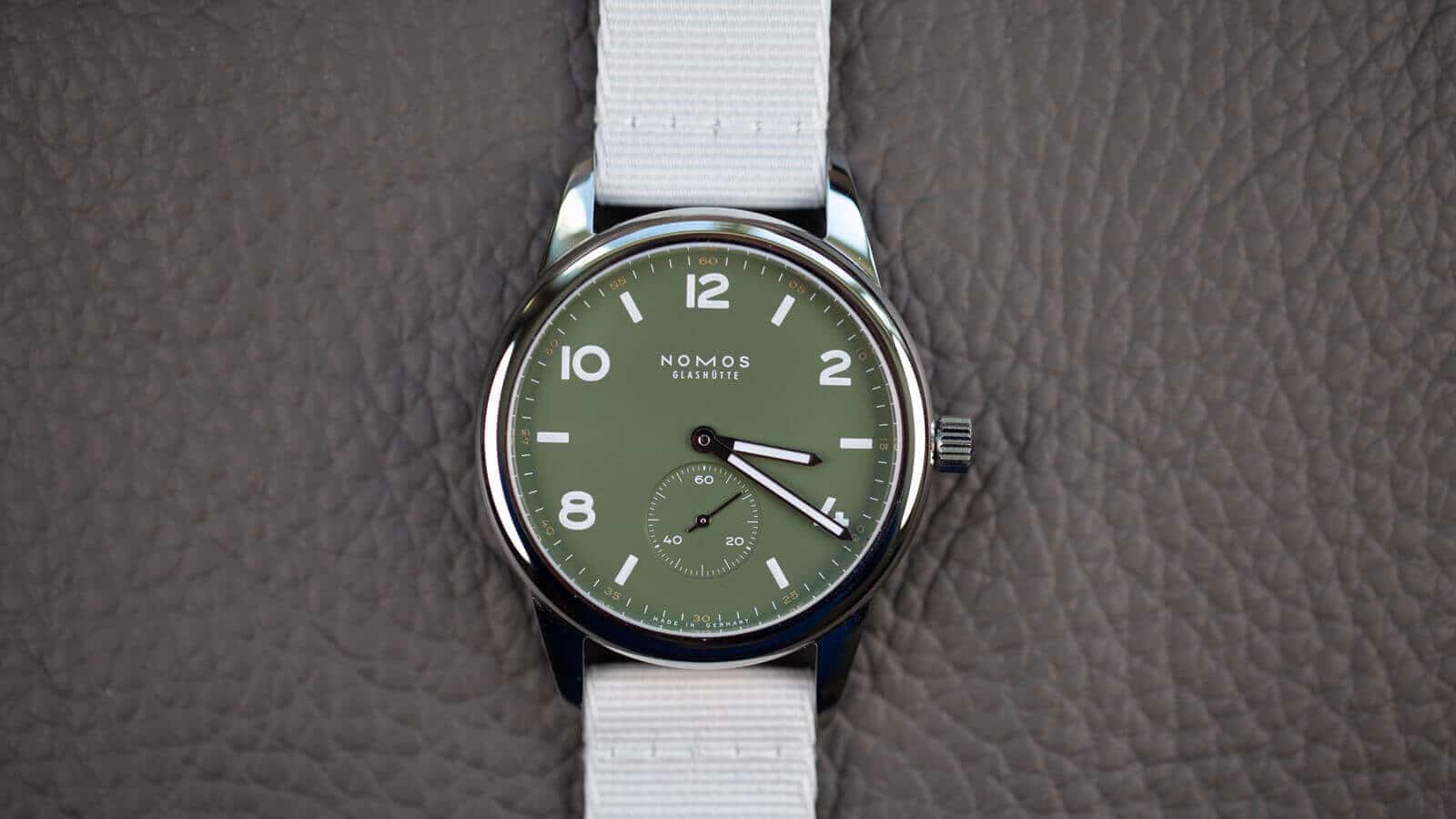
The hour and minute hands are rhodium-plated and lined with white Super-LumiNova. The indexes comprise of Arabic numerals for even-numbered hours and rectangular batons for odd-numbered hours. The indexes also feature a liberal application of white Super-LumiNova. NOMOS Glashütte has chosen a modern font for the Arabic numerals, sans serifs, which endows the dial with a fresh, contemporary character.

A lightly snailed small seconds display is recessed, sitting below the main dial epidermis. This detail inevitably increases the cost of production, however, the play with depths enriches the overall composition and heightens the overall sense of luxury. The small seconds hand is rhodium-plated, but eschews any form of luminescent treatment. A minute track encircles the dial augmenting intelligibility.
The case
The NOMOS Glashütte Club automatic Olive is housed in a bipartite steel case measuring 40mm in diameter with a slim profile of just 9.7mm. Interestingly, the watch looks bigger when affixed to the wrist owing to the elongated, gently arcing lugs. Indeed, using a simple ruler, I measured the lug to lug distance and recorded it to be approximately 51mm.

Where most watches feature a separate bezel atop the case, the bezel on this watch is an integral part of the housing. This confers a smooth, neat appearance to the case. The caseback is screwed into position and provides a trained watchmaker with the means to access the movement. In addition, the caseback is fitted with a pane of sapphire crystal, granting views of the self-winding movement within.
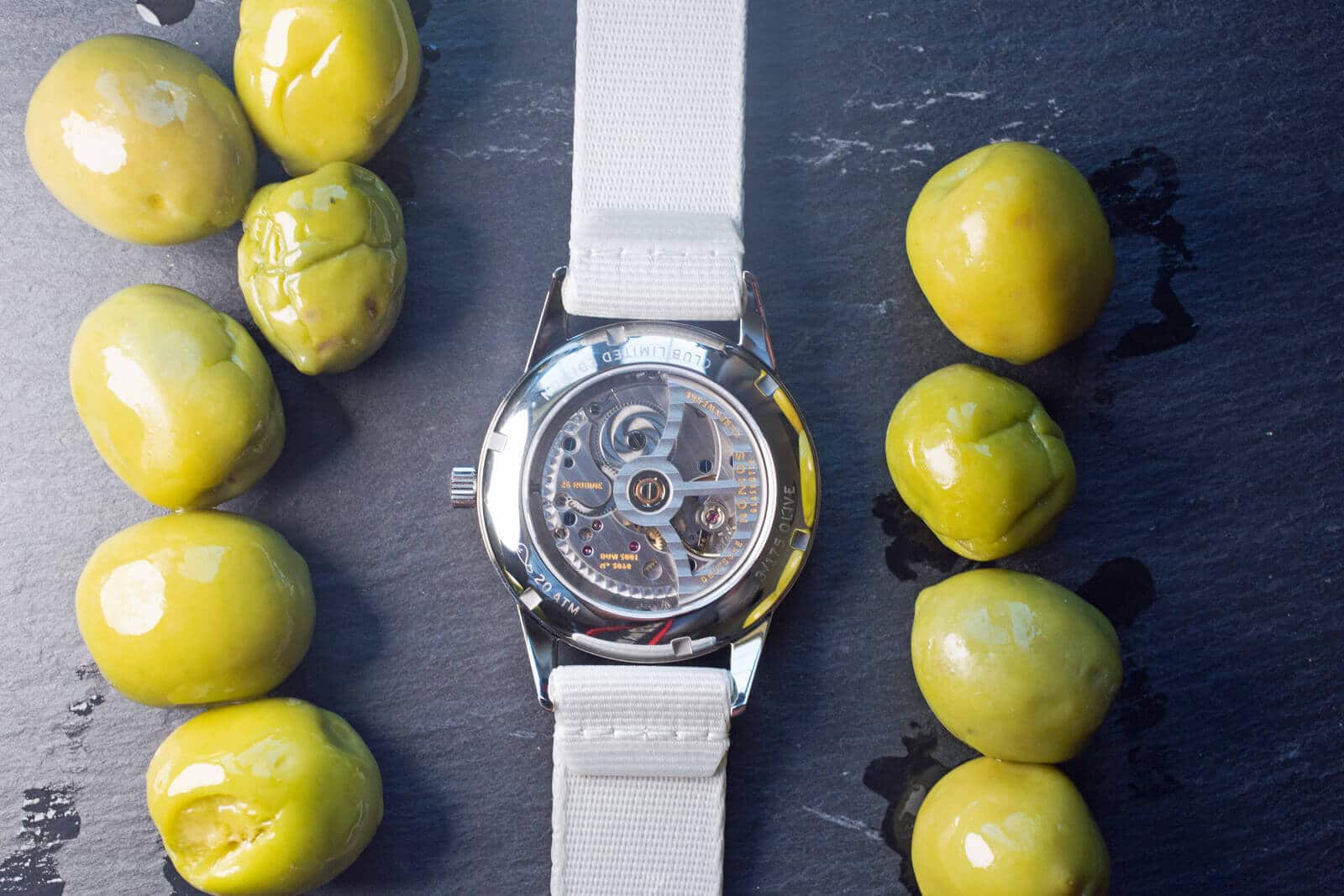
All facets of the case are highly polished. Sometimes this can appear excessive and, to this end, I usually favour a blend of satin-finished and highly polished surfaces, however, the Club automatic Olive’s gleaming case treatment works remarkably well. The polished case surfaces counterbalance the slightly understated olive dial, providing a wonderfully harmonious aesthetic.
The NOMOS Glashütte Club automatic Olive proves a practical ownership proposition for several reasons including its 20 atm water resistance, a figure which makes it ‘suitable for diving’.
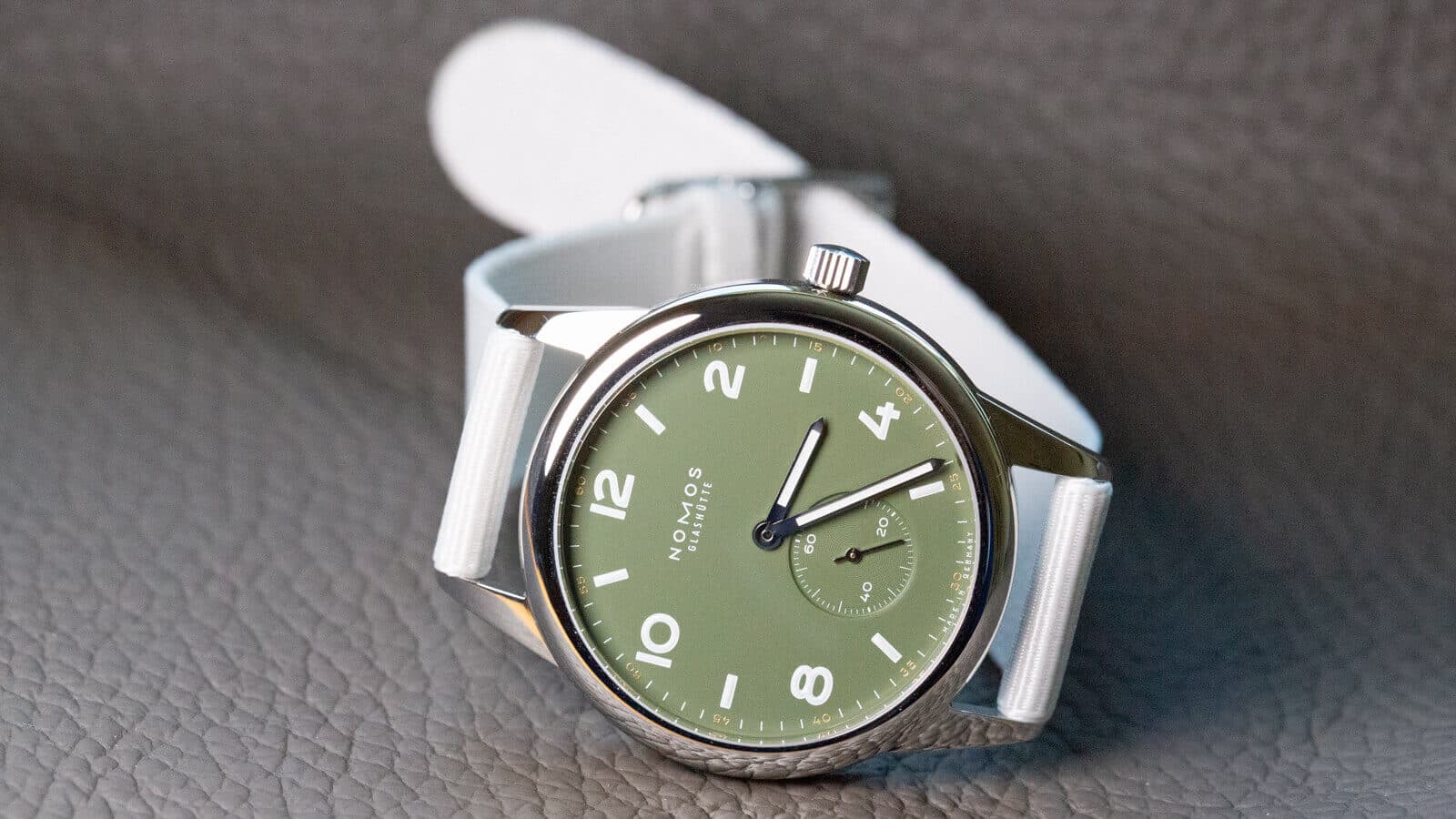
The model is supplied on a light grey textile strap paired with a highly polished pin buckle. However, the Club automatic Olive can also be purchased with a sports bracelet for an additional fee of £280.
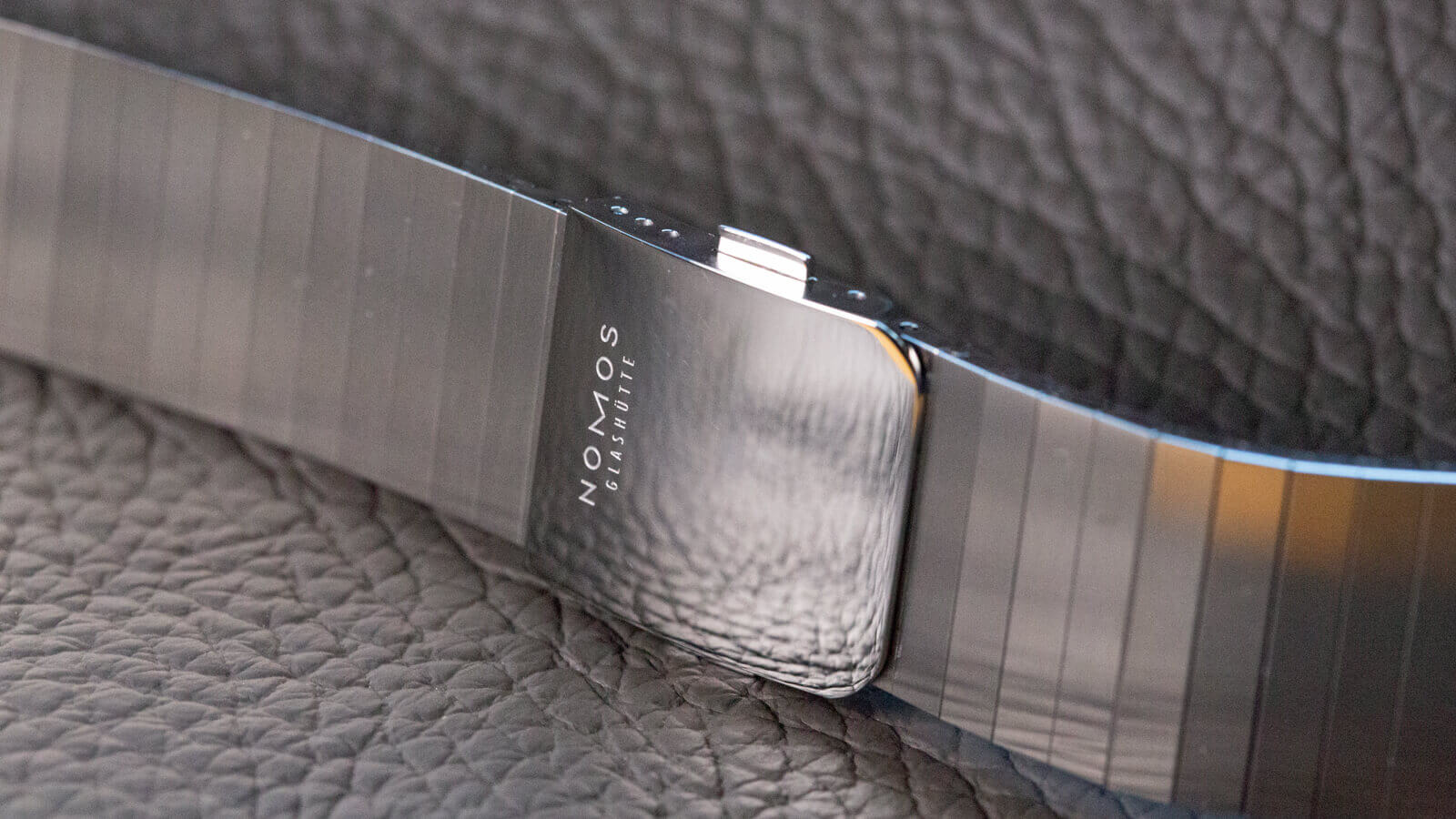
For the purpose of my hands-on assessment, I received the watch with both options. The steel bracelet is comprised of brushed horizontal bars juxtaposed with a highly-polished folding clasp. Close examination of the bracelet reveals a highly complex means of construction. Each link is integrated with its neighbour and is held securely with two small screws. By adopting this approach, the bracelet exhibits an extraordinary degree of flexibility, thereby bestowing a sublime ergonomic union with the wearer’s wrist.
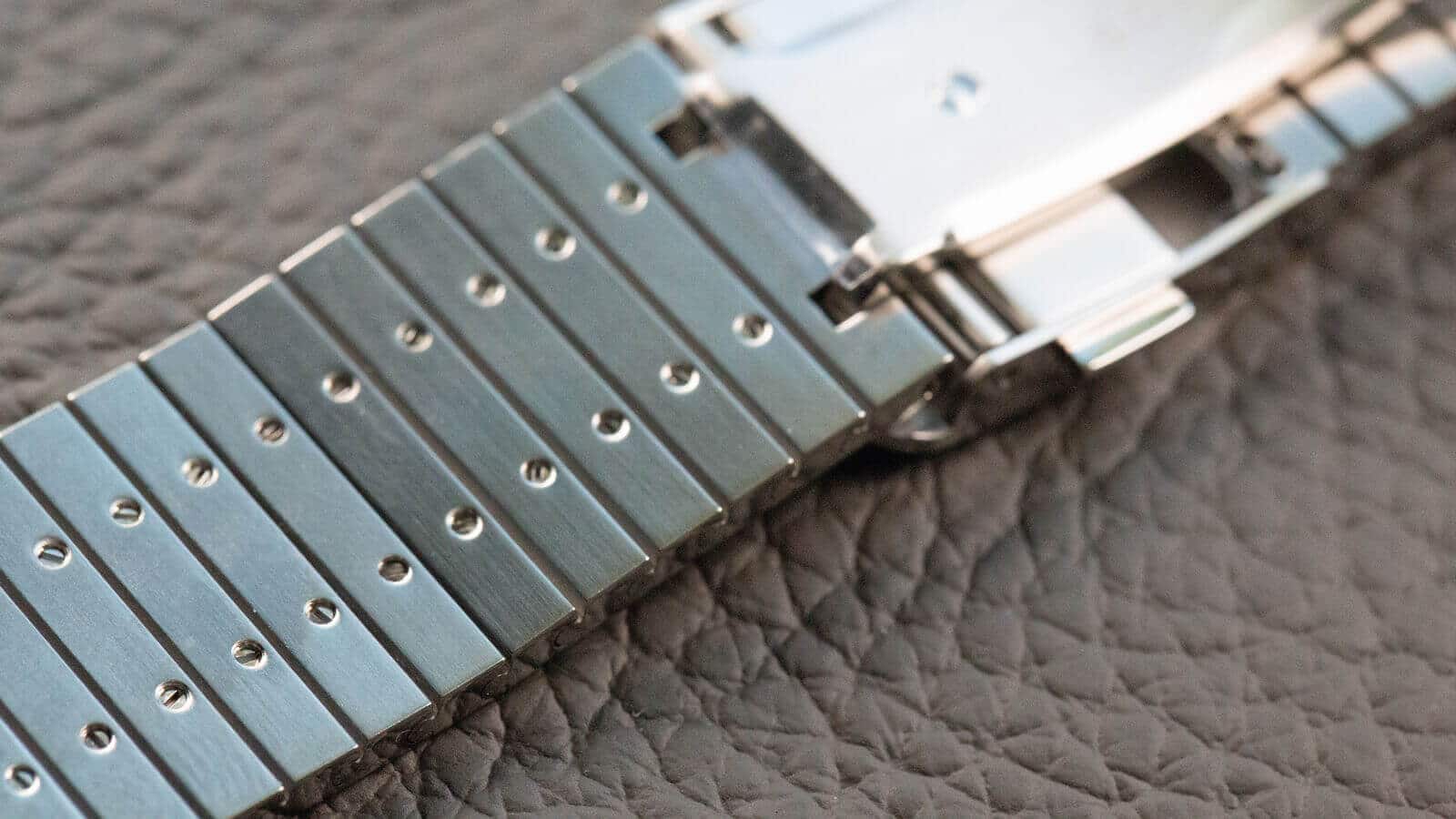
Previously, I mentioned the horizontal bars and described them as brushed and, in the main, they are. However, a close look at the sides of the bracelet reveals they are highly polished, further demonstrating the brand’s obsession for details.
The movement – a desire to make components in-house
The Calibre DUW 5001 sits at the heart of the Club automatic Olive. Despite the comparatively modest price of the watch, £1960 for the version supplied with a textile strap, the watch has an in-house movement. This characteristic is normally the preserve of much costlier watches, however, it has been a point of differentiation with NOMOS watches for a number of years.
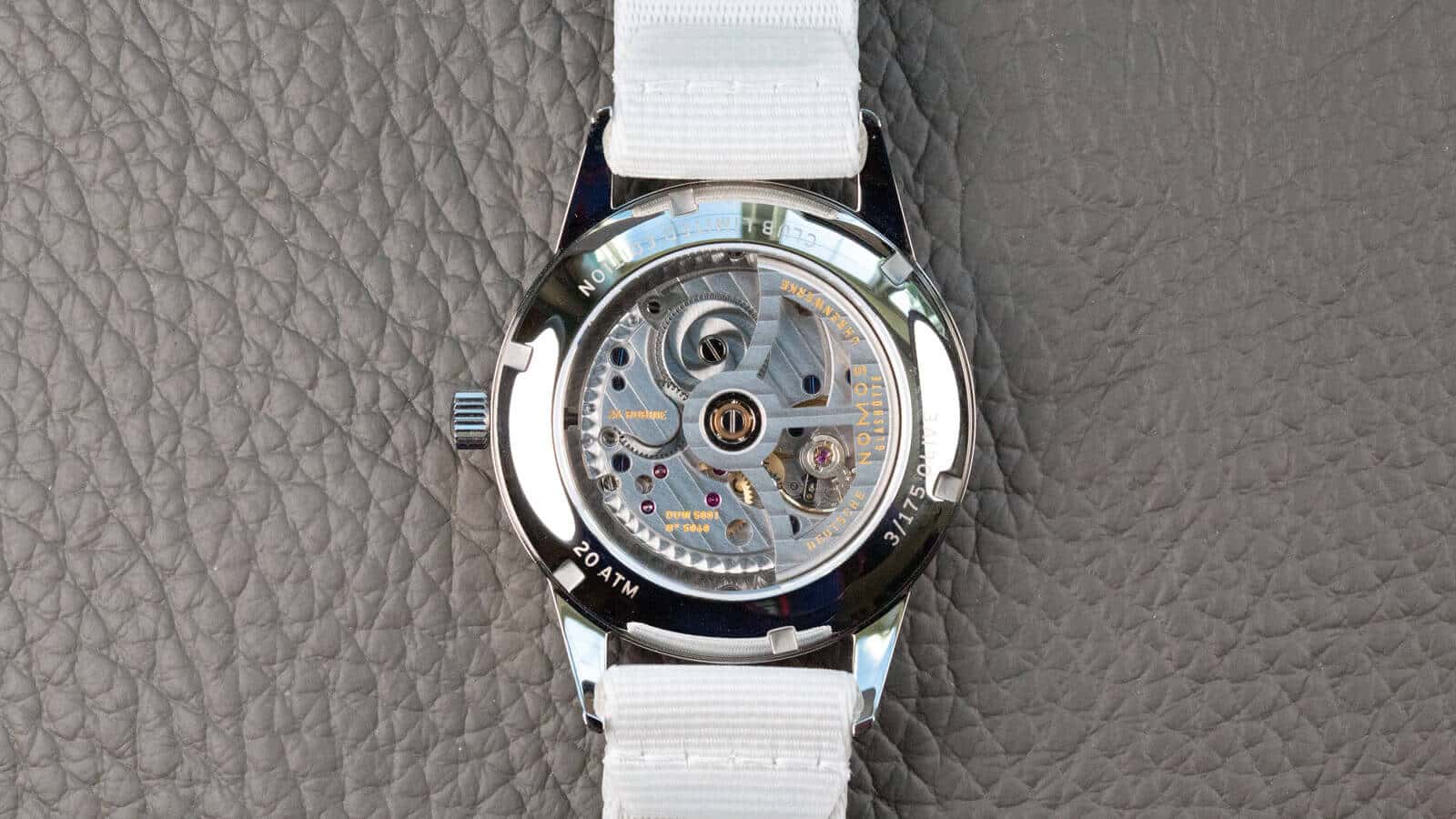
A fundamental element of the NOMOS paradigm relates to vertical integration. The brand has repeatedly demonstrated its desire to make more components in-house. Most competing brands choose to procure third party movements, however, NOMOS chose to invest vast sums of money purchasing an array of machines such as CNC, spark-erosion and profile-turning machines. Furthermore, it has expended many Euros researching, developing and designing its own movements. By adopting this approach the German marque is less dependent on external companies.
Surprisingly, NOMOS has gone much further. Even those companies that make their own movements usually purchase the escapement and regulating organ from one of a handful of specialist firms. NOMOS has invested several million Euros in producing its own proprietary system which it calls a ‘Swing System’.
By adopting this approach, many inherent technical obstacles had to be surmounted. For example, parts such as the hairspring have to be made to infinitesimal tolerances. A hairspring is often made to a tolerance measured in nanometres (1 nm = 0.000001 mm). A minuscule variance of 100 nm could result in a rate variation of circa 4 minutes per day. Therefore, it is essential that the manufacturing process is strictly controlled.
The hairspring must remain unaffected by temperature or magnetism and should behave uniformly. The composition of the alloy used to make the hairsprings necessitates significant investment and usually remains a closely guarded secret.
When a hairspring is made, it has to be paired with a balance wheel. Despite the remarkable tolerances previously mentioned, there will still remain small manufacturing differences between one balance wheel and another and, indeed, one hairspring and another. For this reason, the hairspring and balance wheel are classified into different categories and then paired. Thereafter, the hairspring is affixed to the collet. For additional information, please see my feature about the NOMOS Glashütte Ludwig neomatik 39 and the Ludwig neomatik 39 – 175 Years Watchmaking Glashütte in which I discuss this topic at great length.
The movement – design and finishing
Unlike many Swiss timepieces which employ a series of small bridges and cocks, watches from Glashütte usually have a three-quarter plate. This provides a more stable method of construction.
The self-winding Calibre DUW 5001 has a slender profile of just 4.3mm. This is quite remarkable for an automatic watch which tend to be thicker than their hand-wound counterparts owing to the addition of an oscillating mass.
Often with oscillating weights, most of the mass is focussed on the outer edge in order to create more inertia. However, this has a tendency to make the mass bulkier at the edge of the rotor. NOMOS has cleverly designed the edge of the rotor to run in a channel, termed a ‘trottoir’. By placing most of the mass’s bulk within the channel, positioned adjacent the three-quarter plate, the overall height of the movement is reduced.
The oscillating mass is openworked, affording sublime views of the various components below. Despite the watch’s modest price, the movement is beautifully appointed. The mainplate is adorned with perlage, while the three-quarter plate is embellished with Glashütte ribbing.
Tempered or ‘blued’ screws abound. On cheaper watches, the blue hue is achieved using a galvanic treatment, however, blued screws are subject to heat, bestowing them with an eye-catching cornflower blue tone. The primary reason for bluing screws is to enhance corrosion resistance and they are indicative of a high quality timepiece.
The ratchet wheel is adorned with a sunburst motif. The rate is altered using an index adjuster and the movement contains 26 jewels. If the watch is removed from the wrist and the mainspring is fully wound, the movement will run autonomously for up to 43 hours.
Closing remarks
As its name implies, the NOMOS Glashütte Club automatic Olive is a product of the watchmaking town in Saxony, a region synonymous with crafting fine watches for the last 175 years. While NOMOS Glashütte was founded in 1990 and is young by comparison, it has repeatedly demonstrated its design prowess and watchmaking know-how.

Setting aside its distinctive dial colour, a point I will return to shortly, this watch is eminently legible. The bold hands and indexes articulate the time clearly, free ambiguity. Produced in a nation famed for Bauhaus and its ‘form follows function’ doctrine, the dial is practical and notably handsome.
Measuring 40mm in diameter with a modest height of 9.7mm, the Club automatic Olive should suit the majority of wrists. Having worn the watch for a number of days, I can attest that it proves very comfortable. Personally, I would recommend the sports bracelet which is beautifully engineered and, courtesy of its folding clasp, proves easier to put on and remove.
The Calibre DUW 5001 offers the convenience of automatic winding and yet, as stated earlier, the height of the watch is not excessive. It’s rare to see an in-house movement in this price segment, especially one finished to this standard.

Since its foundation, NOMOS has repeatedly shown its desire to be independent and has demonstrated a willingness to set aside convention when this confers strategic benefits. When the firm chose to embark on creating its own Swing System, it made a bold statement by showing a willingness to invest significant sums in order to realise its goal. That investment paid off and the German marque has been fitting its movements with the Swing System for a number of years. This represents a huge achievement for the brand. Moreover, it also demonstrates the firm’s willingness to go its own way, delivering commercial benefits and, most pertinently, customer delight.
It is this willingness to set aside watch industry convention that has led the brand to view horology with an open mind. Indeed, it this propensity for free thought that has led to the very agreeable olive complexion of this beautiful watch.
Further reading
Technical specifications
- Model: NOMOS Glashütte Club automatic Olive
- Reference: 753.S3
- Case: Stainless steel; diameter 40mm; height 9.7mm; water resistance 20ATM (200 metres); sapphire crystal to front; exhibition case back.
- Functions: hours; minutes; small seconds
- Movement: Calibre DUW 5001; automatic movement; 26 jewels; power reserve up to 43 hours.
- Strap: Light grey textile strap paired with a stainless steel pin buckle. Alternatively, the model is available on a sports bracelet for an additional fee of £280.
- Price: £1960 – textile strap (RRP as at 17.3.2021)
- Price: £2240 – sports bracelet (RRP as at 17.3.2021)
- Limited edition: 175 pieces (also available with onyx or navy dial)