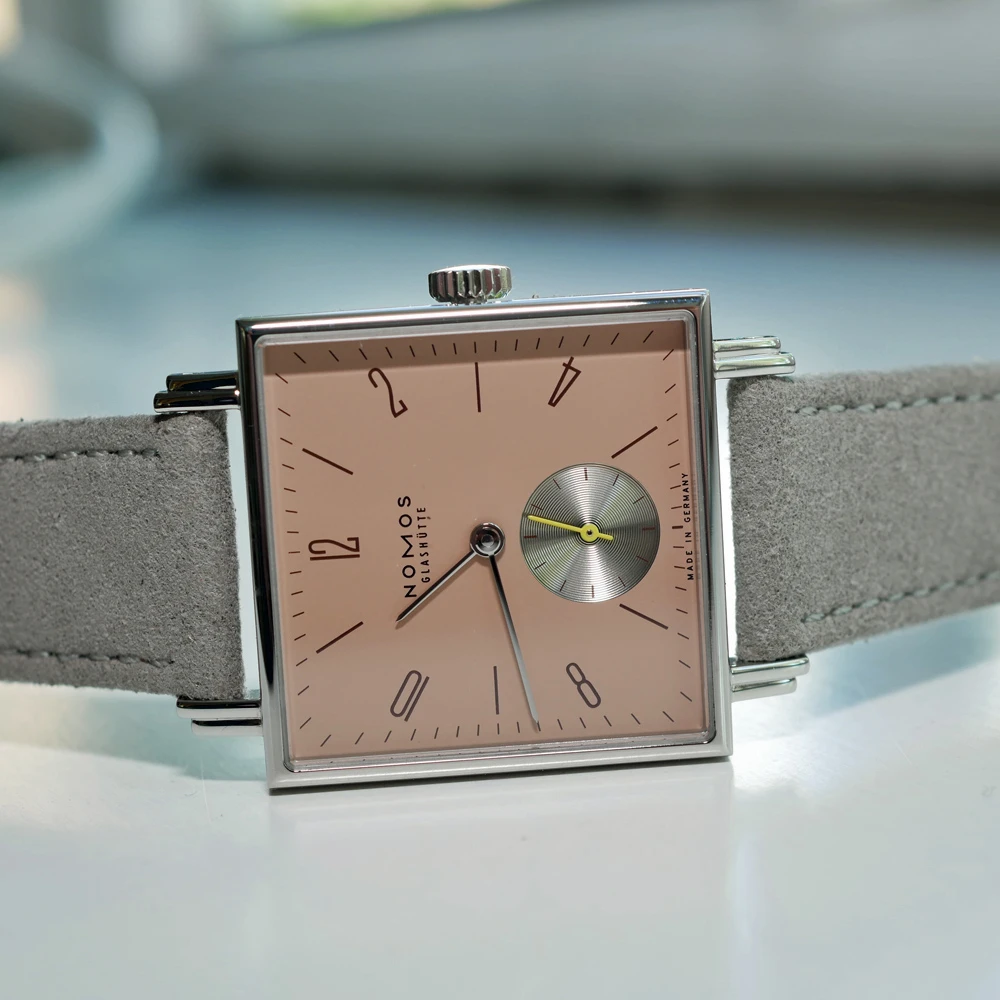
NOMOS Glashütte Tetra history
In 1992, the NOMOS Glashütte Tetra burst onto the market. One of four models released by the German watch brand at the time, the Tetra was unusual in that it was presented in a square case. Now in its thirties, the watch has worn an array of clothes, but it still retains the same ageless looks as it did from the outset. Angus Davies looks at the history of the Tetra, sharing some of his thoughts along the way.

The Fall of the Berlin Wall (1989)
As a child of the 60s, I remember viewing the Berlin Wall on television with a sense of incredulity. I was fascinated by the idea of two different political systems distanced from one another by a concrete structure. I’d talk to my school friends about the images shown on television, of East German guards standing in sentry towers, looking down on Potsdamer Platz through Zeiss binoculars. The Berlin Wall played with distances, two groups of people, just a few metres apart, yet a world away from one another.
And yet, discounting the actions of politicians, the people of the former West and East were the same. With the fall of the Berlin Wall in November 1989, the subsequent demise of communism and the reunification of Germany, a sense of normality returned to Europe.
The birth of NOMOS Glashütte (1990)
Just two months after the collapse of the Berlin Wall, Roland Schwertner, an IT expert and photographer from Düsseldorf, established a new watch company in Glashütte and planted the seeds for what has since grown into a gorgeous brand: NOMOS Glashütte.
Glashütte, the picturesque town in Saxony, formerly part of the German Democratic Republic, has a rich history of making watches dating back to 1845 when Ferdinand Adolph Lange set up his Manufactory with 15 apprentices. While Glashütte has witnessed various political regimes come and go, watchmaking has always remained a constant presence in the town.
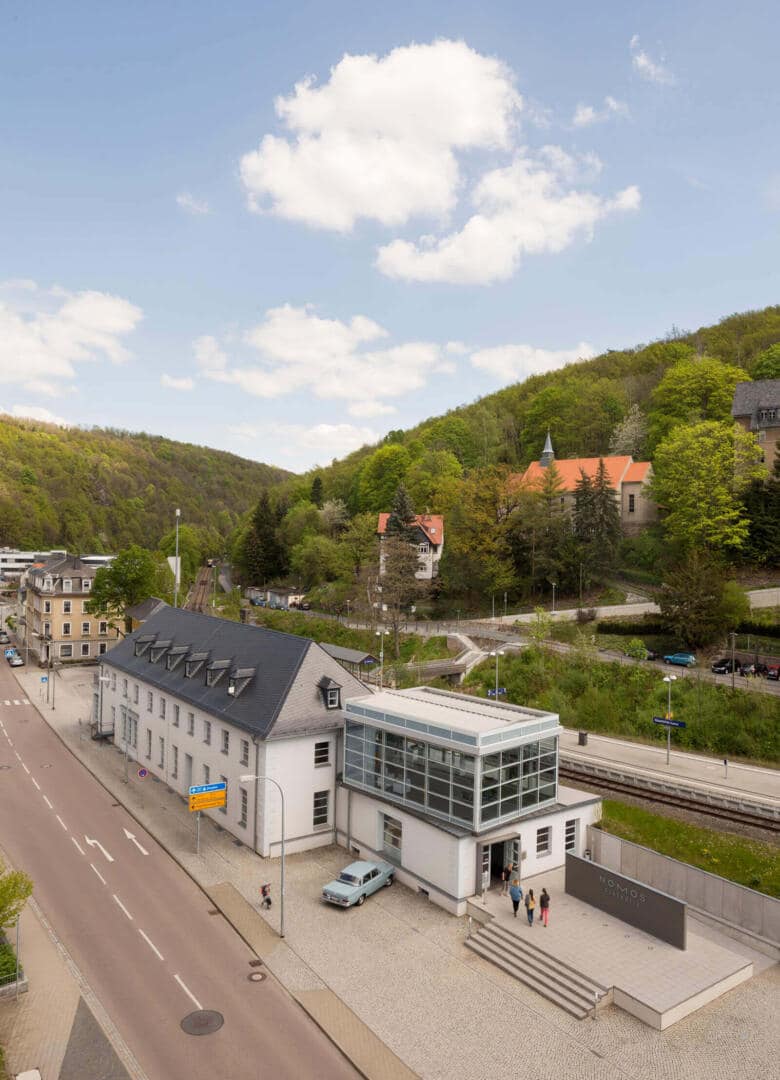
Image – Copyright: NOMOS Glashütte
NOMOS Glashütte Tetra – the inaugural collection (1992)
In 1992, NOMOS Glashütte unveiled its inaugural collection comprising four models, namely the Ludwig, Orion, Tangente and Tetra. The models were housed in round cases, save for the Tetra which bucked the trend with its square housing.
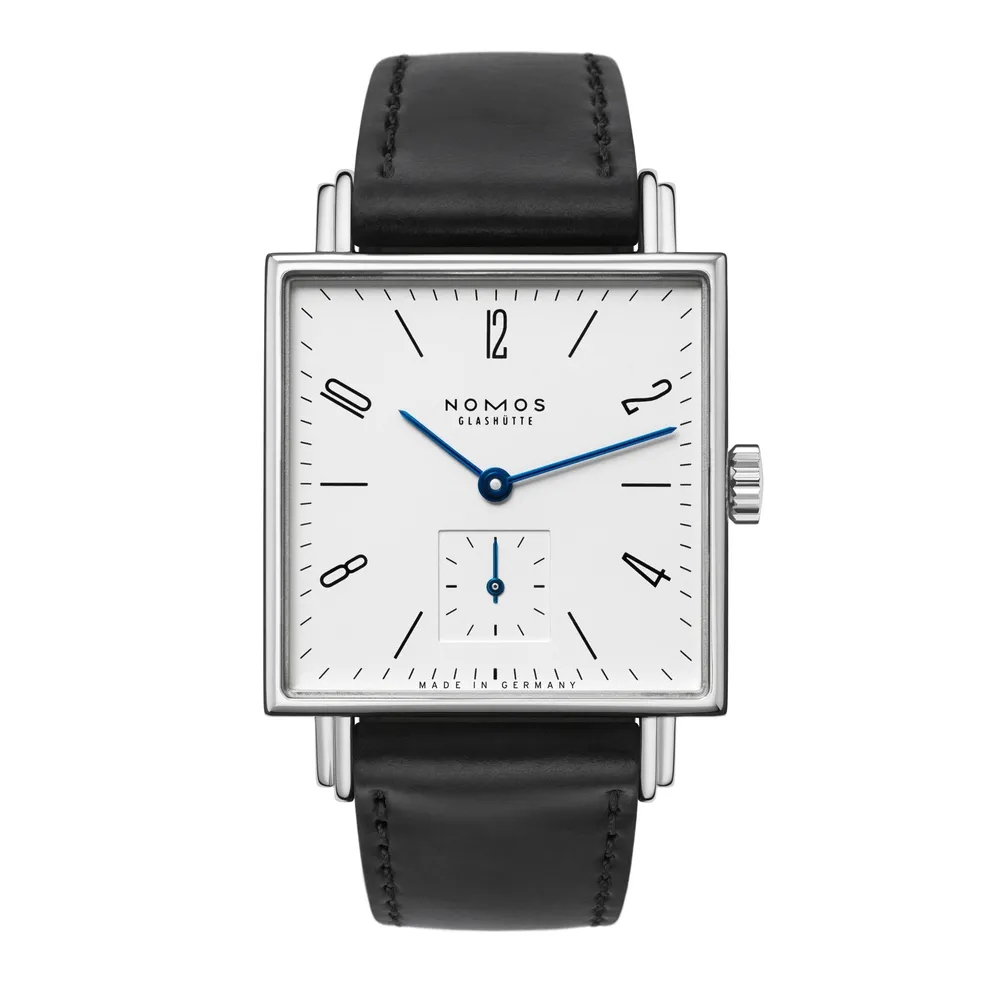
Image – Tetra Ref. 408 (Copyright: NOMOS Glashütte)
Form watches
‘Form’ watches such as cushion, rectangular, rhomboid and tonneau are nothing new. For instance, they were particularly popular during the Art Deco period. However, despite their obvious charms, these unusually shaped cases have historically sold in comparatively small numbers.
Chat to any watch industry expert and they will tell you that round watches are the most popular, selling in volumes that simply dwarf so-called ‘form’ watches. I suspect most industry veterans would have cautioned against making the Tetra, considering its creation to be commercially risky.
The German marque has always been tight-lipped when it comes to discussing sales volumes or turnover, however, based on the evidence, it is clear that the Tetra has been a resounding success, vindicating the decision made in 1992. Over the years, NOMOS Glashütte has released numerous versions of the Tetra, again serving to validate the model’s commercial success.
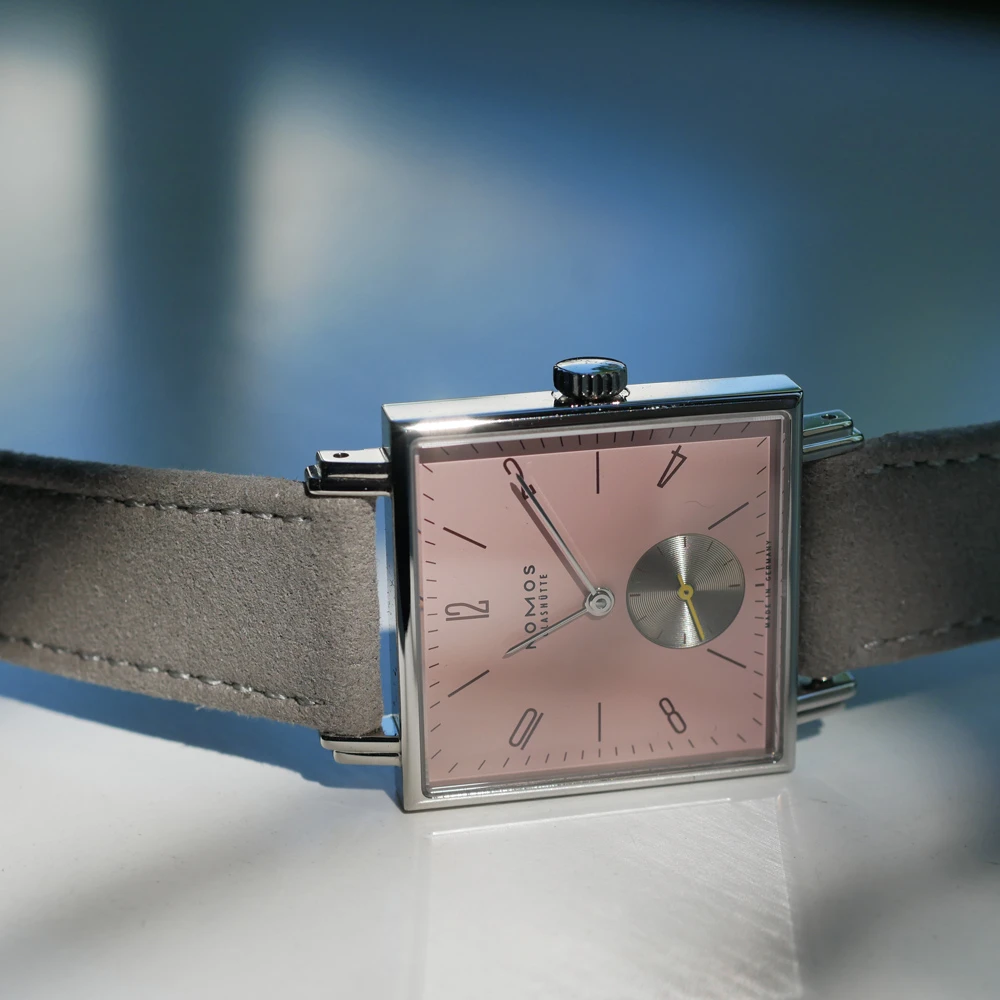
The evolution of the NOMOS Glashütte Tetra size
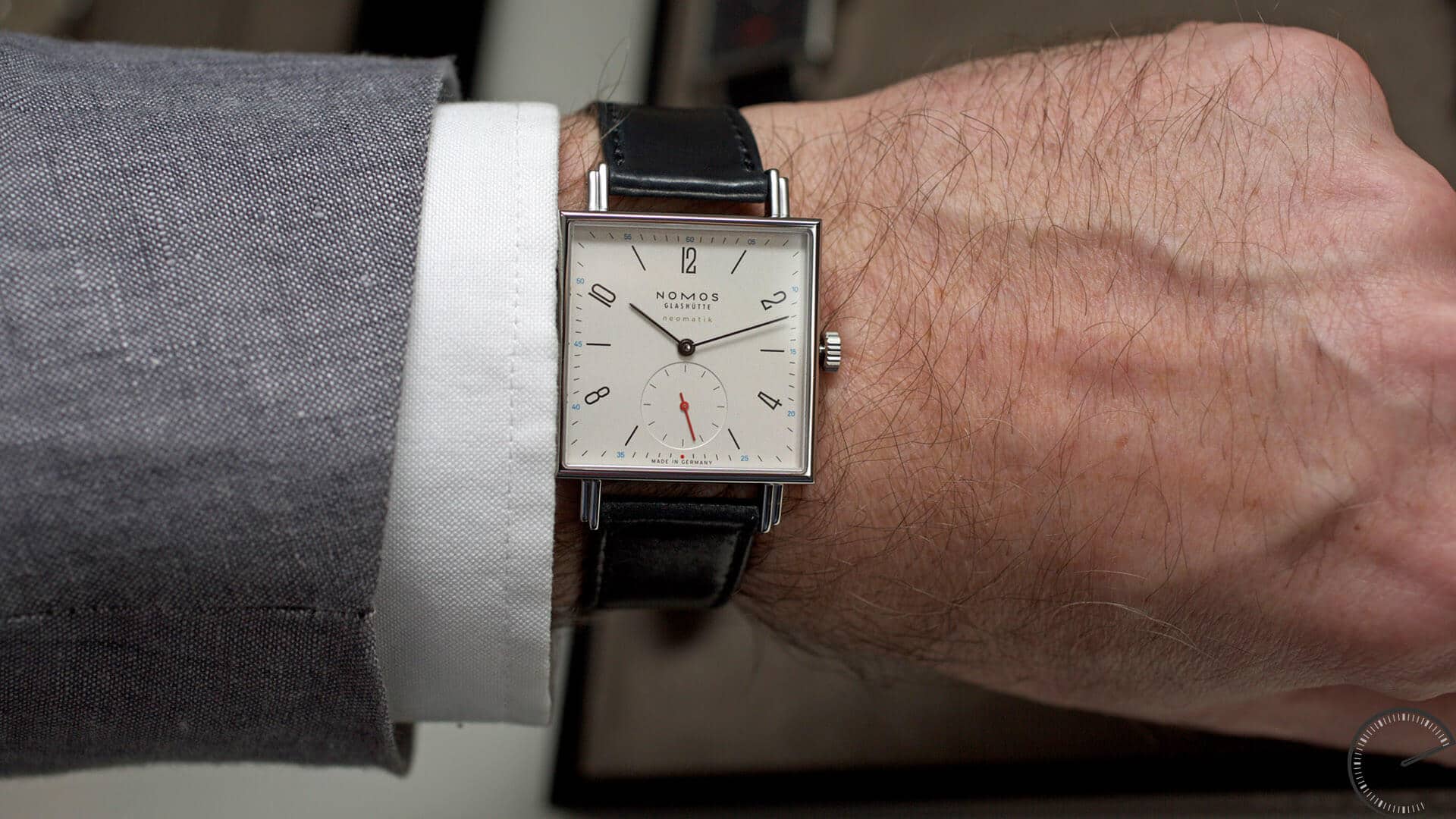
The early NOMOS Glashütte Tetra was offered in two sizes (27.5 mm x 27.5 mm) and (29.5 mm x 29.5 mm). When these dimensions are contrasted with a conventional round watch, they may sound small, however, due to the shape of the case, they appear much larger when worn. Moreover, consistent with other NOMOS watches, the elongated lugs contribute to the watches appearing larger when affixed to the wrist.
NOMOS Glashütte Tetra movements
In the early years, NOMOS procured ETA movements, specifically the hand-wound Peseux 7001. However, a facet of the NOMOS paradigm that repeatedly comes to the fore, is the desire to be independent. In 2005, the German firm unveiled its first in-house movement, the Alpha Calibre. This hand-wound movement featured a three-quarter plate, Glashütte ribbing, perlage, sunburst decoration and a plethora of thermally blued screws. Back in 2005, the refined execution of the Alpha Calibre was incredible, especially considering the modest pricing of the brand’s watches.
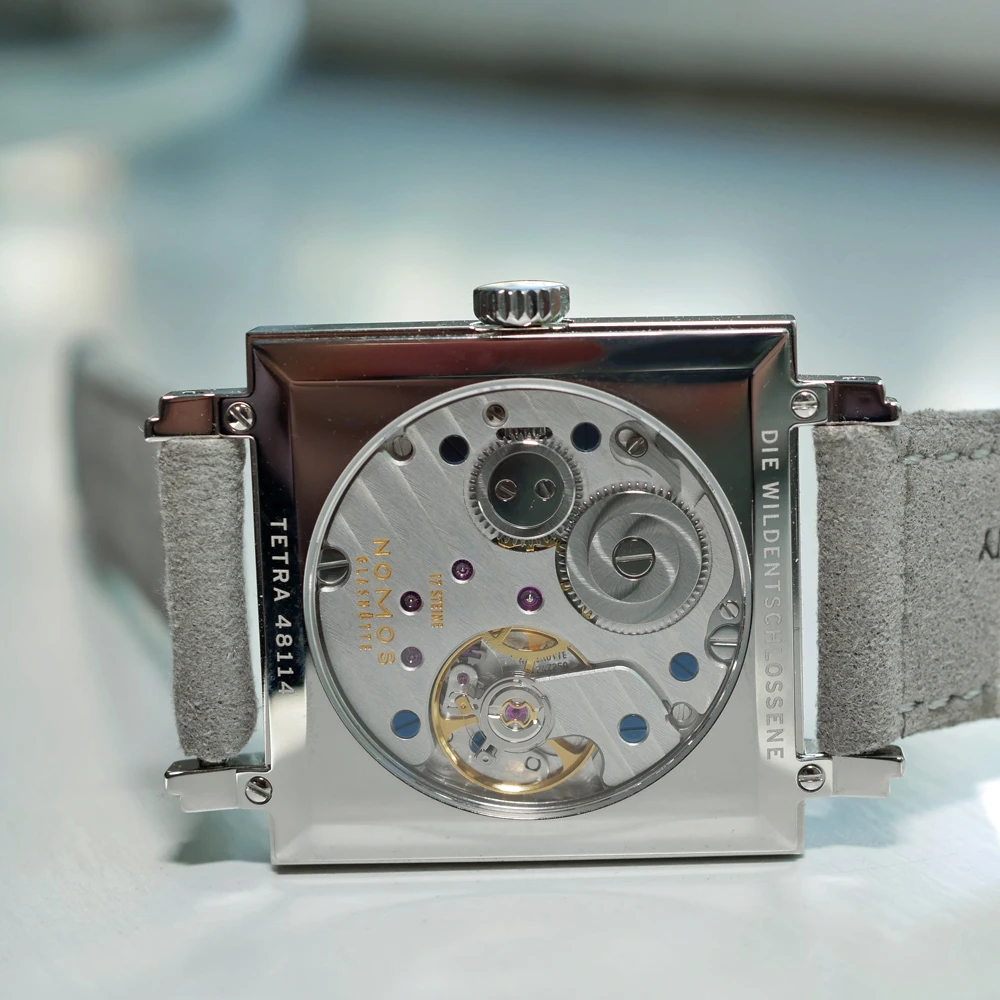
Image – Alpha Calibre
In releasing the Alpha Calibre, NOMOS reduced its reliance on third parties, increased the Glashütte-produced content and achieved a greater degree of independence. Almost 20 years later, the tried and trusted Alpha Calibre continues to feature in several NOMOS models, including the Tetra.
However, the brand’s desire for even greater independence led to two significant developments, namely the ‘swing system’ and the ‘neomatik DUW 3001’.
NOMOS swing system (2014)
At Baselworld 2014, I remember visiting the brand’s exhibition stand and being shown movements featuring the new NOMOS swing system. I can still remember being shocked at how a modestly-sized company had gone to the trouble and expense of making its own escapement and regulating organ. Most companies would procure this group of components from a third-party specialist, typically located in Switzerland.

Image – NOMOS swing system (Copyright: NOMOS Glashütte)
The swing system comprises the escape wheel, pallet lever, balance wheel and hairspring, together with a handful of minuscule parts. A prerequisite of any viable Swiss lever escapement is that all components work in harmony, especially when it comes to the marriage between the balance wheel and the hairspring.
The making of a hairspring is shrouded in secrecy, however, it involves using an alloy wire, the composition of which is a trade secret. Its diameter is gradually reduced using a combination of rollers and dies. Thereafter it is cut, coiled, heated and cooled. All variables remain confidential, however, from past experience visiting other companies, the production tolerances are measured in nanometres (1,000,000 nanometres = 1 mm). Should the diameter of the hairspring fluctuate, it would make it impossible to regulate the movement.
NOMOS Glashütte reputedly spent €11M bringing the swing system to fruition, providing a clear indication of the importance it places on being independent.
Calibre DUW 3001 (2015)
Another endearing characteristic of all NOMOS models is that they are slender. When oversized watches were all the rage 20 years ago, the German brand shunned the trend and stuck to its policy of making modestly sized, slim watches.
For many years, NOMOS only offered hand-wound models, however, it ultimately made the strategic decision to make its own in-house automatic movement. Ordinarily, the problem with a self-winding movement is that the oscillating weight, positioned above the bridges (or three-quarter plate), adds significant height to the movement, an idea that is abhorrent to NOMOS.
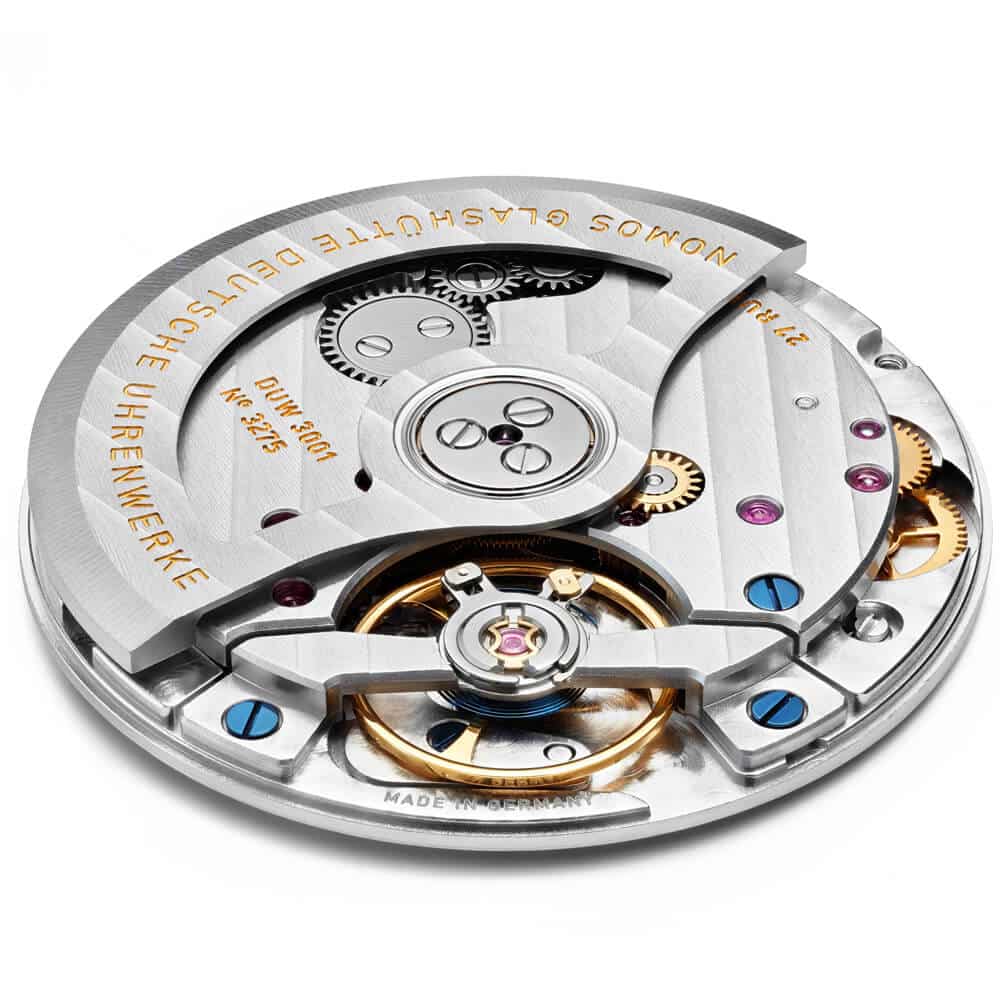
Image – neomatik DUW 3001 (Copyright: NOMOS Glashütte)
When developing its neomatik DUW 3001, the Glashütte-based brand looked at the efficiency of the gear train. With some watches only about 80% of the energy from the barrel reaches the escapement due to frictional losses, etc. NOMOS expended much effort raising this figure by looking closely at each wheel within the gear train, paying close attention to the order, angle and number of teeth. By achieving an efficiency of 94.8%, the German company was able to reduce the size of the mainspring, making the movement less bulky while still delivering a power reserve of 43 hours. The resultant movement, the neomatik DUW 3001, has a lithe torso measuring just 3.2 mm in height.
Despite its svelte profile, the neomatik DUW 3001 is endowed with lots of NOMOS loveliness, including the swing system and the brand’s impressive finishing.
Historical NOMOS Tetra dials
Throughout its history, NOMOS has not been afraid to embrace playful design and colour for the delectation of its clients. Peruse former NOMOS brochures and you will discover an array of dial designs, some more avant-garde than others. For example, the Tetra Helene featured a depiction of leaves and flowers on its dial, the Tetra Rosemarie was festooned with pink blooms and the Tetra Lävograph bamboozled the wearer with its blend of upside-down and correctly orientated dial and case elements.

Image – Tetra Lävograph (Copyright: NOMOS Glashütte)
A few years ago, NOMOS produced the Tetra Gangreserve, a watch with a fuel gauge. This model featured a circular aperture in the northern region of the dial, indicating the status of the mainspring. A burst of ebullient red appearing in the small window served to remind the owner when to wind their watch.

Image – Tetra Gangreserve (Copyright: NOMOS Glashütte)
Tetra Neomatik 39 Silvercut 423 (current)
In 2017, NOMOS released four models with ‘silvercut dials’, including the Metro, Orion, Tangente and Tetra.

The surface of each Silvercut dial is rhodium-plated and enriched with a horizontal brushed motif. Composed of many fine lines, the dial epidermis plays with light, bestowing a plethora of grey hues. A small seconds dial, positioned at 6 o’clock, features snailed detail and a red hand, providing a pop of colour against the monochromatic backdrop. The tempered blue hour and minute hands also add a further dash of colour.

Always a popular choice, the Tetra Neomatik 39 Silvercut remains a member of the brand’s collection today. Measuring 33 mm x 33 mm, the watch is larger than its older siblings of 1992, however, it still remains trim with a case height of 7.3mm.
Sitting at the heart of the watch, the Calibre DUW 3001 is slim and proffers ease of use and notable precision.
Celebrating 175 Years Watchmaking Glashütte (2022)
In 2022, NOMOS, proud of its home town, released four limited-edition Tetra references. Honouring Glashütte’s long history of making watches, these models were offered in four dial colours, including blue, black, off-white and red. All models featured the Calibre DUW 3001, were housed in a 33 mm x 33 mm steel case and were limited to 175 pieces each.
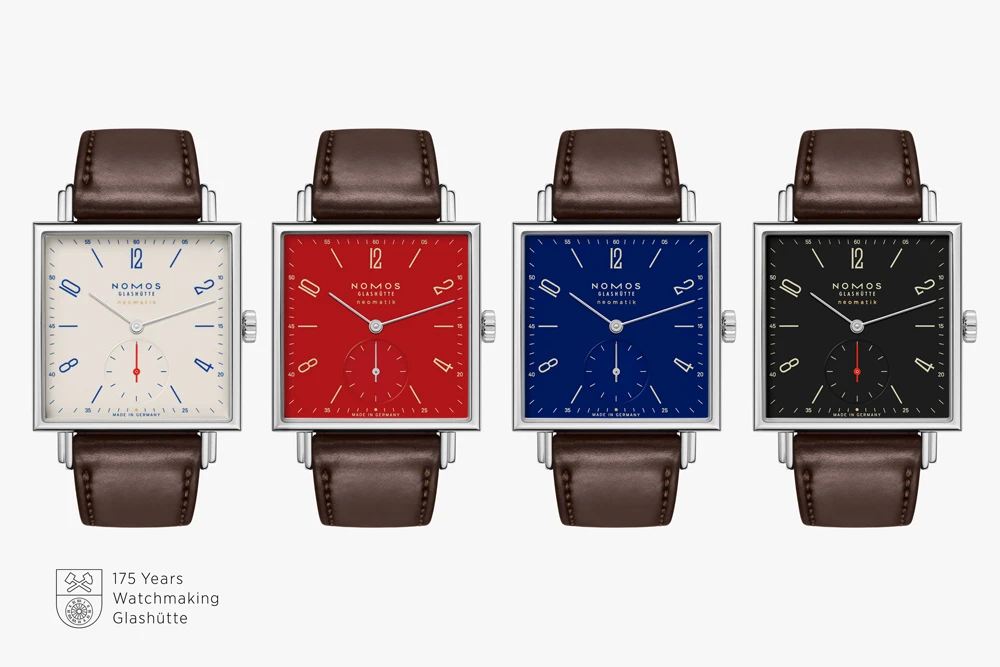
Image – Copyright: NOMOS Glashütte
Shades of pink: the Tetra quartet (2023)
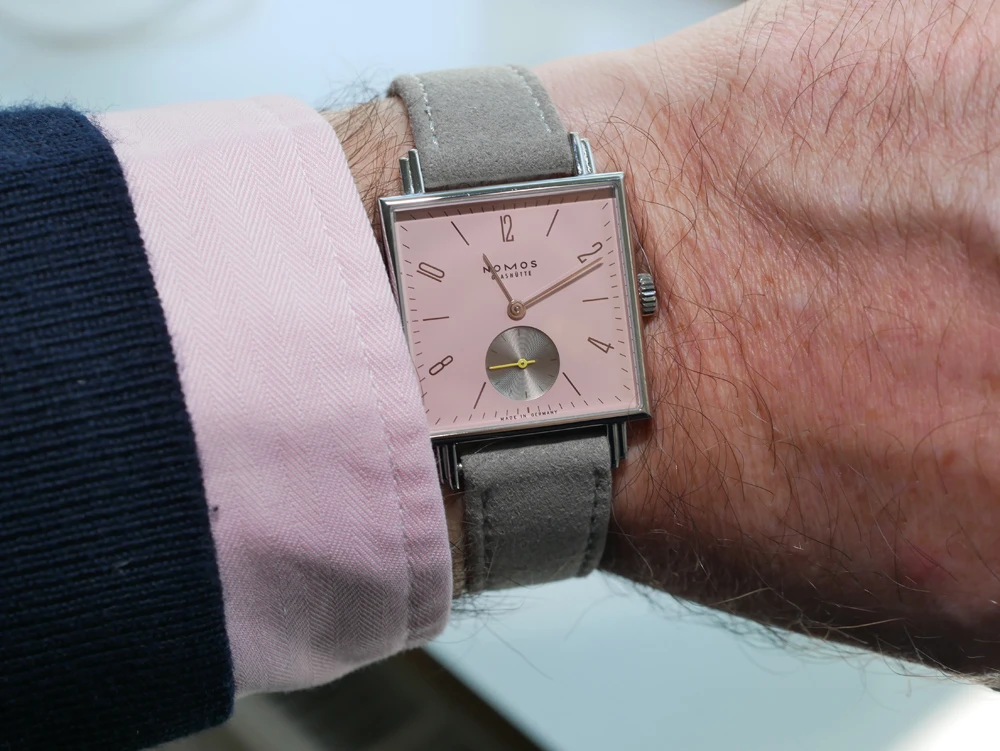
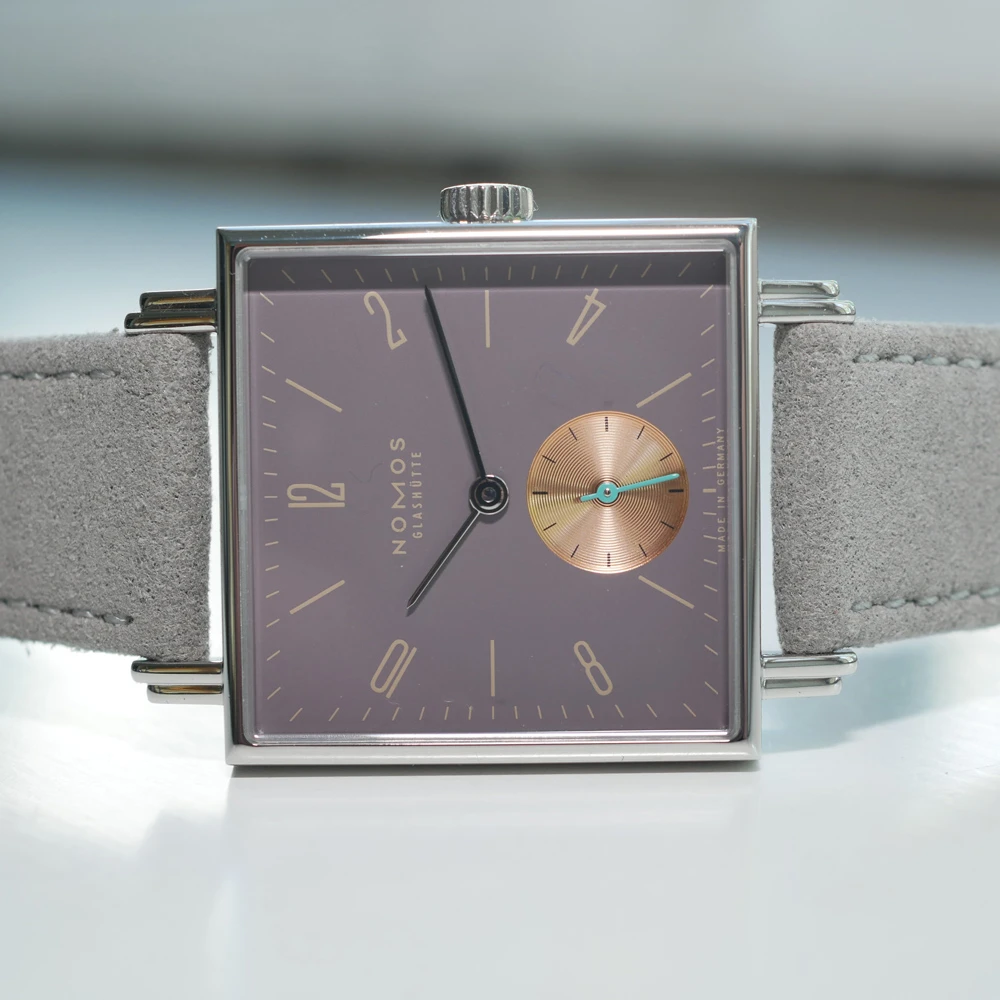
Earlier this year, NOMOS released four watches dressed in shades of pink. On this occasion, the brand from Saxony opted for the 29.5 mm x 29.5 mm case option while playfully juxtaposing different hues to comely effect. The small seconds display is snailed, executed in a different colour to the main dial and paired with a brightly-toned hand, bestowing a wonderful note of contrast. Each watch is fitted with the hand-wound Alpha Calibre, presented on a vegan velour strap and comes with a solid caseback, ideal for a personalised inscription.
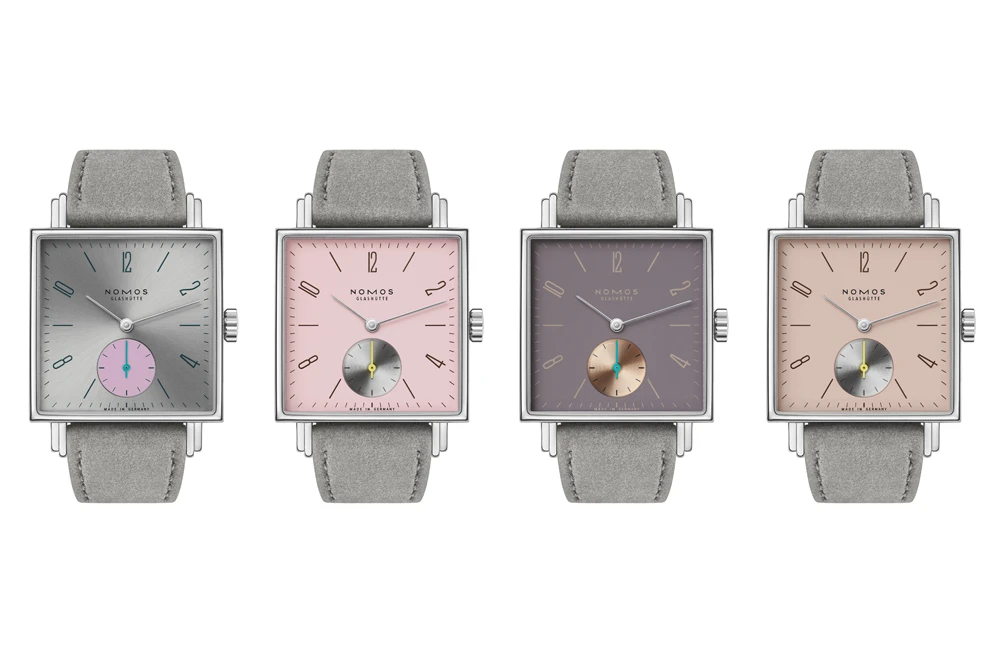
Image – Copyright: NOMOS Glashütte
NOMOS Glashütte Tetra – closing thoughts
Back in 1992, it would have been safer to have made another round watch, however, the brand took the bold step to create its own take on the ‘form’ watch. Arguably, a courageous move, the Tetra has proved to be a roaring success for the brand, not only in commercial terms but also from a design perspective.
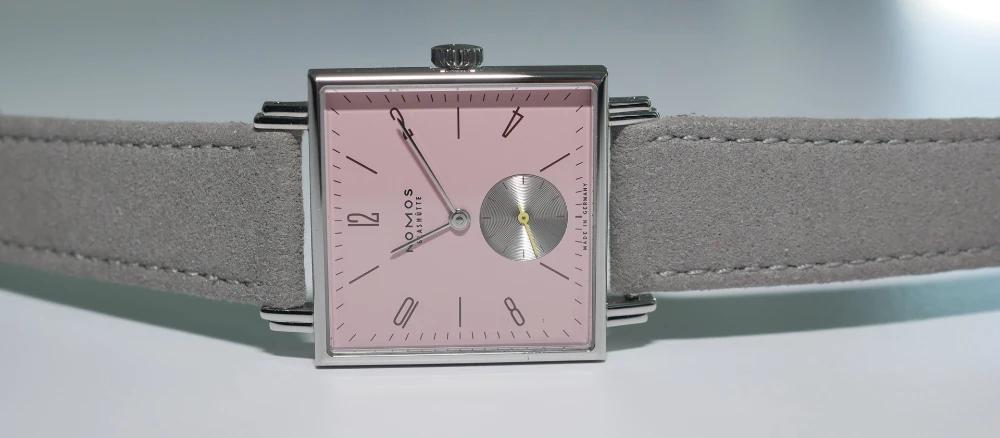
Part of the Tetra’s appeal is that its shape makes it non-conformist and yet it looks crisp and neat. The model does not cynically categorise prospective purchasers into ‘male’ and ‘female’, but is simply offered in three sizes to suit different tastes.
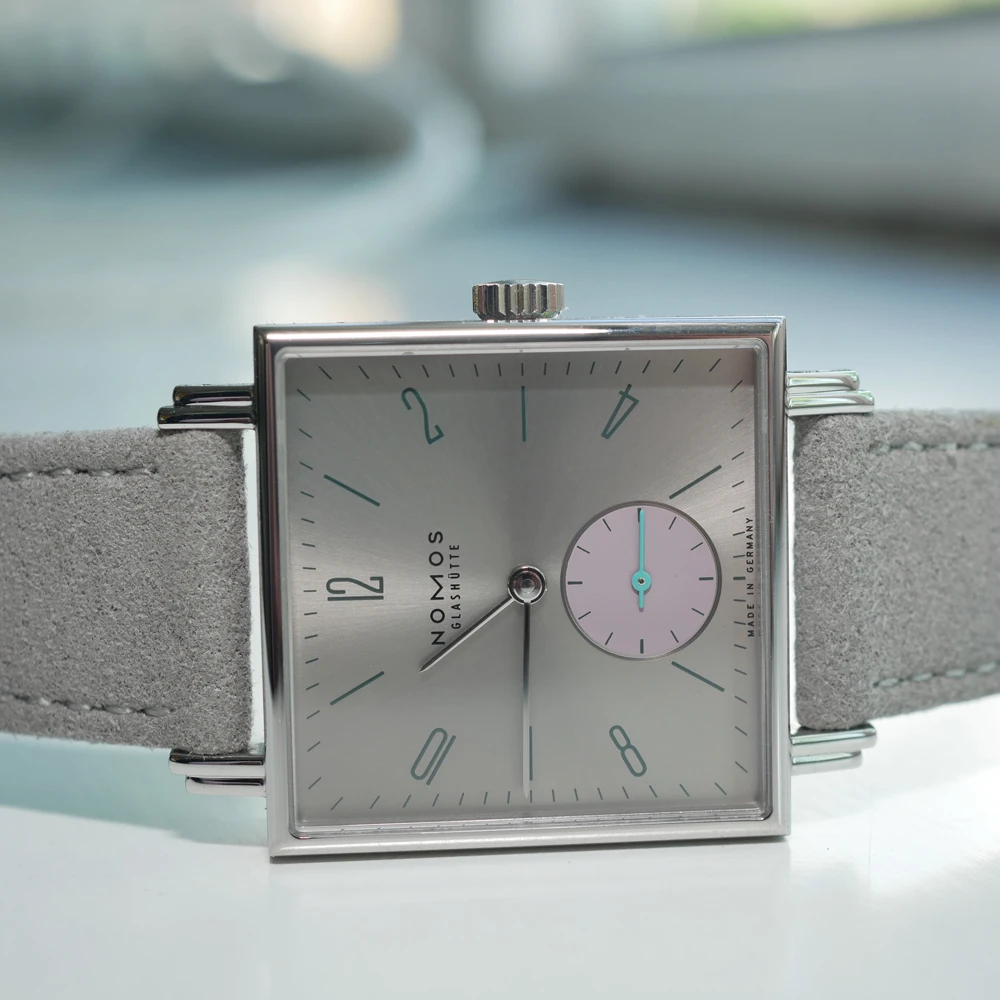
From a mechanical perspective, the NOMOS Glashütte Tetra incorporates traditional German craftsmanship while demonstrating the brand’s determination to be independent. Unwavering in its desire to make slender watches, NOMOS, now 30 years old and counting, conceived the Calibre DUW 3001, proffering automatic winding while remaining slender in appearance.
Most of all, NOMOS Glashütte, has created a range of fine watches, each blessed with a prepossessing face and an impressive mechanical brain. Since it was founded in 1992, NOMOS has democratised watchmaking, making it accessible to more individuals and breaking down the walls that previously precluded legions of would-be buyers from acquiring a luxury watch. It seems a coincidence to talk about breaking down walls when discussing NOMOS, after all that’s where the story began.