
NOMOS Twice Unique Watch Review
At Watches & Wonders 2026, NOMOS pulled back the curtain to reveal a plethora of new watches bearing the ‘Twice Unique’ label. These timepieces are sold in pairs (a steel version and an 18-carat gold model) and are endowed with distinctive dial designs, encompassing ‘artistic experimentation’ and ‘traditional craftsmanship’. On hearing about this new collection, Angus Davies, a confessed NOMOS devotee, wondered whether the German brand had abandoned its egalitarian roots.
‘Chinese watches’ of the 18th century
During the 18th century, Swiss watchmakers exported numerous ‘Chinese watches’ to Imperial China. At the time, the nation was enjoying much prosperity and the ruling classes, having amassed much personal wealth, were busy purchasing luxury goods, including watches. Indeed, it is reputed that the Qianlong Emperor (1711-1799) would often acquire in excess of 100 watches per year.
These products of Western society, uniting intricate mechanisms and artisanal crafts, were held in the highest esteem. The Emperor, his family and chosen officials enjoyed buying pairs of watches which often featured mirror-image enamel paintings. While some pocket watches celebrated Chinese culture, most pieces were adorned with figures and landscapes inspired by life in Europe.
Interestingly, there appears to be some debate as to whether the watches were sold in pairs purely for commercial reasons, ie boosting sales volumes, or because buying items in pairs was an accepted practice in 18th century China. Alternatively, some historians believe that watches were purchased in pairs for practical reasons. One watch could be worn, while the second was away being serviced or repaired, a task that could take several months to complete, especially if it necessitated returning the timepiece to Switzerland.
Perhaps the most probable explanation is that mirror-image pocket watches appealed to Chinese society’s fondness for harmony and symmetry. Rare, unique and incredibly expensive, these timepieces were made for a fortunate few and represented the pinnacle of watchmaking excellence and European sophistication.
NOMOS Twice Unique – Watches & Wonders 2026
At Watches & Wonders 2026, I was reminded of these historical mirror-image timepieces when I was presented with a series of modern-day unique watches, again sold in pairs. But, these rare creations haven’t been crafted by the usual makers of six-figure watches. On the contrary, the Twice Unique models have been produced by NOMOS. The brand, based in Glashütte, is reputedly the largest manufacturer of mechanical watches in Germany and has enjoyed much success producing accessible luxury timepieces.
A proud owner of a NOMOS watch (my wife and daughter are too), I freely admit to being an ardent admirer of the brand. Nevertheless, I confess that prior to Watches & Wonders, I would never have envisaged NOMOS making pairs of watches in very limited numbers (see later). Indeed, on seeing these new models, I couldn’t help but wonder whether the brand I love had abandoned its founding principles.
NOMOS – an egalitarian brand
Roland Schwertner founded NOMOS in 1990, just two months after the fall of the Berlin Wall. Formerly a photographer and IT specialist, and armed with an MBA, Schwertner had a vision for a new type of luxury watch brand.

Image – Roland Schwertner
He chose to base his fledgling company in Glashütte, a town in Saxony with a long tradition of watchmaking dating back to 1845 when Ferdinand Adolph Lange opened his first atelier with 15 apprentices.
The inaugural NOMOS models were designed by Susanne Günther, a graphic designer who was influenced by Bauhaus, the Deutscher Werkbund and the Ulm School. Bauhaus, founded by Walter Gropius in 1919, subscribed to the doctrine of ‘form follows function’, a phrase attributed to Louis Sullivan, an American architect, back in 1896. Sullivan believed that a building’s purpose should dictate its design. Likewise, Gropius’s Bauhaus valued function above ornamentation and advocated standardisation. With regard to the Ulm School, much emphasis was placed on designers being socially minded, using modernist principles to conceive products for a bright new world. The design ethos favoured democracy over financial gain.
But above all, the single biggest influence guiding the design and composition of NOMOS’s products has been, and remains, the Deutsche Werkbund. Founded in 1907, the Deutsche Werkbund united product manufacturers and design professionals. The underlying objective was to boost Germany’s competitiveness on the world stage, bringing together traditional crafts and mass production techniques. The organisation’s motto was ‘Vom Sofakissen zum Städtebau’ (from sofa cushions to city-building), an ethos that has since influenced the design and manufacture of numerous products.
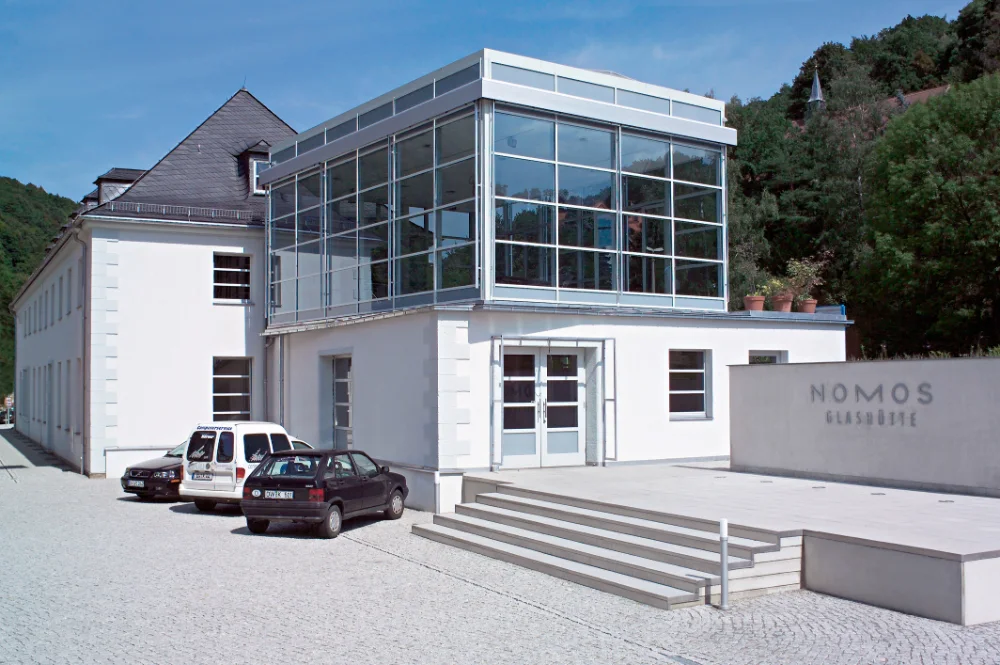
Image – NOMOS Glashütte HQ
From the outset, NOMOS has focussed on making high quality, functional and affordable watches. The brand embraces modern mass production techniques such as CNC (Computer Numerical Control), while respecting watchmaking traditions. The German marque’s products subscribe to the notion of understated luxury yet remain accessibly priced. In short, NOMOS has gained a reputation for design, in-house movements and reliability, while consistently adhering to the aforementioned design influences.
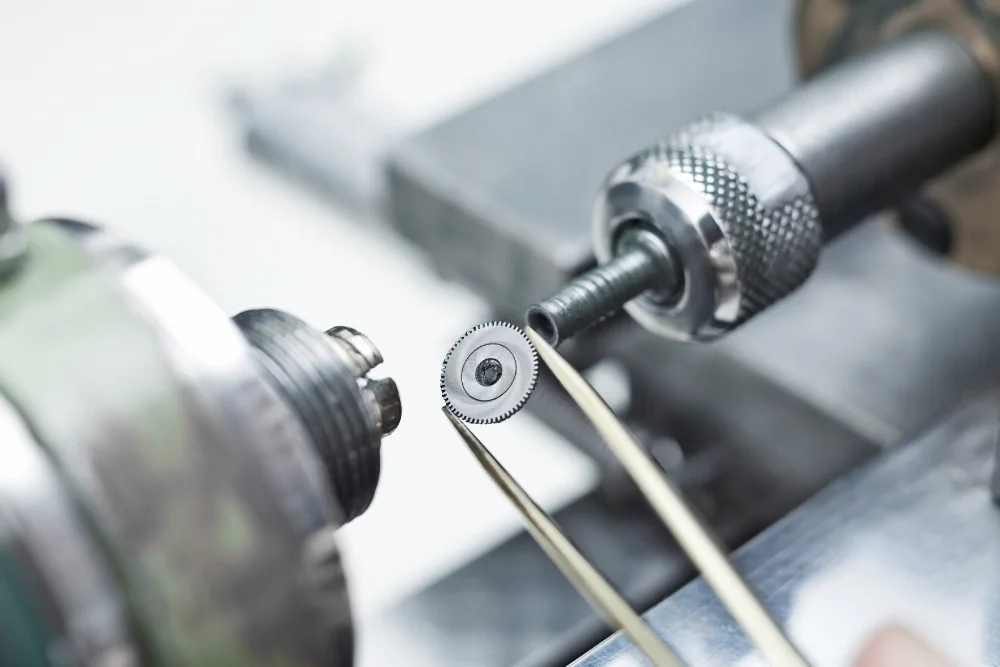
Image – applying sunray motif to ratchet wheel
The recipient of more than 170 international awards at the time of writing, NOMOS has shown that affordability does not necessitate forgoing quality or sacrificing style. Indeed, this maker of quintessentially German timepieces has repeatedly demonstrated an egalitarian approach to fine watchmaking.
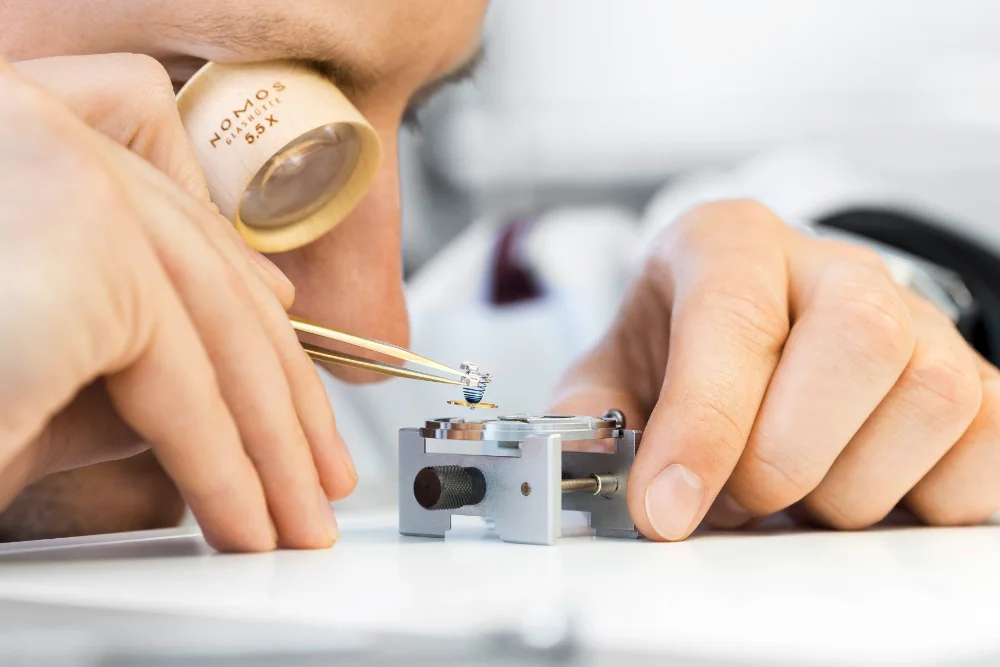
NOMOS Twice Unique – based on creative freedom
Rather than abandon its founding principles, the new NOMOS Twice Unique models are not intended solely for the elite but have been conceived based on the idea of ‘creative freedom’ and the celebration of artisanal crafts.
These models are sold in pairs, effectively identical ticking twins save for their cases, with one executed in stainless steel and the other in 18-carat gold. NOMOS is no stranger to making gold watches, but it has significantly enlarged its portfolio of aurum-themed models of late, thereby augmenting customer choice.
Brand devotees will recognise the shape of each Twice Unique pairing with the Ludwig, Orion, Tangente 33, Tangente neomatik 38 Update and Tetra styles all making an appearance. Likewise, the German firm has drawn on its impressive repertoire of in-house movements to power these rare watches. By using existing cases and movements, NOMOS is able to achieve some of the economies of scale that have led to its success, an approach consistent with the ethos of Deutsche Werkbund.
NOMOS Twice Unique – Anna Diederichs
The first couple of sets of Twice Unique pieces were inspired by the work of Anna Diederichs, a textile designer and artist. Born in Sigmaringen, Germany, Diederichs moved to Paris in 1969 where she worked for the fashion house, Dessins Kanitz. During the 1960s, the world of fashion was in the midst of a revolution. The idea of haute couture was becoming outdated and an increasing number of women sought accessible, ready to wear garments. In 1966, Yves Saint Laurent opened his first Rive Gauche boutique selling prêt-à-porter garments on Paris’s Left Bank.
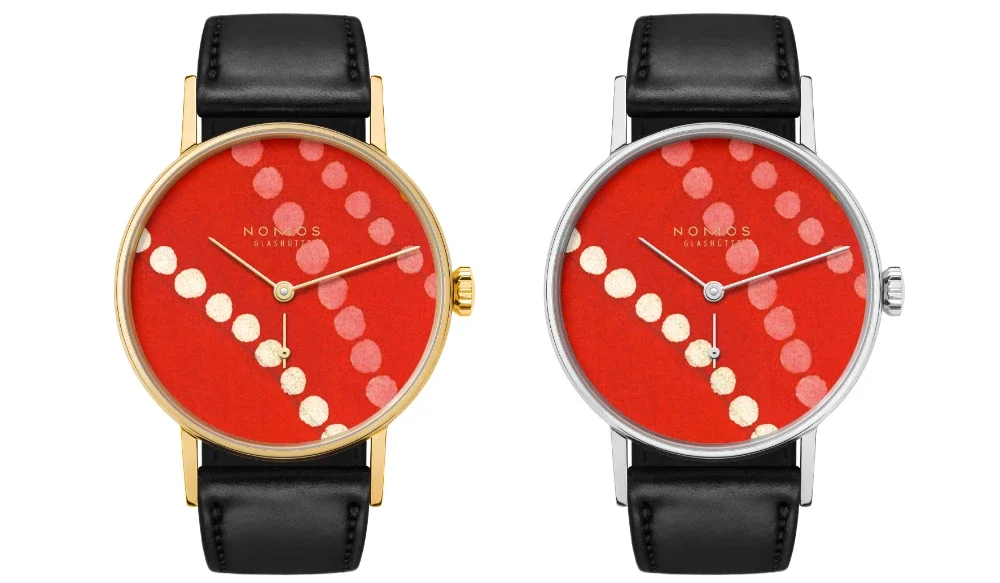
Image – NOMOS Ludwig Rive Gauche
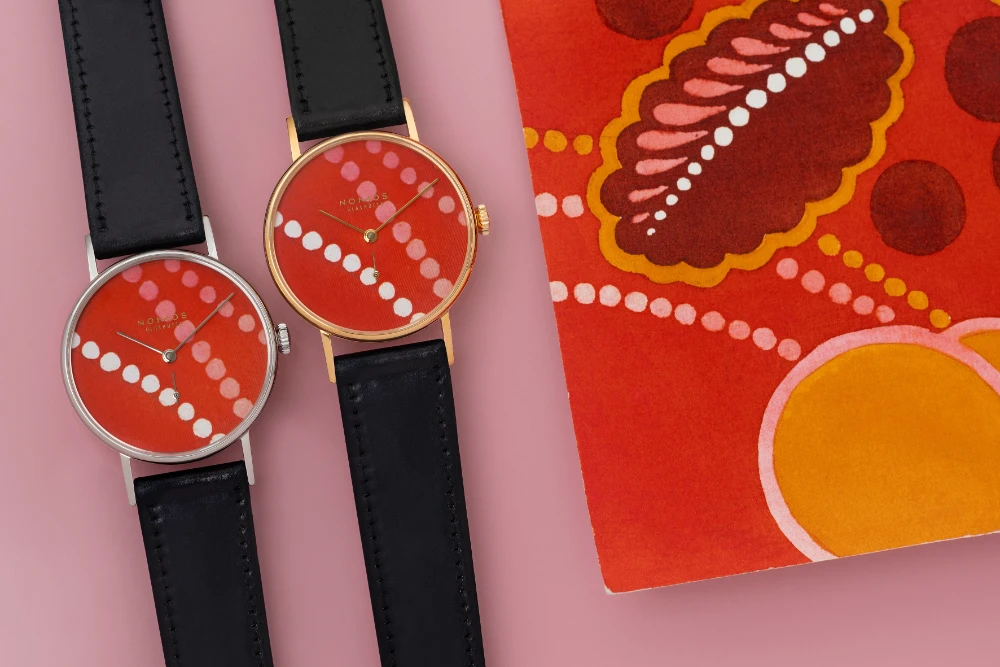
The dial of NOMOS Ludwig Rive Gauche replicates an original Diederich sketch, complete with traces of pencil. Both steel and gold models are endowed with a matching canvas, composed of a sea of scarlet, dotted with random circles of carmine and cream, providing the perfect background for the hour and minute hands, together with the small seconds indication.
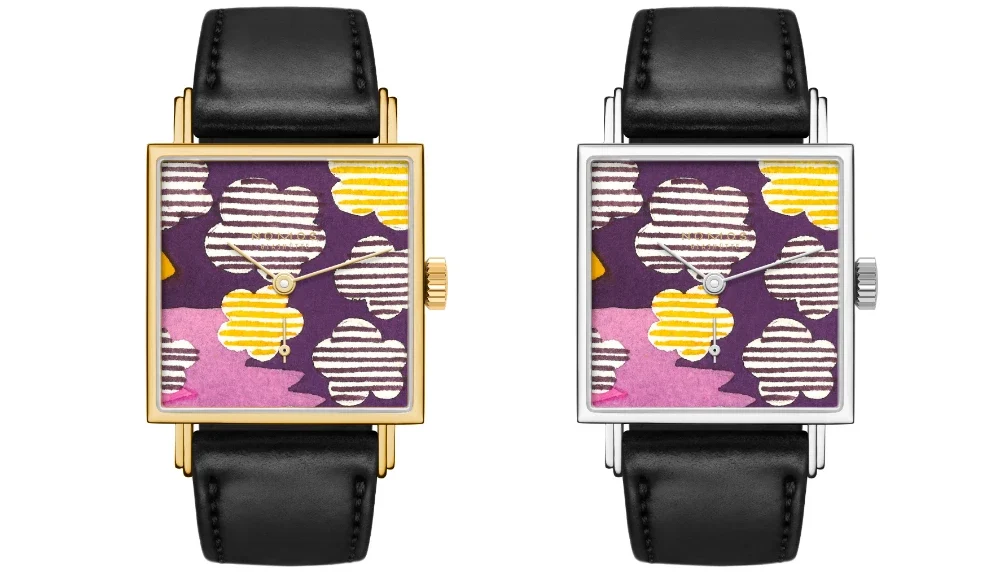
Image – NOMOS Tetra Paris 1966
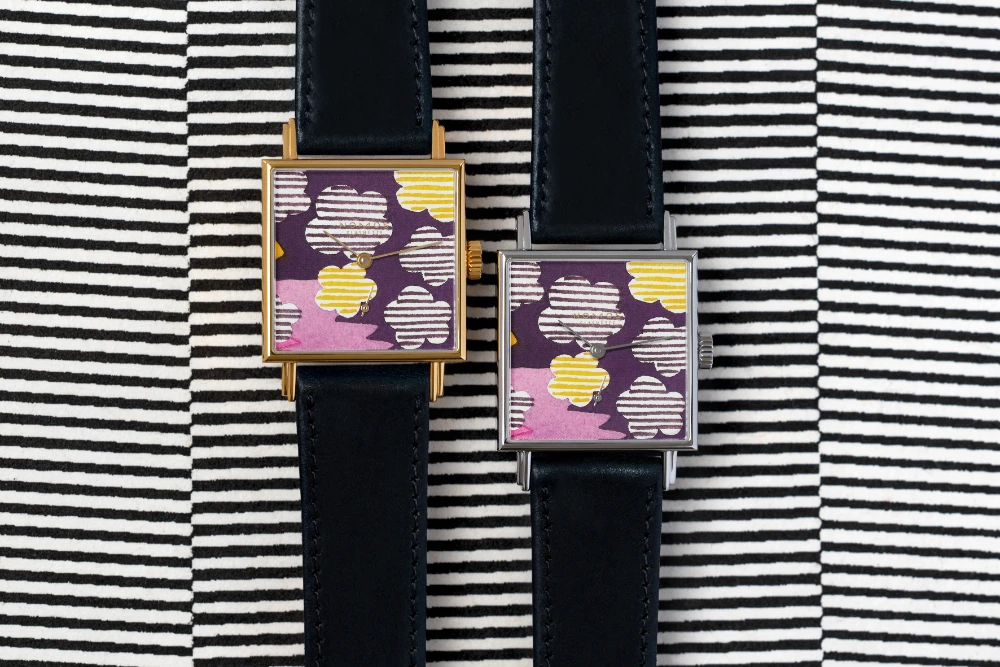
For the second horological composition inspired by the work of Diederichs, NOMOS has chosen a textile pattern, again created in the French capital. NOMOS Tetra Paris 1966 is a scene of brightly coloured flowers, characterised by horizontal lines set against a kaleidoscopic vista. Playful, neoteric and non-conformist, the dial design is complemented by the Tetra’s 27.5 mm case, an iconoclastic square housing created in a world dominated by round watches.
NOMOS Twice Unique – Urania
The marque from Saxony has not fixated on one style alone, but has found inspiration from an array of universes. For its Urania models, NOMOS looked to the heavens, embracing an astronomical world where obsidian skies are punctuated with shimmering stars. Using an ultra-fine, mouse-hair brush, the company’s artisans have applied small speckles of silvery hues to a dark blue dial, creating a glorious depiction of the sky at night. Some of the stars appear luminescent, with some executed in Superluminova that emit a warm glow in dim light. These Twice Unique models are offered in a choice of NOMOS Ludwig Urania with its slender elegant batons or the NOMOS Orion neomatik Urania with hours denoted using Roman numerals. Consistent with other NOMOS Twice Unique creations, each pairing is supplied in a steel case and 18-carat gold housing.
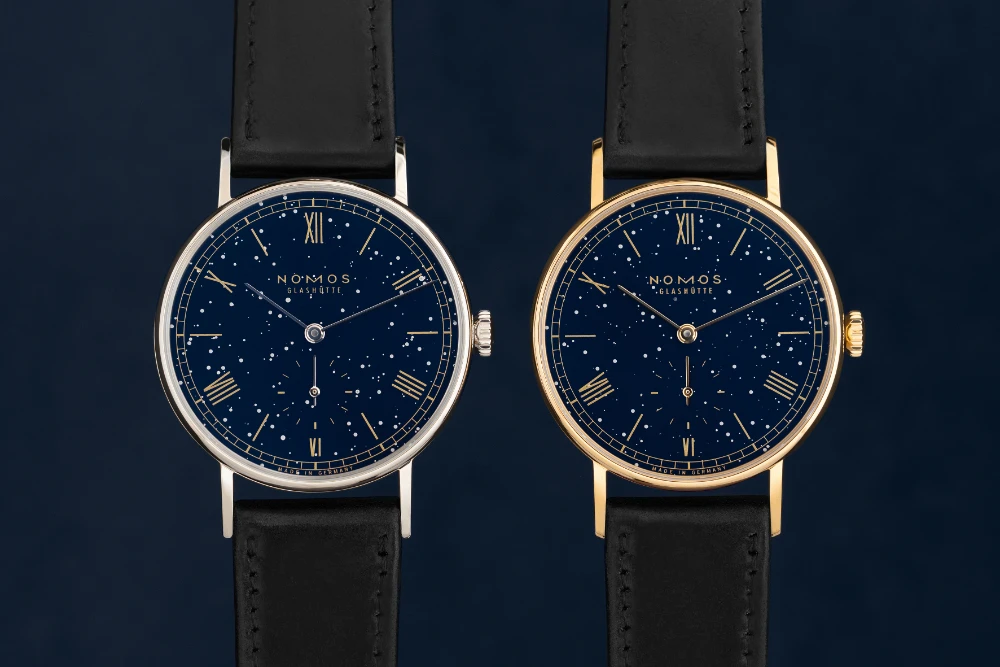
Image – NOMOS Ludwig Urania
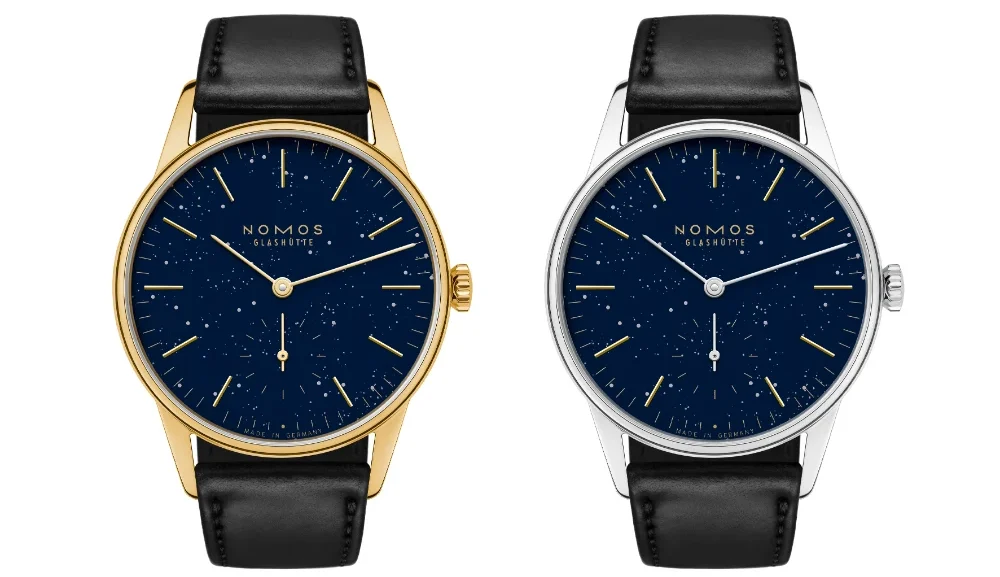
Image – NOMOS Orion neomatik Urania
NOMOS Twice Unique – Auric
In 2013, NOMOS released its first gold watches, the Lambda and the Lux. Over the years, the marque has expanded its catalogue of gold models. While the price of gold is set by the market, NOMOS has still managed to maintain its reputation for delivering value for money, offering several watches housed in solid gold cases (no PVD or plating here), at remarkably keen prices.
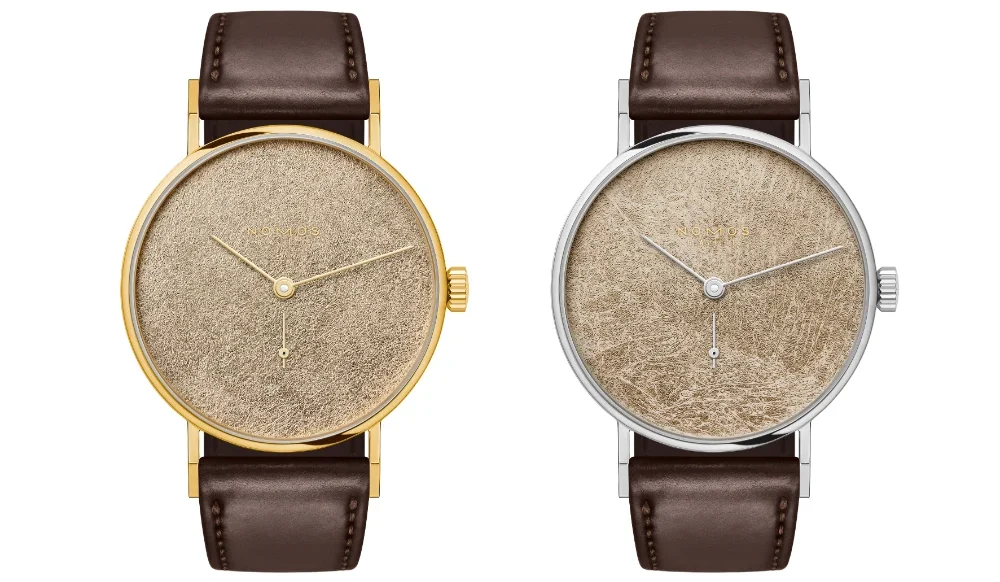
Image – NOMOS Tangente 33 Auric
NOMOS Tangente 33 Auric celebrates the noble metal. Once again, consisting of a steel watch and its gold twin, the Auric features a dial formed of multiple layers of gold leaf, crafted by ‘Berlin-based gilder Michelle Sachs’. Rather than a smooth, homogeneous surface, the gold leaf is repeatedly manipulated to create a wonderfully textured dial epidermis. The dial of Tangente 33 Auric eschews hour markers and branding, presenting just three hands floating above a lustrous vista.
NOMOS Twice Unique – Now
Since it was founded in 1990, NOMOS has consistently democratised luxury, producing stylish, quality products that remain relatively accessible. NOMOS Tangente 33 Now features a dial created using a ‘lapping technique’, an artisanal approach occasionally employed on some über-expensive Swiss watches. The process involves applying an abrasive paste to the dial, in combination with water, before brushing or scraping the surface.
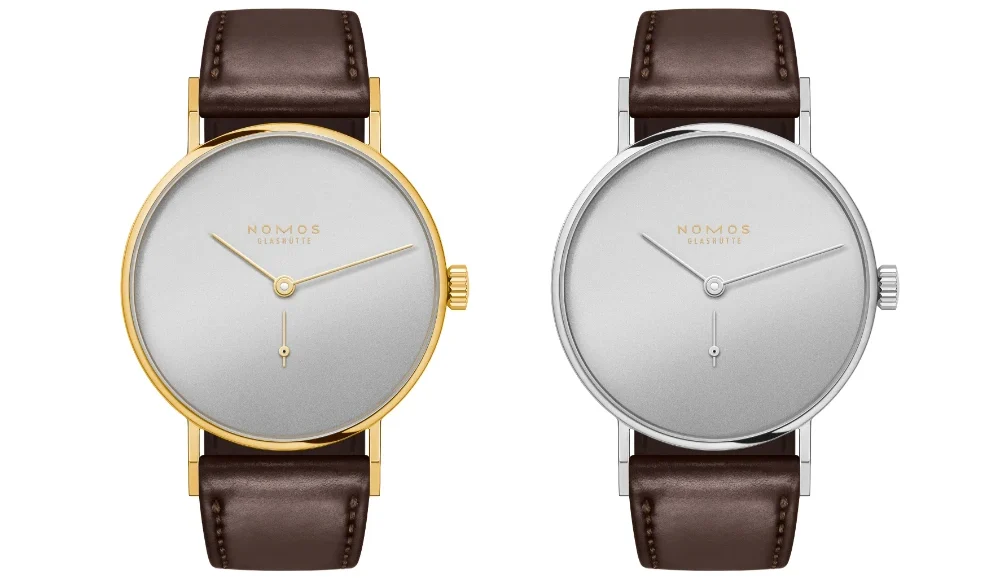
Image – NOMOS Tangente 33 Now
NOMOS Twice Unique – Scribble
The brand from the Ore Mountains has repeatedly turned to German artisans when creating the Twice Unique models. In this instance, the company has collaborated with Saskia Licina, a German jewellery artist and master goldsmith, to create an impressive body of work, ‘Scribble’. The dials are enriched with a motif formed of hand-engraved, flowing loops, imbuing each brass dial with a distinctive texture. Thereafter, the dial membrane is coated with ruthenium and silver.
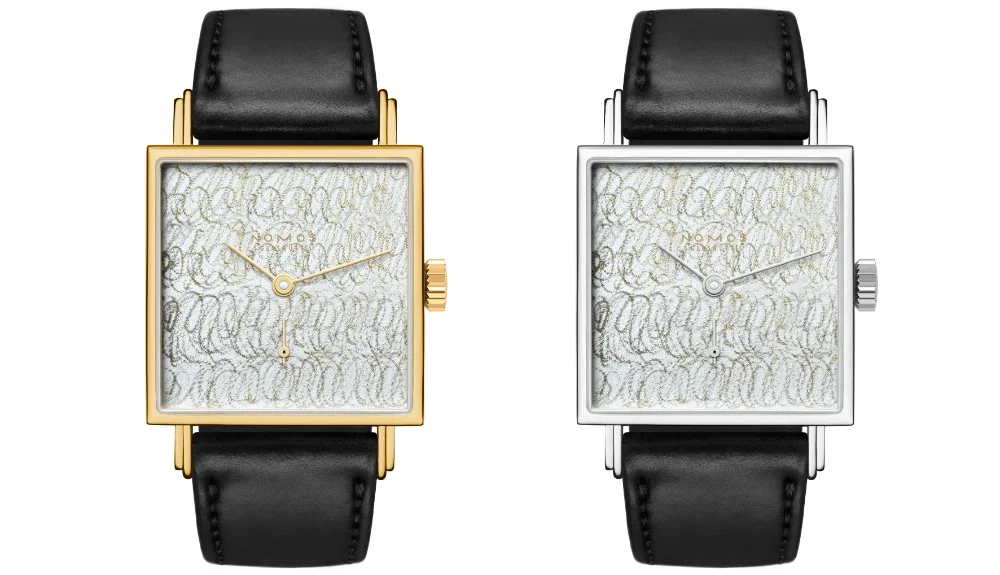
Image – NOMOS Tetra 27 Scribble
Licina has created two styles, NOMOS Tetra 27 Scribble and NOMOS Tangente neomatik 38 Update Scribble Dark. The Scribble harnesses light tones, while its alter ego, the Scribble Dark, embraces brooding blacks, accentuating the fine gold hoops.
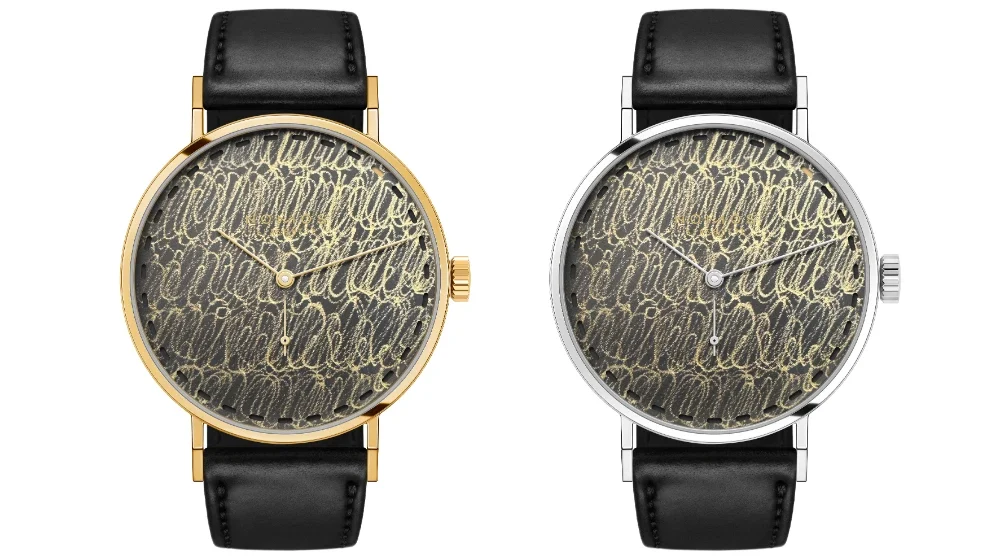
Image – NOMOS Tangente neomatik 38 Update Scribble Dark
NOMOS Twice Unique – Drift
In 2018, NOMOS released Tangente neomatik 41 Update. This watch unites Tangente’s beloved typography with a highly original date indication. A total of 31 apertures fringe the dial, while a rotating disc sits below. As the disc rotates, a coloured section is revealed through two neighbouring apertures, straddling the prevailing date. Highly innovative, the indication proves intuitive to use.
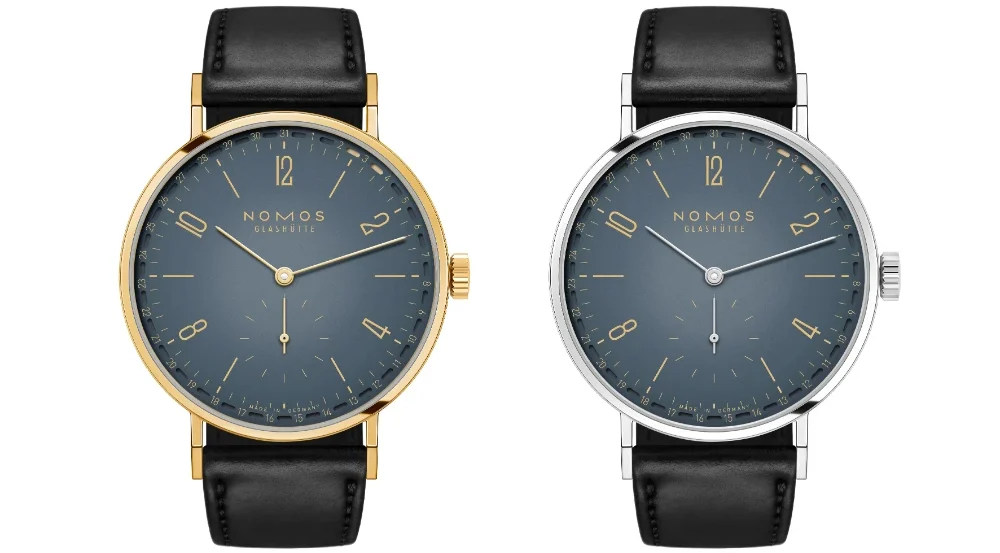
Image – NOMOS Tangente neomatik 38 Update Drift
The NOMOS Tangente neomatik 38 Update Drift is based on the 2018 release, but is endowed with a smoky blue frosted dial. Again, the twins are created using a historical technique, involving the use of a ‘pre-industrial airbrush’ where lightly primed brass dial blanks are ‘worked by hand with a die’ to endue the surfaces with a finely grained structure. The resultant aesthetic, with its gradient tones, ‘creates a sense of flow or ‘Drift’.
NOMOS Twice Unique – Moiré
For the first time, NOMOS has created a watch with a guilloché dial. Named, NOMOS Ludwig Moiré, the model features a dial with an elegant wave pattern. Upholding Ludwig convention, the dial is endowed with Roman numeral hour makers and chemin de fer, but on this occasion is presented in a new sophisticated shade of dark blue. The intricate dial motif plays with light and bears a strong resemblance to fine silk, conferring a seemly shimmer.
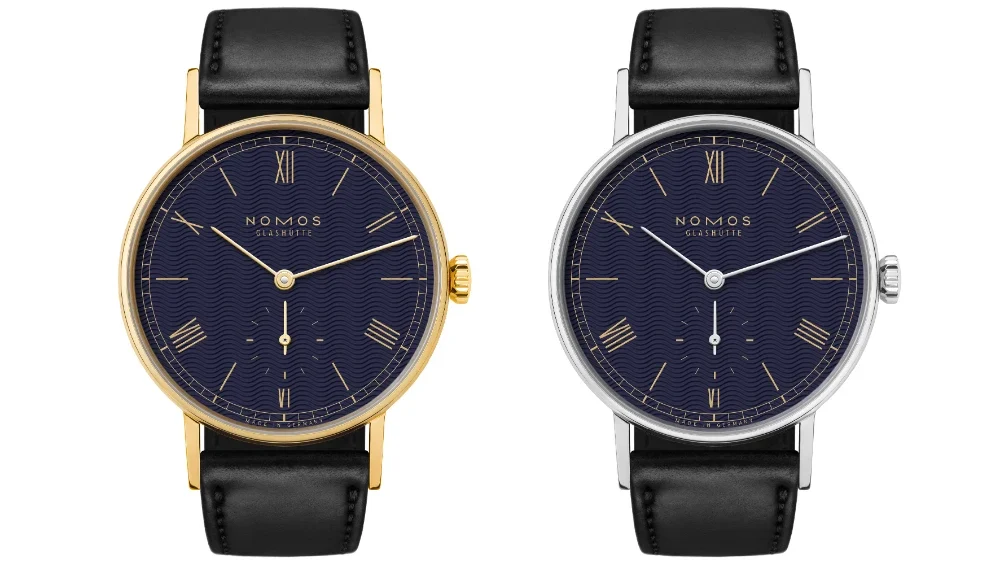
Image – NOMOS Ludwig Moiré
Closing remarks
As I mentioned earlier, creating watches in pairs is nothing new. However, NOMOS has reimagined this horological genre, viewing the idea of ticking twins through its own, unique lens. Rather than being expensive objects, made for Emperors, royalty, aristocracy and well-healed individuals, NOMOS Twice Unique are rare timepieces, crafted with creative freedom, celebrating artisanal techniques. NOMOS continues to adhere to the principles of the Deutsche Werkbund, cleverly using standard components such as cases and movements in order to achieve economies of scale. At the same time, the brand has crafted highly unique, rare expressions of watchmaking, while upholding the brand’s ethos of delivering affordable luxury.
Twice Unique models are sold in pairs. Should your ideal design have been sold, there’s no need to fret, further pairs are available on request, made to order and individually numbered. However, the brand has stated these models will only be available this year, hence vacillating may lead to disappointment.
Although the NOMOS Twice Unique collection represents new territory for the brand from Glashütte, it has not sacrificed its principles nor abandoned its loyal fan base, it has merely created an additional body of work that is likely to engage with an even larger audience.
Images – copyright: NOMOS Glashütte