
Patek Philippe 5470P 1/10th Second Monopusher Chronograph Watch Review
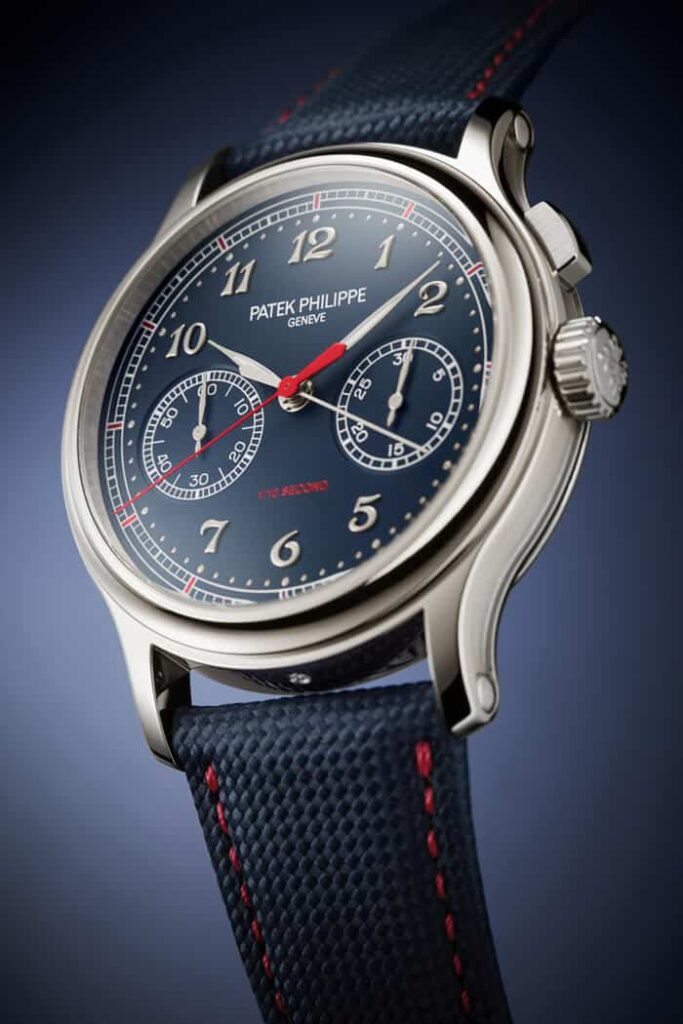
The Patek Philippe 5470P 1/10th Second Monopusher Chronograph is housed in a glorious 41mm platinum case. It sports a blue dial and can measure elapsed periods to the nearest 1/10th of a second using a dedicated red hand and accompanying track. Quite simply, it’s exquisite. However, as Angus Davies explains, it is the work of the Patek Philippe Advanced Research department, which has been instrumental to the creation of this model, that proves particularly interesting.
Patek Philippe Advanced Research
Despite having a rich history dating back to the 19th century and upholding a number of traditional practices that date back generations, Patek Philippe has never shied away from progress. The ‘Patek Philippe Advanced Research’ department is at the forefront of new technologies. In 2017, it masterminded the Ref 5650G, the Advanced Research Aquanaut Travel Time equipped with an ‘optimised Spiromax balance spring made of Silinvar; with patented terminal curve and inner boss, an innovation that ensures greater precision within mechanical watches.’ Moreover, the movement featured ‘a compliant (flexible) mechanism crafted from conventional horological steel used to set the second time zone in time-zone watches.’
In December 2021, the Genevan Maison unveiled the 5750P, the Advanced Research Fortissimo. This minute repeater incorporates ‘a patented sound amplification and diffusion system comprising a flexible suspended sound lever, a sapphire-crystal oscillating wafer and a titanium ring with four openings’. While the minute repeater is a centuries-old complication, the Patek Philippe Advanced Research department chose to challenge convention and pursue advancement for the benefit of its clients.
Silinvar
These are just two examples of the work undertaken by the Patek Philippe Advanced Research department, but this specialist team is continuously pushing the performance envelope within the esoteric world of horology. Founded in 2005, the department has produced an impressive body of work. Most notably, it has been a pioneer in developing applications for Silinvar, a material derived from silicon (silicium in French).
Patek Philippe 5470P 1/10th Second Monopusher Chronograph – two separate chronograph mechanisms
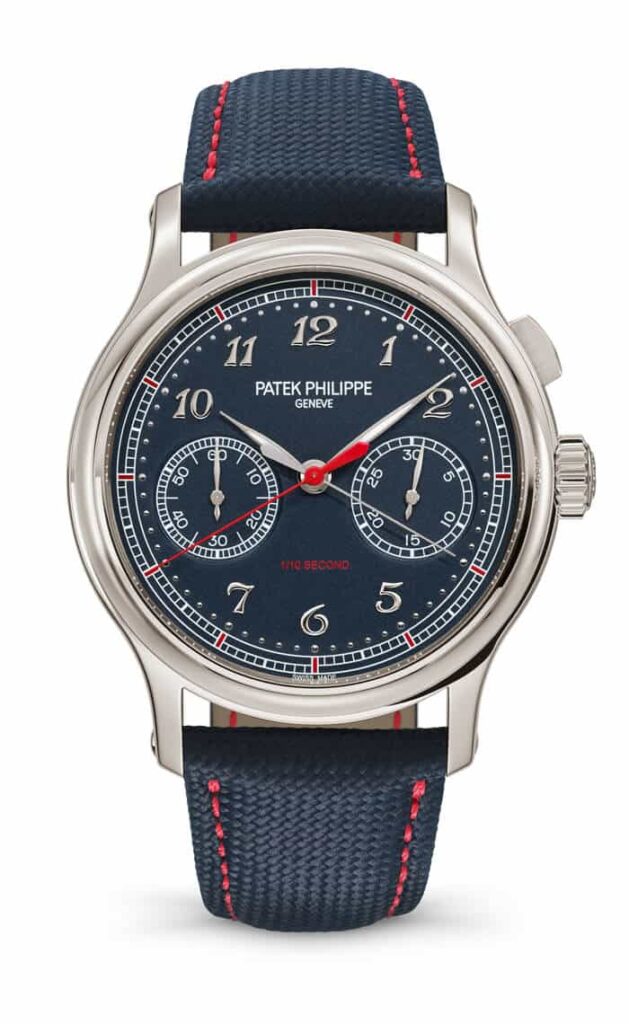
Now, the men in white coats working in the Patek Philippe Advanced Research department have been instrumental in the creation of a new model, the Patek Philippe 5470P. This watch contains two separate chronograph mechanisms, one linked to the central chronograph seconds hand, rotating 360° every minute, and a second mechanism driving a vermilion-hued hand, making one revolution every 12 seconds. Each hand works in conjunction with its own dedicated track encircling the dial with the red hand and its seconds track displaying time to the nearest ⅒-second.
Patek Philippe 5470P 1/10th Second Monopusher Chronograph – 5Hz frequency
The frequency of the balance is 5Hz. This in itself is not groundbreaking, indeed, the Zenith El Primero, released in 1969, shares the same cadence. However, what does make the Patek Philippe 5470P special is that it has the ability to display elapsed periods to the nearest ⅒-second in a highly intelligible format.
The problem with high-frequency movements is that they consume lots of energy, quaff lubricants and can be subject to excessive wear. But, with the creation of the Silinvar, a light, friction-free material, such problems have been overcome. Furthermore, by addressing the aforementioned problems, high frequency movements deliver superior rate stability and are less susceptible to positional influence.
Patek Philippe 5470P 1/10th Second Monopusher Chronograph – Caliber CH 29-535 PS ⅒
Reading the specification sheet of the Patek Philippe 5470P-001, one is struck by the plethora of terms used, many of which are accompanied by a ® symbol. Oscillomax, Silinvar, Spiromax, Silinvar and Gyromax are all mentioned in the brand’s press release. Likewise, seven patents relate to the new model’s movement, the CH 29-535 PS ⅒ movement. Even the nerdiest aficionado could easily be bamboozled, however, rest assured, each registered trademark and patent signifies progress, something everyone can appreciate.
Quite simply, Patek Philippe may be a traditional company with its own museum and an impressive back catalogue of greatest hits, but the Advanced Research department is always looking ahead, delivering superior performance for the benefit of future owners and, in my opinion, that’s a good thing.
Patek Philippe 5470P 1/10th Second Monopusher Chronograph – the brand’s press release
Patek Philippe unveils its first wrist chronograph for tenths-of-a-second short-time measurements with a new, very precise high-performance movement.
The manufacture reasserts its competence and innovative spirit in the field of short-time measurement: it presents a manually wound movement with two separate chronograph mechanisms and sweep hands. One of them indicates tenths of a second – precisely and very crisply. This high-tech high-frequency caliber (5 Hz) with 31 patents, of which seven new patents are specific to the new mechanism, ticks in a platinum case with a blue dial and red accents. Its sporty design emphasizes the highly technical and performance-oriented facets. With this tenth-of-a-second monopusher chronograph produced in small series – it is just as difficult to craft as a tourbillon, a minute repeater, or a split-seconds chronograph – Patek Philippe is delighting connoisseurs and enthusiasts with a new attraction in the domain of grand complications.
At Patek Philippe, chronographs have a rich, long-standing tradition. Since 1856, the manufacture has stood out with the sublime assets of its pocket chronographs with or without rattrapante hands, often in combination with other complications such as perpetual calendars or minute repeaters. In ca, 1930– 1931, the manufacture even developed a pocket watch with a tenth-of-a-second chronograph; today, it can be admired in the Patek Philippe Museum (Inv. P-340). As early as 1923, in response to a commission, Patek Philippe had already crafted its first split-seconds chronograph. This single piece was followed starting in 1927 by the first regularly produced wrist chronographs with or without rattrapante hands, among them the legendary Ref. 130 which was made from 1934 onward to the early 1960s.
The first decades of the third millennium were particularly prolific in the field of short-time measurement. As from 2005, Patek Philippe developed an extensive suite of chronograph movements with and without additional complications (rattrapante hands, minute repeaters, perpetual calendars, Annual Calendars, World Time) that were all designed and crafted in the manufacture’s ateliers. These chronograph movements feature numerous innovations and patented optimizations. Today, they are embedded in a regular collection with over 20 different models for ladies and gentlemen.
A condensate of mechanical achievements
To further push the boundaries of mechanical horology and delight the aficionados of highly technical timepieces, Patek Philippe decided to develop its first movement for a wrist chronograph that can measure and display tenths of a second. For this purpose, the engineers relied on one of the in-house movements that had been developed during the past twenty years. It was the caliber CH 29-535 PS launched in 2009; it reflects traditional architecture (manually wound, column-wheel control, horizontal wheel clutch) enhanced with six patented innovations and is complemented by its split-seconds version with two sweep chronograph hands (CHR 29-535 PS).
The first task was to increase the frequency of the movement. With a frequency of 4 Hz (28,800 semi- oscillations per hour that let the movement and the chronograph hands execute 8 jumps per second), the caliber CH 29-535 PS can merely measure eights of a second. Conversely, the new caliber CH 29- 535 PS 1/10 beats at a frequency of 5 Hz (36,000 semi-oscillations per hour for 10 jumps per second) and thus allows the measurement of tenths of a second. This is a premiere for a Patek Philippe wrist chronograph but it also requires more energy.

But a sweep seconds hand alone and a frequency of 5 Hz would not be sufficient to display tenths of a second with the desired accuracy. The dial of a wristwatch does not provide enough space for a scale with a microscopically tight tenths-of-a-second graduation. The designers thus resolved to provide the caliber CH 29-535 PS 1/10 with two independent chronograph mechanisms: one for the seconds and the instantaneous 30-minute counter, the other exclusively for measuring and displaying stopped tenths of a second.
A patented concentric display
With this decision, Patek Philippe opted for good legibility. In keeping with the manufacture’s customer-centric creation philosophy, it was essential to assure the ideally organized, fast and dependable readability of the tenths of a second, the seconds, and minutes of the chronograph.
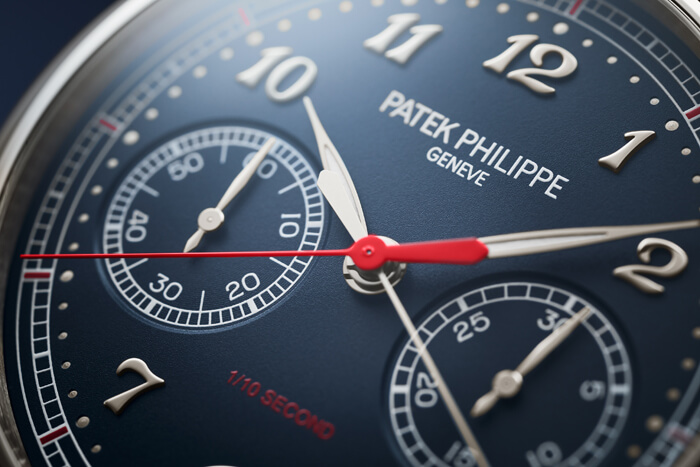
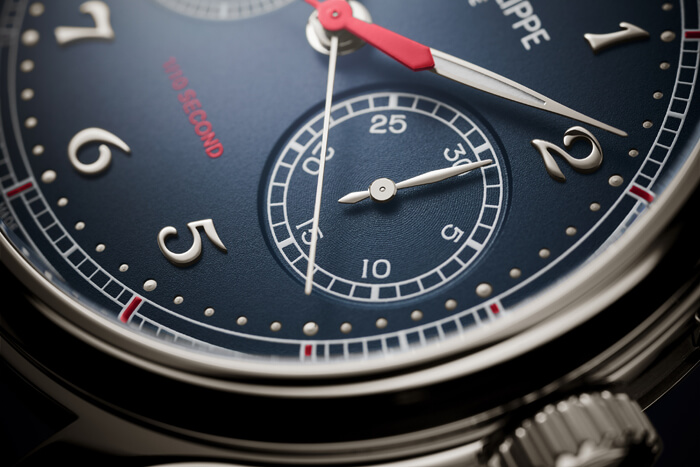
The engineers therefore conceived a patented system that displays the measured seconds and the fractions of a second concentrically. The watch features two sweep chronograph hands, each of them driven by an independent mechanism. The hand that performs a complete revolution per minute shows the stopped seconds in the traditional manner. The other hand (lacquered red in the new Ref. 5470P- 001) performs one revolution per 12 seconds, i.e. five times faster than an ordinary chronograph hand and sweeps across 12 sectors subdivided into tenths. In this way, the user can immediately read the elapsed seconds guided by the pearl markers and then, on the outer railway track scale, read the number of elapsed tenths of a second departing from the last red marker. The minutes of the short-time measurement are displayed by the instantaneous 30-minute counter on the subsidiary dial at 3 o’clock.
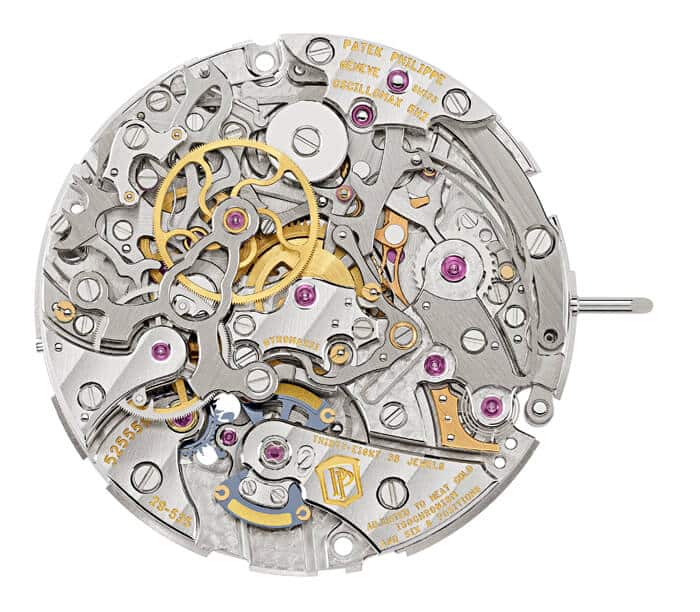
Given so much simplicity in use, the patented system’s heart is a true treasure chest of ingenious solutions in the movement but out of sight. As usual, Patek Philippe raised the bar and specified that the new caliber should meet ambitious requirements in every respect. The watch should not only be able to measure and display tenths of a second but also retain this precision during a 30-minute run of the chronograph. Additionally, the caliber CH 29-535 PS 1/10 had to be built as compactly as possible while retaining the diameter of the base caliber (29.6 mm) and allowing only a slight height increase (from 5.35 mm to 6.96 mm) – despite the two chronograph mechanisms and a total of 396 parts. As a true accomplishment in miniaturization, this new movement is even shorter than the rattrapante caliber CHR 29-535 PS (7.1 mm).
Energy control and high precision
The Patek Philippe Grand Complication thus created is as complex as a tourbillon, a minute repeater or a split-seconds chronograph. For the frequency of 5 Hz and the integration of a second chronograph mechanism with a high-speed hand, the new caliber CH 29-535 PS 1/10 requires considerably more energy. To master and limit this energy appetite, the engineers had to intervene at all nooks and crannies of the movement. And of course, the term “precision” dominated the entire development of the movement.
The challenge began with a single mainspring that was needed to provide energy for the whole movement. Patek Philippe reworked this component and increased its efficiency to preserve the amplitude of the balance spring as much as possible and to assure optimized rate stability. To increase the available energy and boost the power reserve, the diameter of the barrel arbor was reduced and the number of mainspring coils increased. A patented notch reduces the tension of the slip bridle during the winding process, thus eliminating the risk of damage due to the increased force.
A high-tech regulator mechanism
To handle the three challenges – efficiency, reliability, and rate accuracy – Patek Philippe decided to use its Oscillomax® ensemble that had been developed by the “Patek Philippe Advanced Research” department. This high-tech regulator mechanism was presented in 2011, was granted 17 patents, and has three innovative components that rely on all advantages of the Silinvar® technology – it is based on a derivative of silicon with extraordinary physical and mechanical characteristics (lightweight, rugged, antimagnetic, etc.). The ensemble operates with a Spiromax® balance spring with a patented terminal curve and an inner boss (patent granted in 2017, Ref. 5650), a Pulsomax® escapement consisting of a lever and escape wheel with extensively reworked geometries as well as a Gyromax® balance in Silinvar® with gold inlays. This is the first time since the launch of the perpetual calendar “Patek Philippe Advanced Research Ref. 5550P“ (2011) that Patek Philippe has added the Oscillomax® ensemble in its current collection. But this decision plays a decisive role for the exceptional performance of the new caliber CH 29-535 PS 1/10 movement. And it enables the high rate accuracy with a maximum deviation of -3/+2 seconds per day specified by the Patek Philippe Seal – despite the clearly higher energy consumption of the movement.
Fluid and perfectly synchronized hand movements
Another big challenge arose during the development of the caliber CH 29-535 PS 1/10 regarding the quality of the display, particularly of the tenths of a second. The two chronograph displays must be perfectly synchronized. Despite the high speed of rotation, the tenth-of-a-second hand must move fluidly without jumps or vibrations. Here, too, the manufacture’s engineers developed and implemented innovative solutions.
The mechanism for displaying the tenths of a second receives its energy via a driving wheel from the fourth wheel of the base movement. Patek Philippe designed the driving wheel in a novel two-part arrangement: the upper wheel with flexible spokes, the lower one with rigid spokes. Thanks to this patented anti-backlash principle that is both compact and energy-saving, the teeth of the driving wheel exert an elastic force on the clutch wheel, eliminating any risk of hand vibration.
As soon as the chronograph is started, the tenth-of-a-second driving wheel (with one revolution per minute) engages with the tenth-of-a-second pinion that performs one revolution in 12 seconds (turning five times faster). To enable this “acceleration”, Patek Philippe provided the tenth-of-a-second pinion with microtoothing: 136 teeth on a pinion diameter of 1.469 mm and with a tooth height of 30 μm. The pretensioning force exerted by the clutch wheel on the pinion suppresses tooth backlash. Many individual measures maximize the accuracy of the display.
A proven shock absorber
Another indispensable measure needed for a user-centric solution relates to the shock absorber. The new caliber CH 29-535 PS 1/10 had to handle all requirements and risks to which it would be exposed in daily use. For this purpose, Patek Philippe developed two patented mechanisms. One of them is a shock absorber hook that would secure the clutch rocker during the entire short-time measurement process. The second one uses the “unbalances” (centres of gravity, not to be confused with centres of rotation) of components of the mechanism for the tenths-of-a-second chronograph. In the event of a shock, the acceleration values of the components exposed to it are compensated instead of being cumulated. The result is that all components remain in the desired positions, eliminating any impact on the correct function of the watch.
A monopusher chronograph
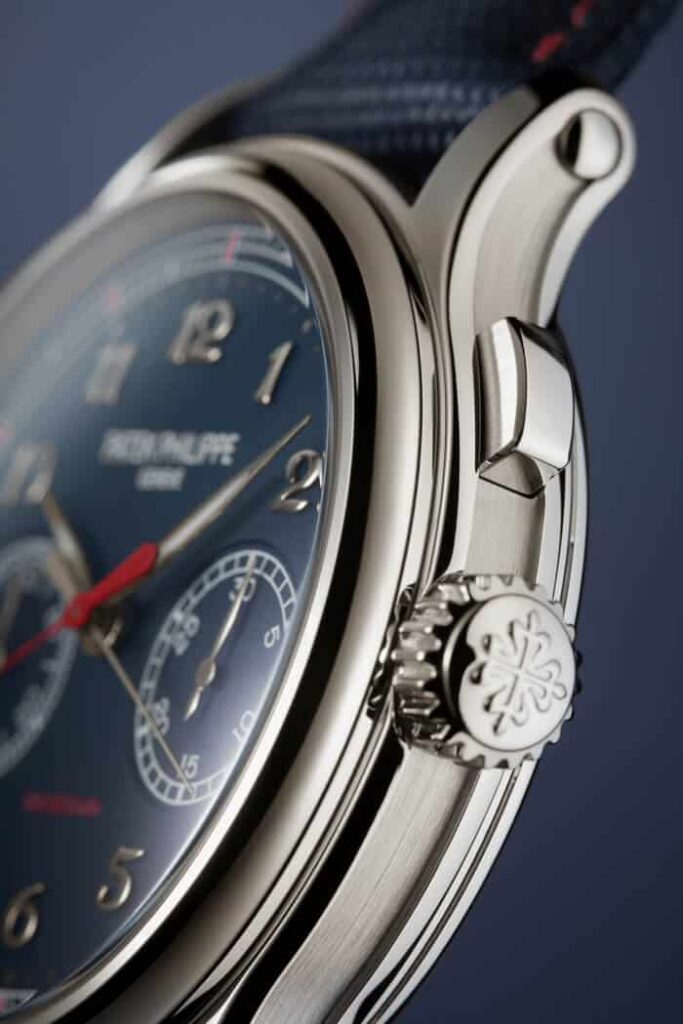
The last notable feature: The chronograph has a single pusher at 2 o’clock that successively executes the start, stop, and reset commands. This monopusher arrangement recalls the classic chronographs and will delight the aficionados of technical timepieces. In addition to the patented special features of the caliber CH 29-535 PS 1/10, the new watch embodies the seamless pairing of tradition and innovation that constitutes the core of the Patek philosophy.
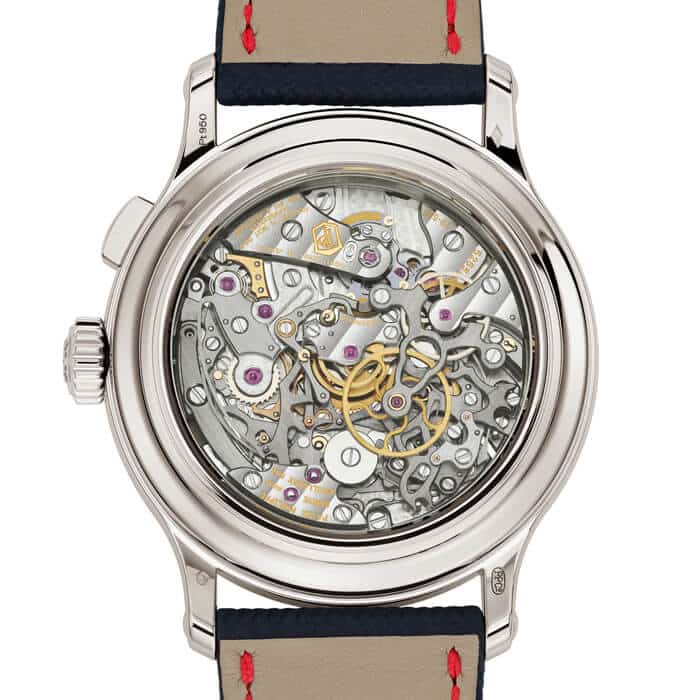
The sapphire-crystal case back (interchangeable with the solid platinum back delivered with the watch) affords a spectacular view of the caliber CH 29-535 PS 1/10 with its filigreed components and the elaborately executed finissage (bridges with chamfered and polished edges, Geneva striping, etc.). The engraved, gilt inscriptions “Oscillomax 5 Hz” and “GyromaxSi” on the bridges refer to the innovative movement components.

A resolutely sporty style
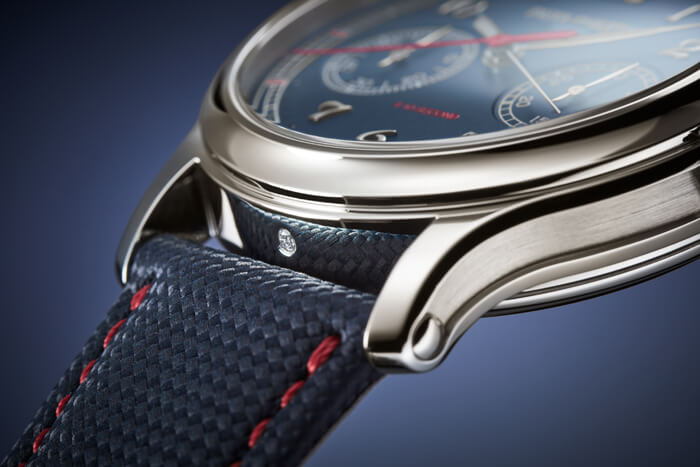
A movement dedicated entirely to performance and short-time measurements needs to be well protected so Patek Philippe created an inimitably sporty exterior. To case this condensate of technical prowess, the manufacture chose platinum, the most precious metal but also the most difficult one to machine. The gently rounded case has the same design as the manually wound Ref. 5370 Split Seconds Chronograph launched in 2015. As a special feature, it has a concave bezel that forms a perfect transition to the slightly domed sapphire-crystal glass The case flanks are slightly recessed and satin-finished, the lugs are subtly curved and feature decorative cabochons at the ends of the spring bars. Like all of Patek Philippe’s platinum models, the Ref. 5470P-001 is adorned with a flawless brilliant-cut diamond between the lugs at 6 o’clock.
The elegant blue of the dial harmonizes exceptionally well with the shimmering reflections of the platinum case, at the same time offering the perfect contrast for the crisp legibility of the individual displays. The chronograph seconds are indicated with a sandblasted and rhodiumed steel hand on a minute scale with small gold pearls. The tenths of a second are displayed with a slender hand in Silinvar®. Because it is so lightweight, the high-tech material saves energy but has the rigidity needed to withstand the shock that occurs when the chronograph is abruptly stopped. Thanks to a new patented process for decorating the Silinvar® hand, in this case lacquered red, and a second patent concerning the attachment of the pipe to the Silinvar® hand by brazing, Patek Philippe succeeded for the first time in using the promising material for external features of a watch. The red colour of the hand is also echoed on the markers of the railway-track scale for reading tenths of a second. As long as the chronograph is not operating, the red and grey chronograph hands are superposed and look like a single hand. Once a short-time measurement has been started with the pusher at 2 o’clock, it launches its fascinating ballet with two separate rotation speeds. The instantaneous 30-minute counter at 3 o’clock and the small seconds at 9 o’clock have crisp railway-track scales to improve the legibility of the respective information.
The new 5470P-001 is worn on a navy blue calfskin strap with an embossed fabric pattern and red decorative seams in perfect harmony with the colours of the dial. Its fold-over clasp in platinum assures comfort and safety on the wrist.