
Pequignet Royale Paris Coral Dial
The Pequignet Royale Paris Coral Dial is the latest expression of Haute Horlogerie to emanate from Morteau, France. Executed in a particularly eye-catching hue, the dial of this new model features a small seconds display and a power-reserve indicator. US-based Meehna Goldsmith provides a fascinating insight into this French alternative to fine Swiss watchmaking.
French watchmaking
Bistros, beignets and berets. Mention those words and France immediately comes to mind. But watches? La Belle France isn’t usually the country that collectors think of when dreaming of horology. Pequignet intends to change that.
For over two centuries, the Swiss have dominated the watchmaking conversation, but France has a formidable history as a horological powerhouse as well. In 1775, Abraham-Louis Breguet set up shop in Paris, where three Kings Louis (XIV, XV and XVI), along with Marie Antoinette, commissioned pieces from the master. In addition to Breguet, Ferdinand Berthoud and Julien Le Roy, again located in France, were also tinkering away at their workbenches. Berthoud made great advancements with marine chronometers, fusee-and-chain systems and detent escapement refinements, while Le Roy made his mark improving temperature compensation of balances, innovating lubrication techniques and refining the cylindrical and recoil escapements for better precision.
Although you might not have heard of the brand, Pequignet isn’t a newcomer on the block. It was established in 1973 by Emile Péquignet in Morteau, France, a picture-perfect town in the Jura, close to the Swiss border. Think of it as a below-the-radar gem waiting to be discovered.
Pequignet wasn’t officially trained as a watchmaker. He was an autodidact who began his career as a craftsman in the 1960s, building his brand around the ideals of combining beautiful design with technical innovation. In the 1970s, the quartz crisis decimated the industry, leading to the shuttering of many Swiss and French watchmakers. Pequignet survived the upheaval as an independent, continuing to produce French timepieces into the early 21st century.
‘In the 2000s’, Emile Péquignet sold the brand to Didier Leibundgut, who hailed from a Jura watchmaking family. Leibundgut invested a lot of resources into the company, making it a true Manufacture, culminating in the opening of the Haute Horlogerie lab in 2008. By 2010, the Pequignet manufacture was established, followed shortly after by the launch of the Pequignet Calibre Royal in 2011. The Calibre Royal was a very big deal because it was the first fully French in-house movement in decades.
Pequignet Calibre Royal
The original Calibre Royal was no basic engine, it was the first French-made movement to integrate all complications on the same plate. In many instances, complications are built as modules, positioned atop a base calibre. It’s a lot less expensive to develop a base calibre and then bolt on aftermarket functions to expand model references. For example, a time-only watch can be turned into a chronograph with the addition of a chronograph module sourced from another company. However, sometimes the transformation can be a bit awkward and inelegant.
From the start, the Calibre Royal, which debuted in the Rue Royale, was conceived and produced as a fully integrated big date, day, moonphase, power reserve and small seconds model. It presented these functions on the dial with all the harmonious architecture and symmetry the French are known for. The movement displayed technical elegance with its double large date and day aperture with instant jump on the same axis, which allowed adjustments during any time without the risk of damaging the mechanism.
The original Calibre Royal also incorporated a bidirectional winding system that fuelled a single large barrel with a prodigious 88-hour power reserve on tap. In keeping with Haute Horlogerie, the movement offered such traditional finishing techniques as colimaçonnage, perlage and Côtes de Genève. A fleur de lys, featured on the rotor, ultimately became Pequignet’s emblem. This wasn’t just any other movement, it was a French movement with the symbolism setting it apart from its Swiss counterparts.
Pequignet Royale Paris
Not long after the Rue Royale’s debut, Pequignet revealed the Royale Paris. Housed in a 41 mm case, the Royale Paris also featured the Calibre Royal under the hood, but leaned more into the dress watch vibe with its power reserve and small seconds or moonphase editions. It offered a simplified yet sophisticated staging of the movement.
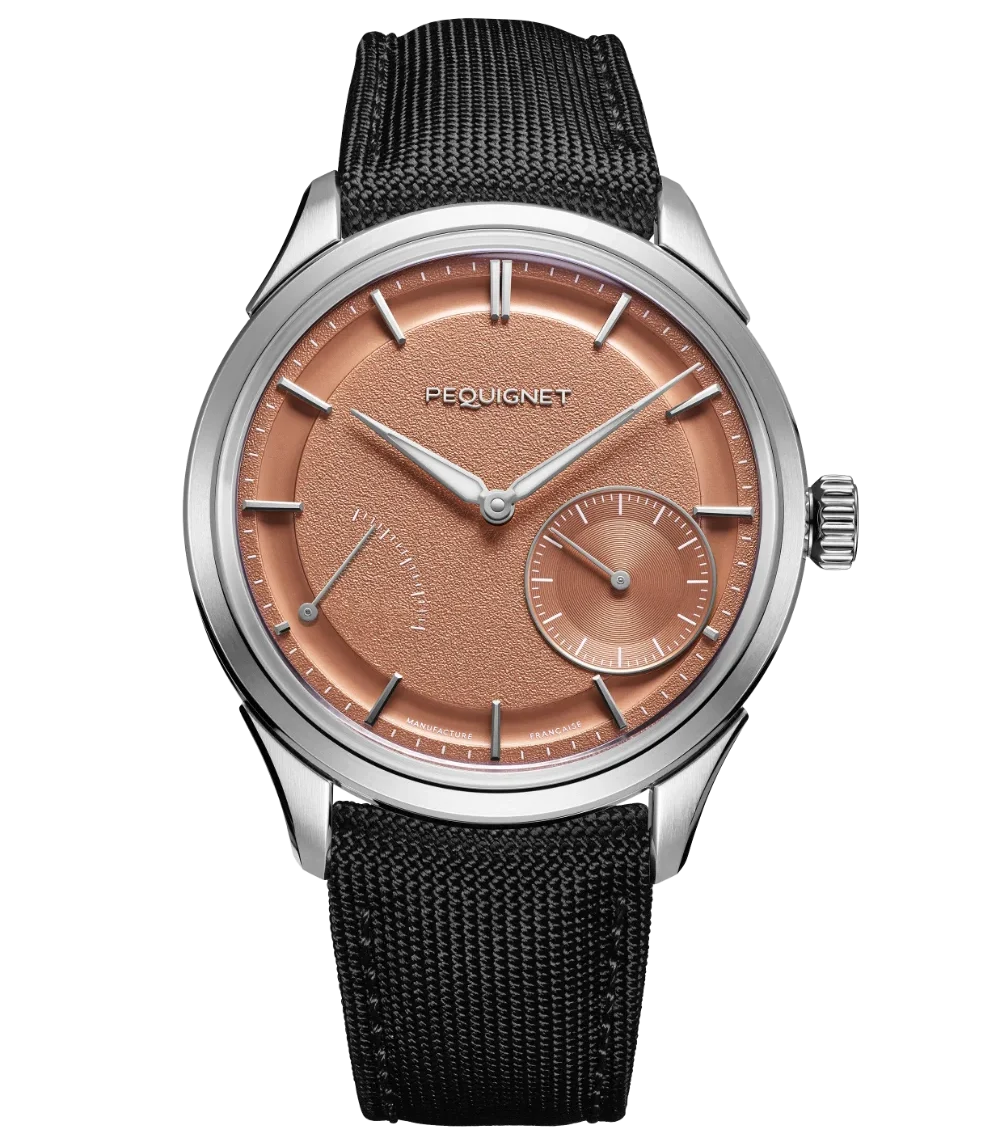
Pequignet Royale Paris Coral Dial
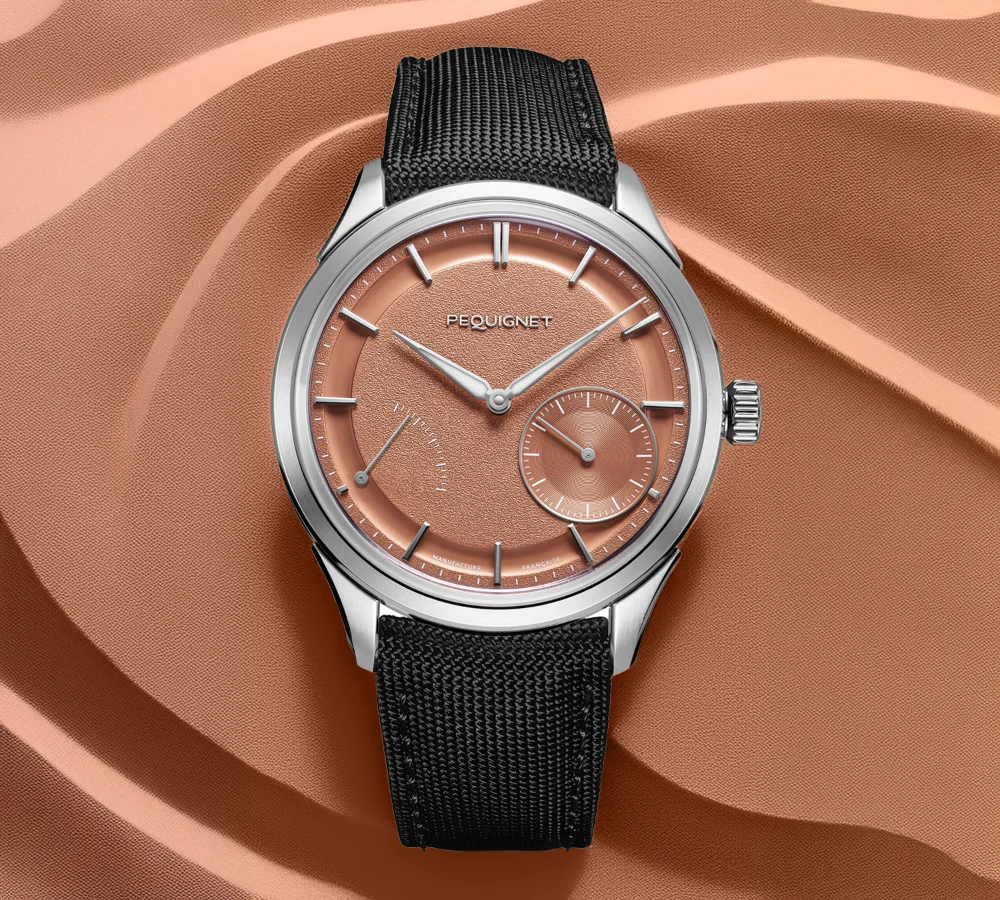
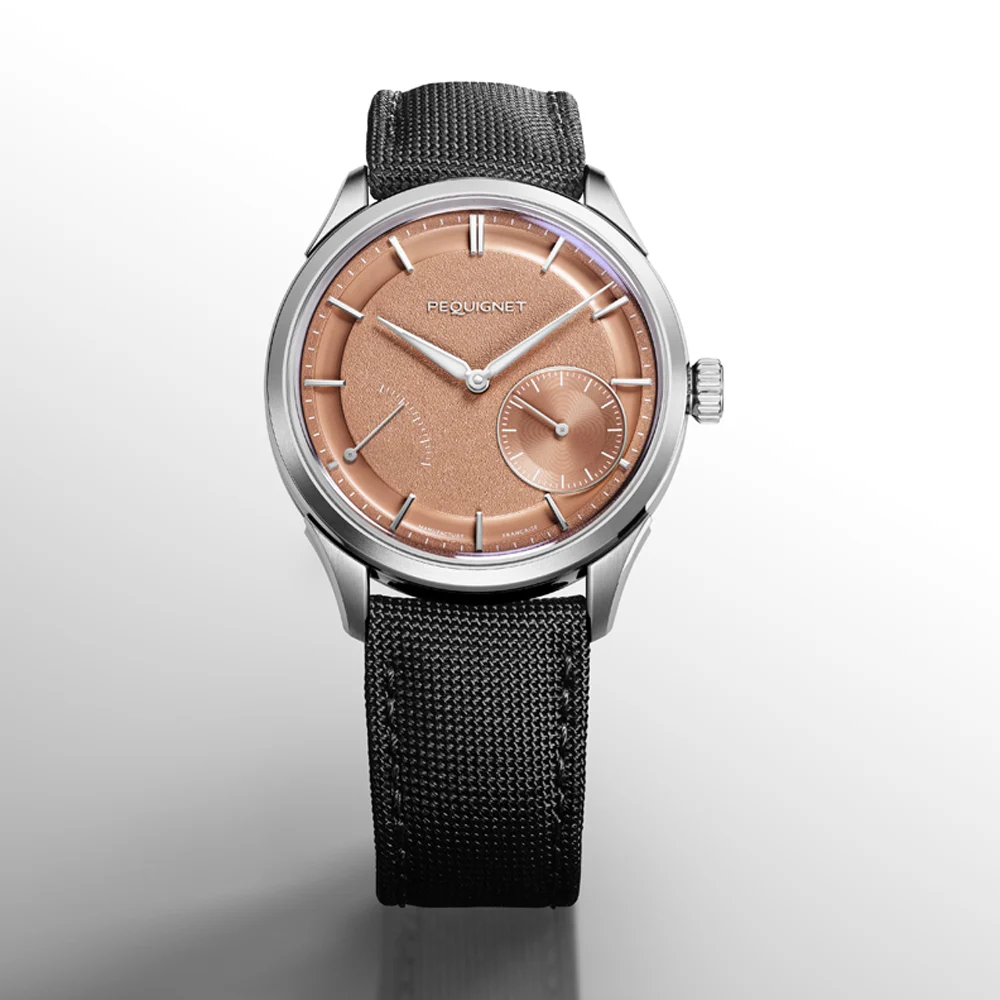
At Watches and Wonders 2025, Pequignet revisited the Royale Paris collection with the introduction of a slimmed down 39.5 mm case to appeal to modern tastes. Let’s visit the Royale Paris with a Coral dial, the newest colour addition to the line. This elegant execution offers a power reserve and small seconds, located between 7 and 9 o’clock and 3 and 5 o’clock, respectively. What I love about this configuration is that the expression of functionality in the indicators is integral to the portrait. From afar, the dial reads more like design than pure engineering.
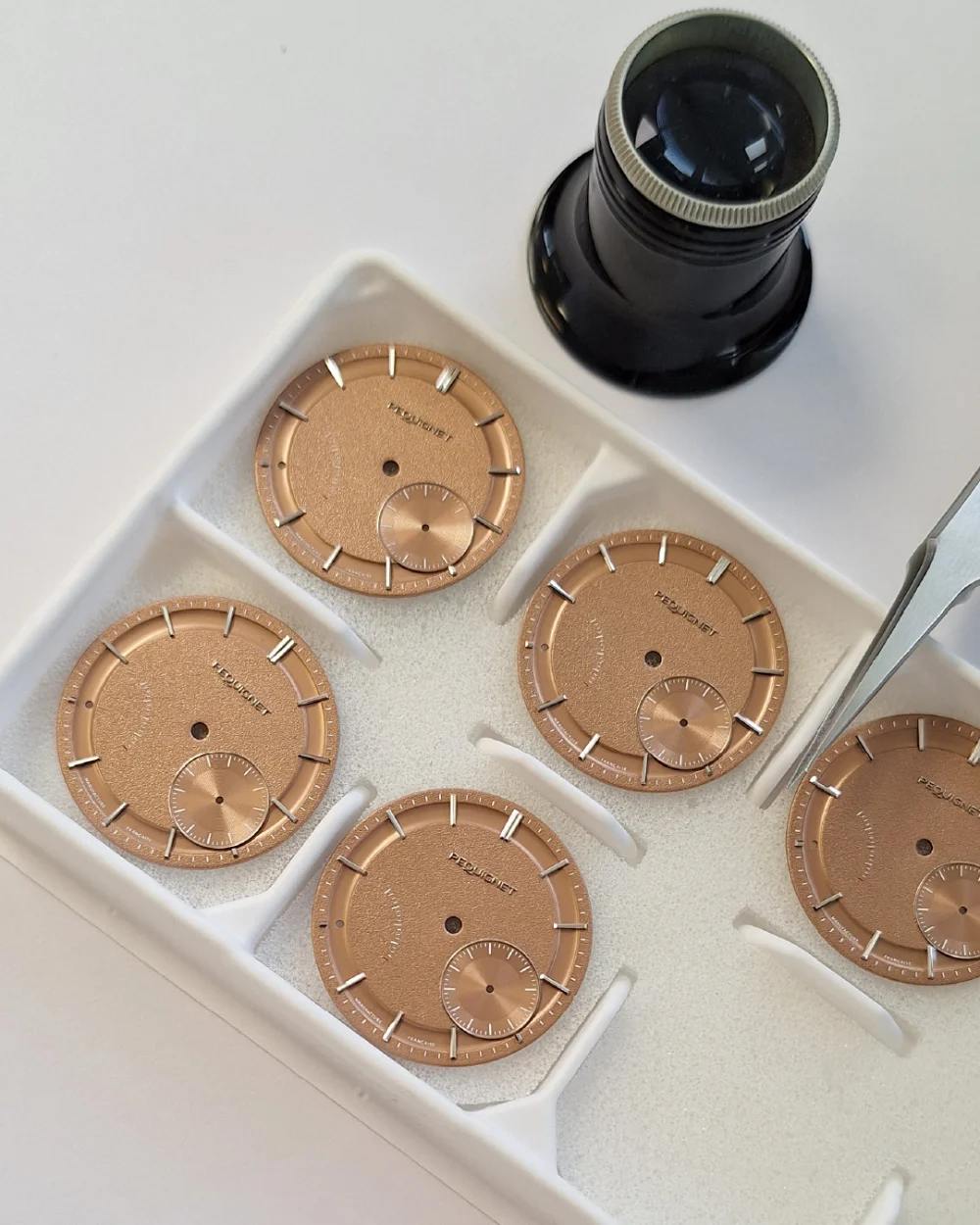
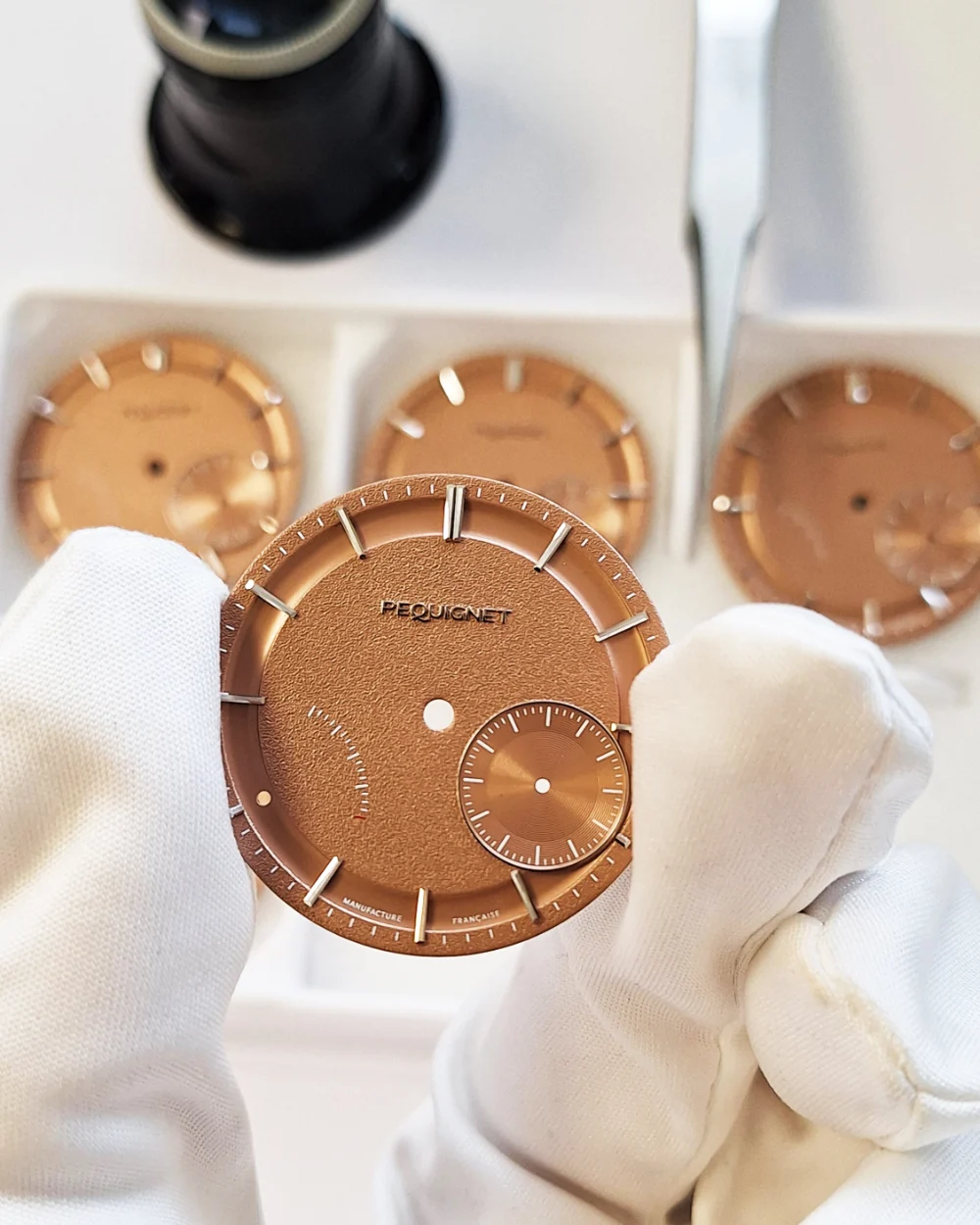
The dial of this Royale Paris Coral is wonderfully textured with marked grains that have been made using a gouge (a small curved chisel or milling bit), imbuing the display with a sumptuous tactile French design signature. The bevelled indices and small-seconds flange have polished and satin-finished surfaces that play with light, while the polished steel hour and minutes hands are filled with blue Super-LumiNova, an intriguing addition for a dress watch. The seconds and power reserve hands are also composed of polished steel. The composition is framed in a stainless steel polished and satin-finished 39.5 mm case, which has the emblematic fleur de lys logo embossed on the crown. To secure the Royale Paris Coral to the wrist is an interchangeable Black Cordura strap with a steel folding clasp.
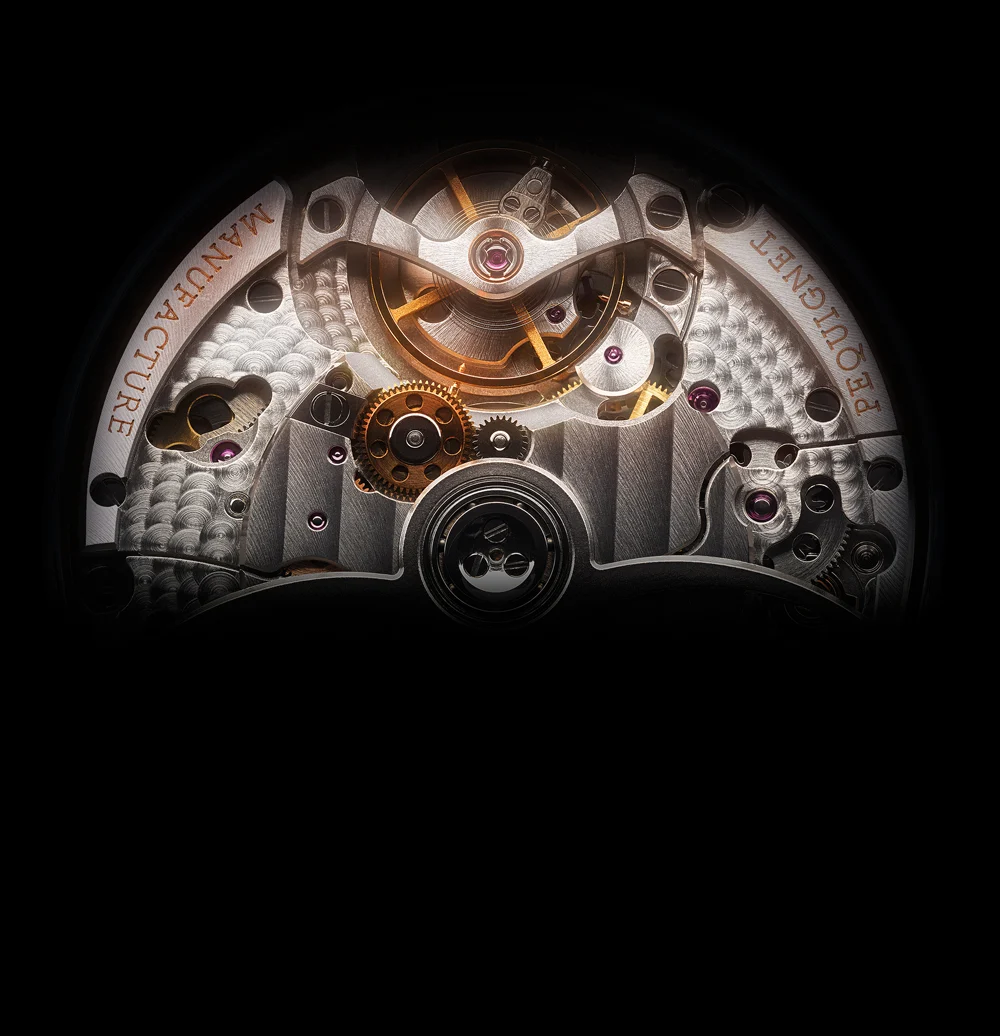
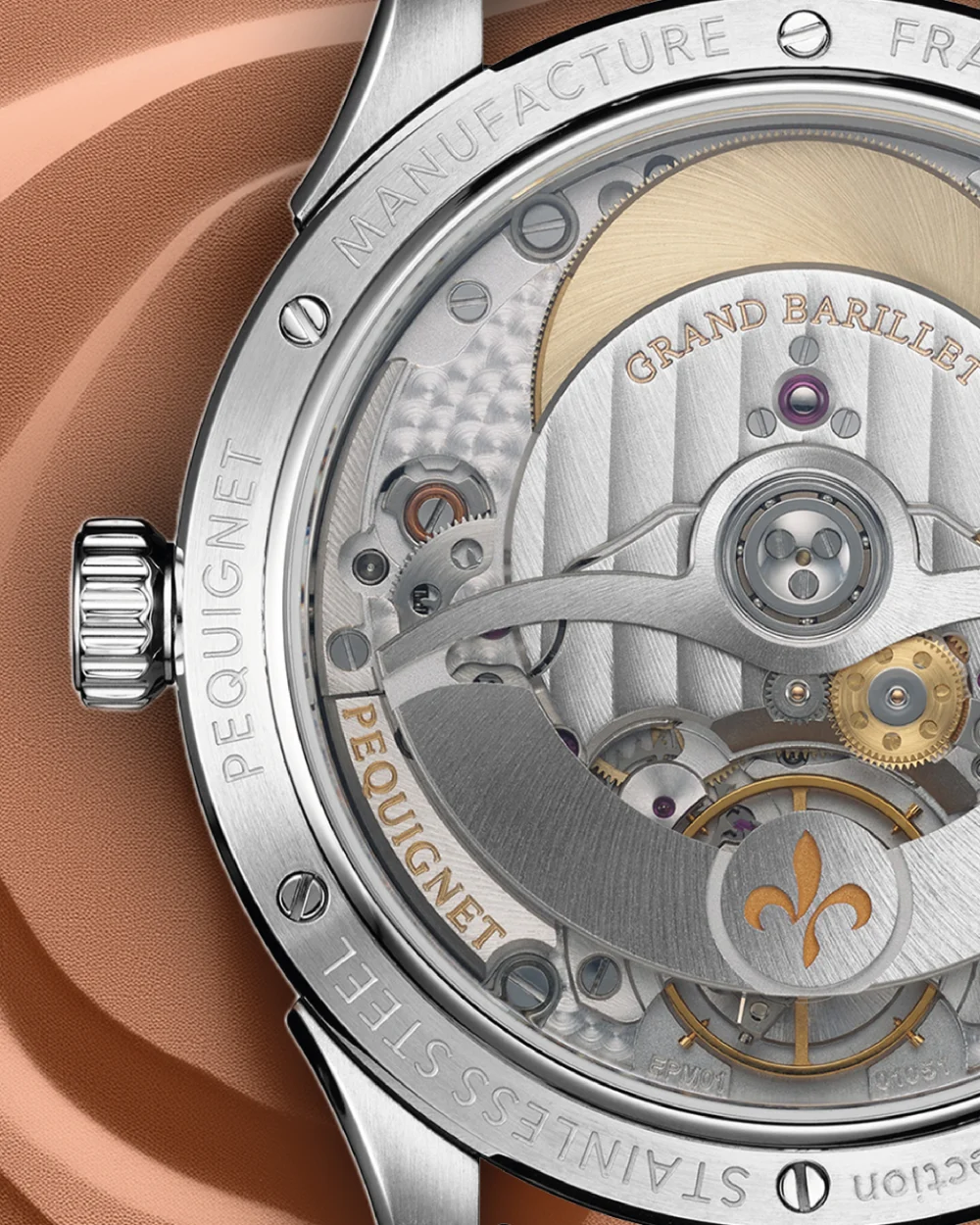
Through the transparent sapphire caseback, the latest version of the Calibre Royal is on view. You’ll see the large balance with compensating screws, along with the rhodium-plated oscillating weight with sunray motif that also bears the fleur de lys emblem. The choice to use a variable-inertia balance instead of an index-regulated balance demonstrates that no shortcuts were taken in the movement’s execution. With this new iteration, the power reserve has climbed even higher to give a full 96 hours of autonomous running time when fully wound.
Closing remarks
Bistros, beignets and berets may always be the calling cards of France, but this new Pequignet Royale Paris Coral adds another to the itinerary – and this one keeps perfect time.
Further reading
Technical specification
- Model: Pequignet Royale Paris Coral Dial
- Reference: 9100123
- Case: stainless steel, diameter 39.5 mm, water resistance 5 ATM (50 metres), sapphire crystal to front, exhibition caseback.
- Functions: hours, minutes, small seconds, power-reserve indicator
- Movement: Calibre Royal, self-winding movement, frequency 21,600 vph (3 Hz), 39 jewels, power reserve 96 hours
- Strap – black Cordura with a steel folding clasp
- Price – €5,300 (RRP as of 12.9.2025)