
Piaget Polo Skeleton
The Piaget Polo Skeleton is the latest watch from the multi-talented brand synonymous with crafting ultra-thin movements, skeleton watches and resplendent Haute Joaillerie creations.

Established in 1874, Piaget began life as a movement specialist, however, in 1943, the Maison took the bold step of transitioning into watchmaking. Perhaps the most significant landmark in the firm’s history relates to the release of its Calibre 9P in 1957. This ultra-thin, hand-wound movement measured a mere 2mm in height. Just three years later, the Swiss marque released the Calibre 12P, the world’s thinnest self-winding movement with a thickness of just 2.3mm. Over the years, the firm has released a plethora of ultra-thin calibres and it is very much at the vanguard of this horological genre.
However, the Swiss watch brand also has other talents. It is a leading name in Haute Joaillerie timepieces and it has been very active making skeleton watches since the mid-1970s. In 2012, Piaget unveiled the Calibre 1200S, a self-winding skeleton movement featuring a micro-rotor. One-year later, a gem-set version of the movement, the Calibre 1200D, was launched. Both of these movements were housed in the brand’s supremely elegant Altiplano case.
Now, the prestigious firm has just unveiled the Piaget Polo Skeleton, equipped with an evolution of the Calibre 1200S, the Calibre 1200S1. The Polo has always been known for its sporty-chic styling, but now the model’s allure is heightened further, courtesy of its ultra-thin waistline and open-worked movement. The case height measures a svelte 6.5mm, while the open-worked mainplate confers a diaphanous appearance.
To create its slender, open-worked specification, Piaget had to overcome various technical challenges. For instance, the case was made 30% thinner than previous versions of the Polo. Furthermore, due consideration had to be made regarding the torsional rigidity of the movement in order to ensure there is no unwanted flex.
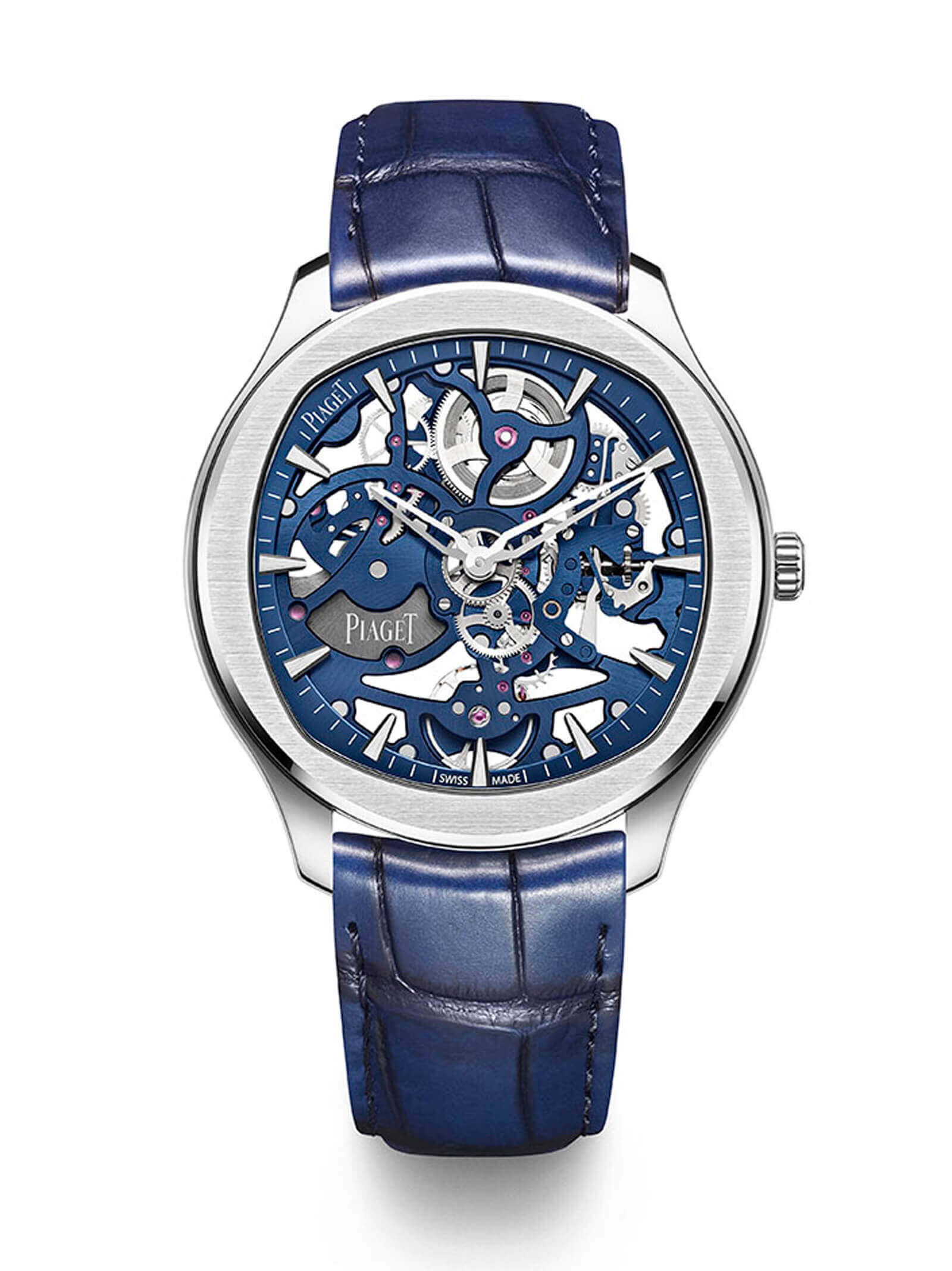
While this is a new addition to the Polo family, it continues to uphold the much-loved design codes, including the curved case, round bezel and cushion-shaped dial opening. The Piaget Polo Skeleton is available in two variants, one version with a slate grey skeleton dial and a second with a movement dressed in blue PVD. Both variants are presented in a steel case.
Prices from £26,500 (RRP as at 5.2.2021)
The brand’s press release
All-new look for Piaget’s famous luxury sports watch
There are few finer expressions of horological art than that of ‘skeletonisation’ – the intricate reduction of dials and movements to their bare minimum in order to reveal the true, beating heart of a watch in all its mechanical glory.
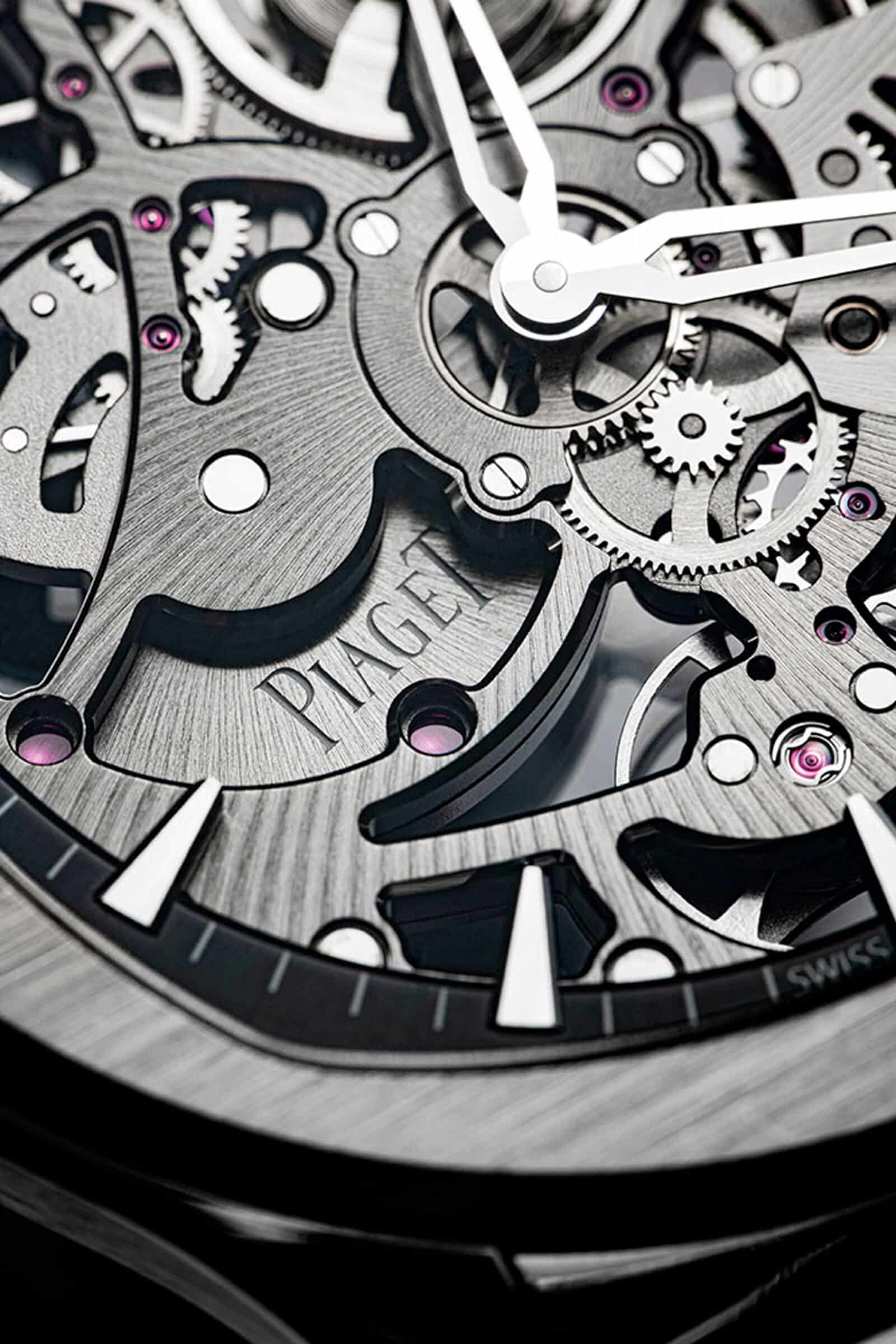
Creating a skeleton watch requires vision, confidence, time and the considerable skill and experience of numerous specialists in order to combine exceptional aesthetics with dependable functionality – and it is a genre for which Piaget has been renowned for half a century.
Loved by the stars
The first Piaget skeleton watches were made during the 1970s and, as with many of the Maison’s creations, they immediately attracted a high-profile following.
One of the most noted early adopters was the jazz trumpet legend Miles Davis who always turned-up to appearances with a briefcase containing a selection of timepieces, including Piaget watches, choosing his ‘watch of the night’ just before he took to the stage.
And fittingly for a man known for the intricacy and innovation of his playing, a gold Piaget skeleton could often be seen on his wrist during major performances.
Ultra-thin Skeleton
And since Piaget has long been renowned for creating mechanisms of exceptional slimness, it set-out to marry its two signature disciplines by developing calibres that were both exquisitely thin and meticulously skeletonised, setting multiple records along the way by unveiling the thinnest skeleton movements the world had ever seen, variously incorporating tourbillons, moonphase displays, exquisite enamelling, diamond settings and automatic winding.
Another Skeleton first
And now Piaget is delighted to announce its latest adventure in skeleton watchmaking: A fully skeletonised version of its celebrated Piaget Polo, the groundbreaking luxury sports watch created by Piaget in 1979.
In order to successfully develop the Piaget Polo Skeleton, Piaget’s designers and engineers had to consider the key aspects of the Piaget Polo that have made it instantly recognizable – notably its curved case surmounted by a round bezel, its cushion-shaped dial opening and its slim profile.
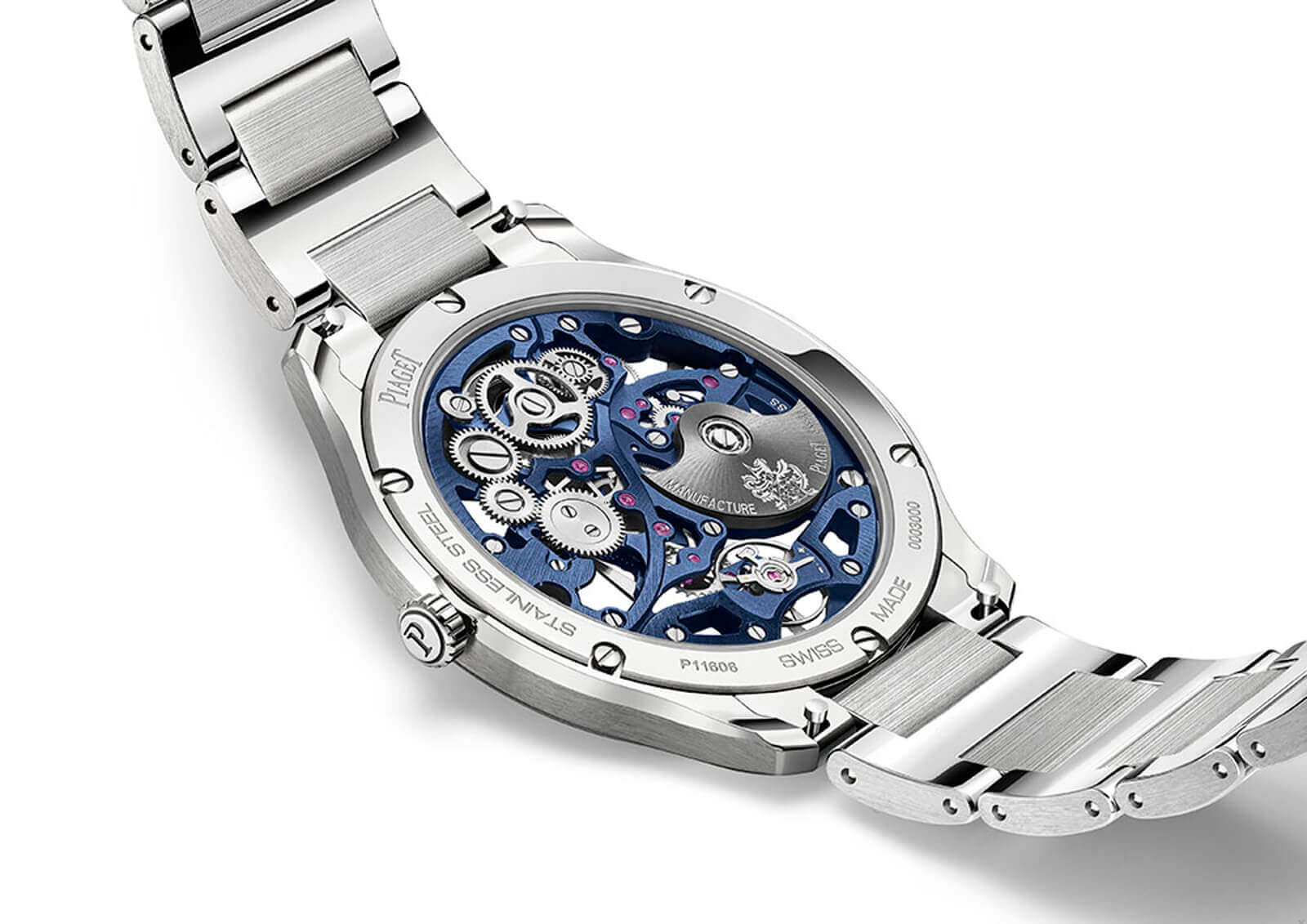
But perfecting the Polo Skeleton required a case to be created that was a remarkable 30 percent thinner than existing versions, and an evolution of the Piaget 1200S self-winding skeleton movement powered by an off-centre micro-rotor engraved with Piaget coat of arms.

The challenge was to maintain the bold and unmistakable look that gives the Piaget Polo its strong personality while simultaneously achieving an unprecedented combination of elegance, usability and comfort through the thinnest case ever seen on the model.
AND THE RESULT? Nothing short of a wearable work of art – a 42mm steel-cased sports watch measuring just 6.5mm thick and powered by Piaget’s 1200S1 self-winding, manufacture movement – entirely developed and produced in-house – which is a wafer-like 2.4mm thin.
Despite the intricate appearance of the pared-down components, the Polo Skeleton remains just as robust, reliable and practical as the other models, featuring 44 hours of power reserve and water resistance down to three atmospheres.
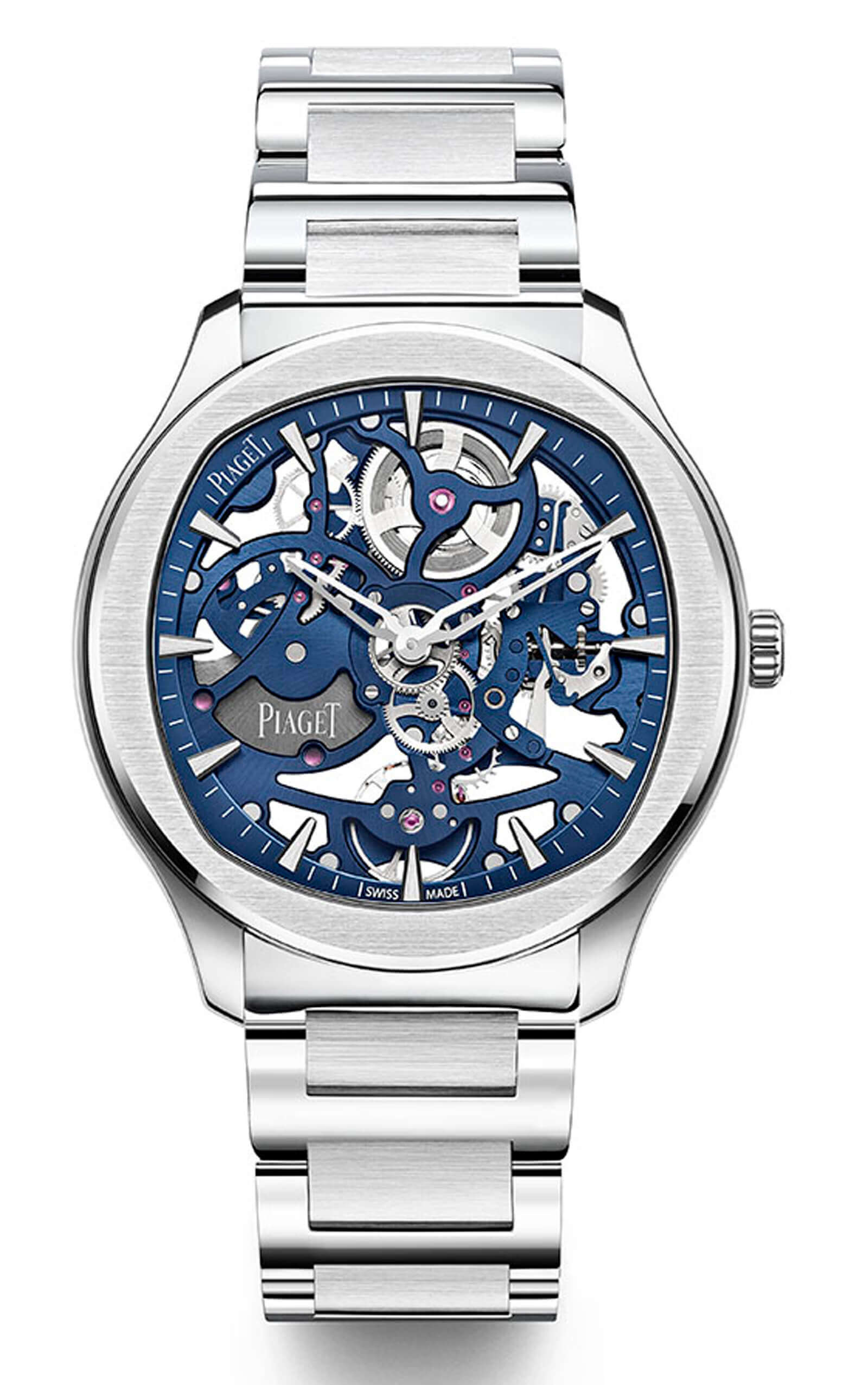
Additionally, the polished and satin-finished ‘H’ design integrated bracelet that has become synonymous with the Piaget Polo has also been revised in order to provide an in- interchangeable function.
This enables it to be swapped effortlessly for the additional interchangeable leather strap supplied with each watch, adding to its versatility and lending an extra dimension to the Piaget Polo Skeleton’s already distinctive character.
Piaget Polo Skeleton – One watch, two styles
The new Piaget Polo Skeleton is available in two highly individual designs – the first with a movement in Piaget Blue PVD, the second in a slate grey finish. In each version, the famous Piaget Polo case has been reduced to a mere 6.5mm thick (almost 3mm slimmer) while the intricately skeletonised movement and even the hands themselves have been pared-down for the ultimate in transparency.
A clear sapphire crystal case back, meanwhile, allows the meticulously finished and highly detailed movement to be seen and appreciated from both sides of the watch.
Further reading