
Renaud Tixier Monday Organica by Ateliers Olivier Vaucher Watch Review
The Renaud Tixier Monday Organica by Ateliers Olivier Vaucher unites mechanical ingenuity, peerless finishing and extraordinary artisanal craftsmanship. Recently, Mark McArthur-Christie travelled to Geneva and viewed first-hand the model’s grand feu enamel dial, exquisite case and sublime movement.
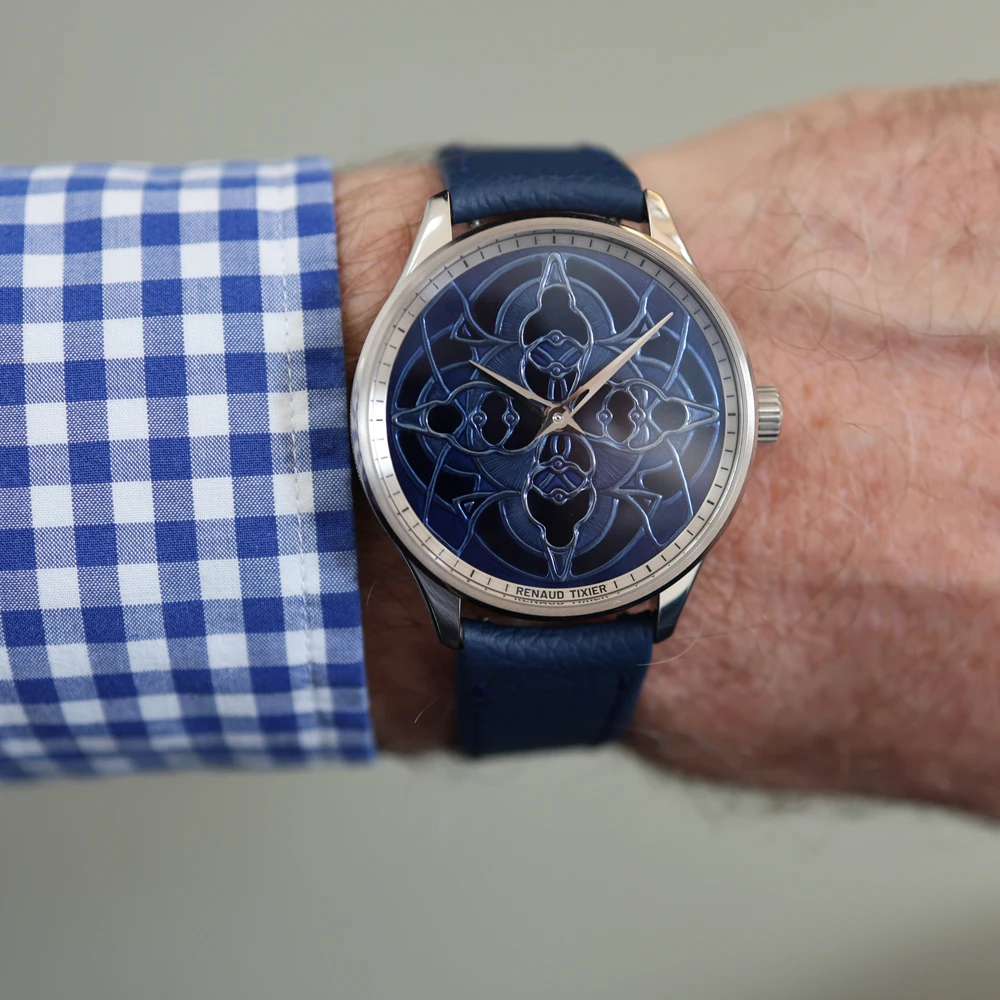
Renaud Tixier – extraordinary watchmaking
If you were planning on putting together a Watchworld rockstar power trio, it’s hard to imagine a better choice than Dominique Renaud and Julien Tixier on movement with Olivier Vaucher of Ateliers Olivier Vaucher on dial. It’s basically The Police, but with a lot less histrionics and more Vallée de Joux.

Image – Olivier Vaucher (left) and Dominique Renaud (right)
Renaud Tixier Monday Organica by Ateliers Olivier Vaucher – introduction
Renaud and Tixier have been working together since 2018, with Vaucher and his team joining for a collaboration last year. Back in late 2025, the three men and their colleagues sent the result of their labours, the Monday Organica, off the bench and out into the world.
It’s one of those rare watches that has as much artistry and craft on the dial as behind it. That said, it’s confident enough not to be shouty; if anything, its appearance understates the decades of experience that have gone into conceiving, designing and producing it.
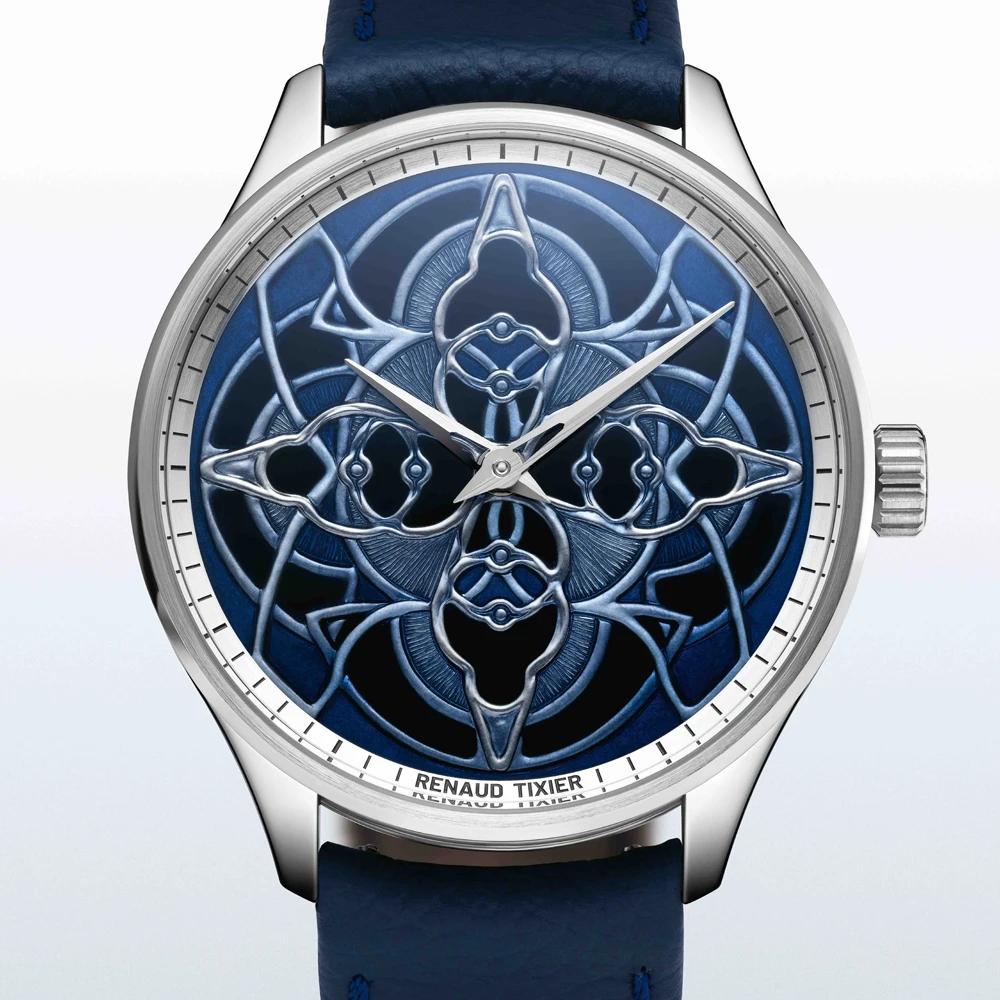
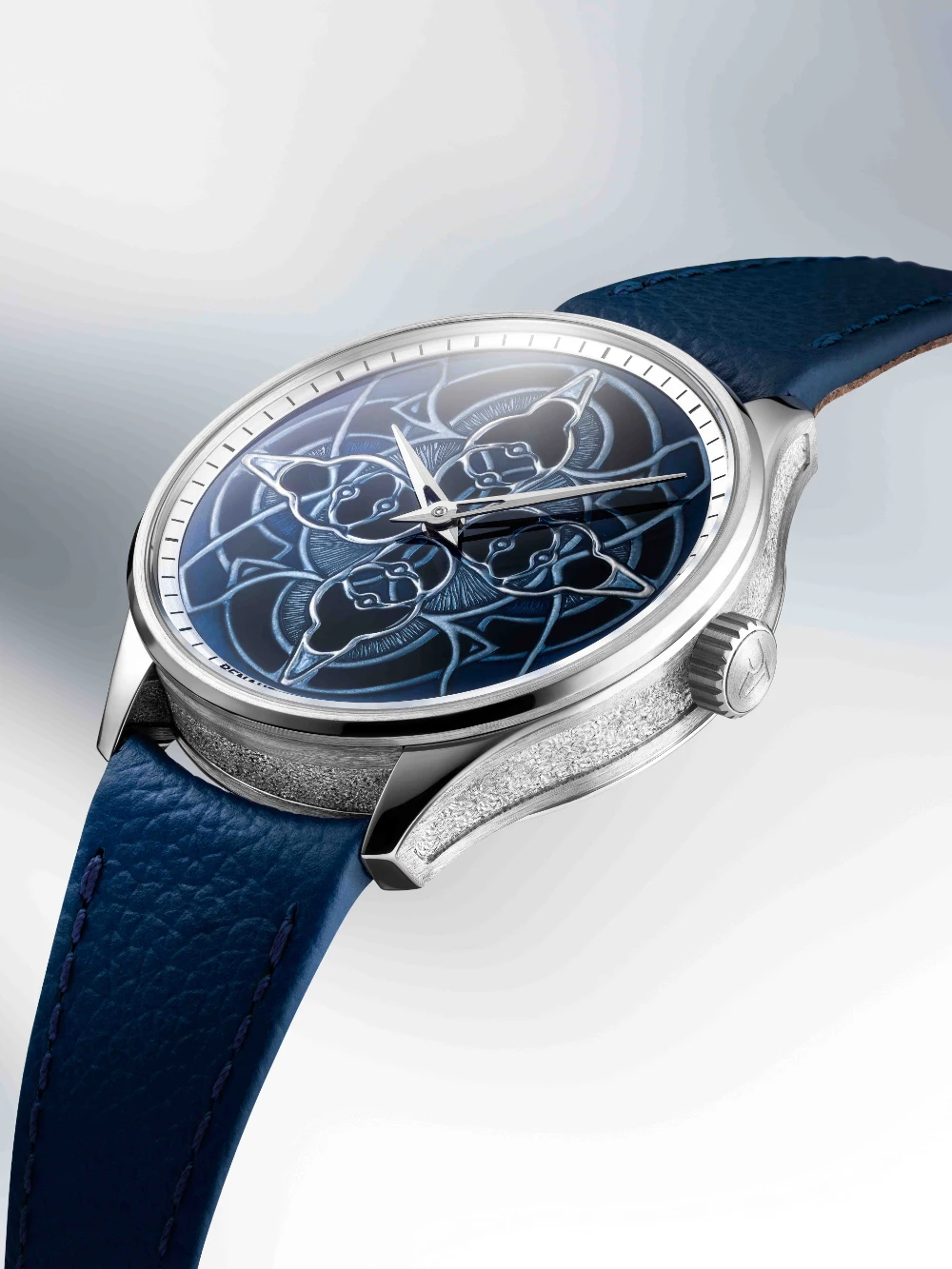
The first Renaud Tixier Monday was launched at Watches and Wonders in 2024. The movement and case of the new Organica are the same; the difference is all in the dial. The ‘original’ Monday had a simple, grained dial, in either petrol blue or racing green, with faceted, applied indices and an open-worked small seconds. In contrast, the Organica’s dial is solid, with translucent blue enamel over a hand-engraved surface.
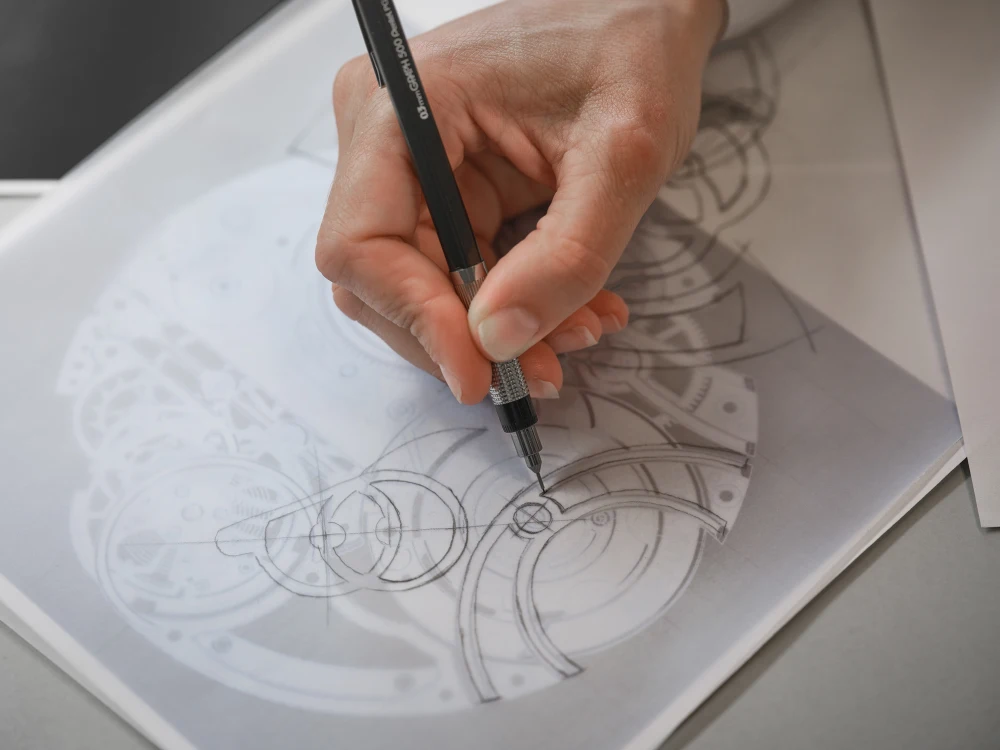
The dial design itself picks up the arcs and details of the movement bridges, linking the two sides of the watch.
Renaud Tixier Monday Organica by Ateliers Olivier Vaucher – dial
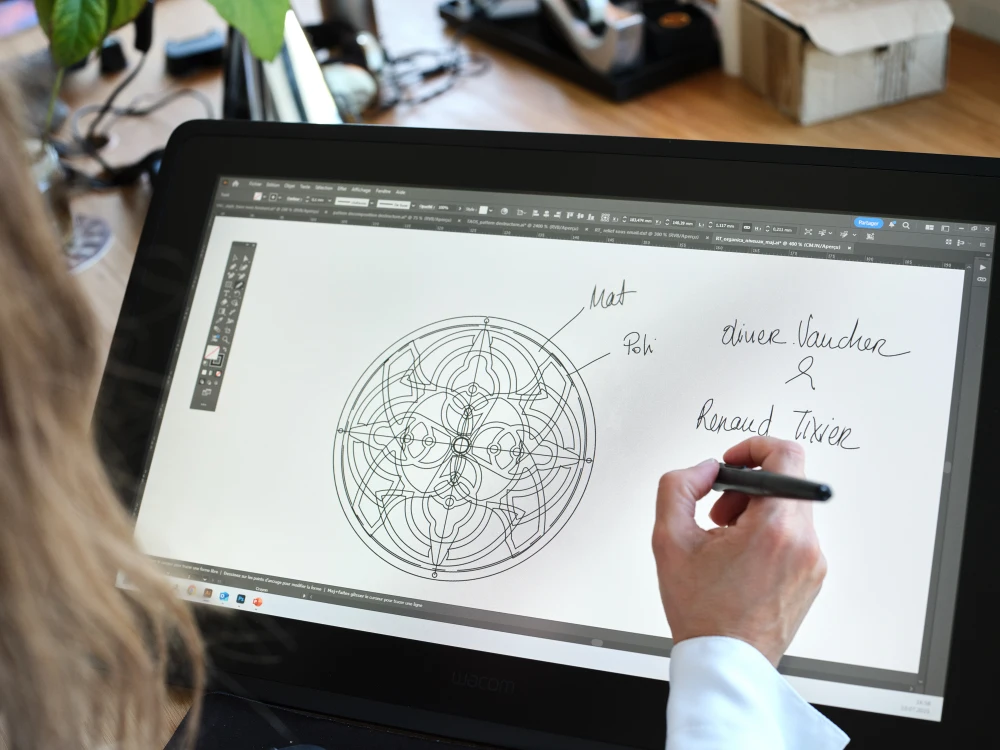
This is all the work of Olivier and Dominique Vaucher and their team at Geneva’s Rue de Bourgogne. If you’re fortunate enough to visit, you might be surprised by what you find. The atelier feels more like a cross between an ad agency and a laboratory than a dial workshop, with its abundant light, airy space and walls full of original art. And the firm doesn’t just produce enamelling – there are 20 trades all working together in five areas plus an R&D function.
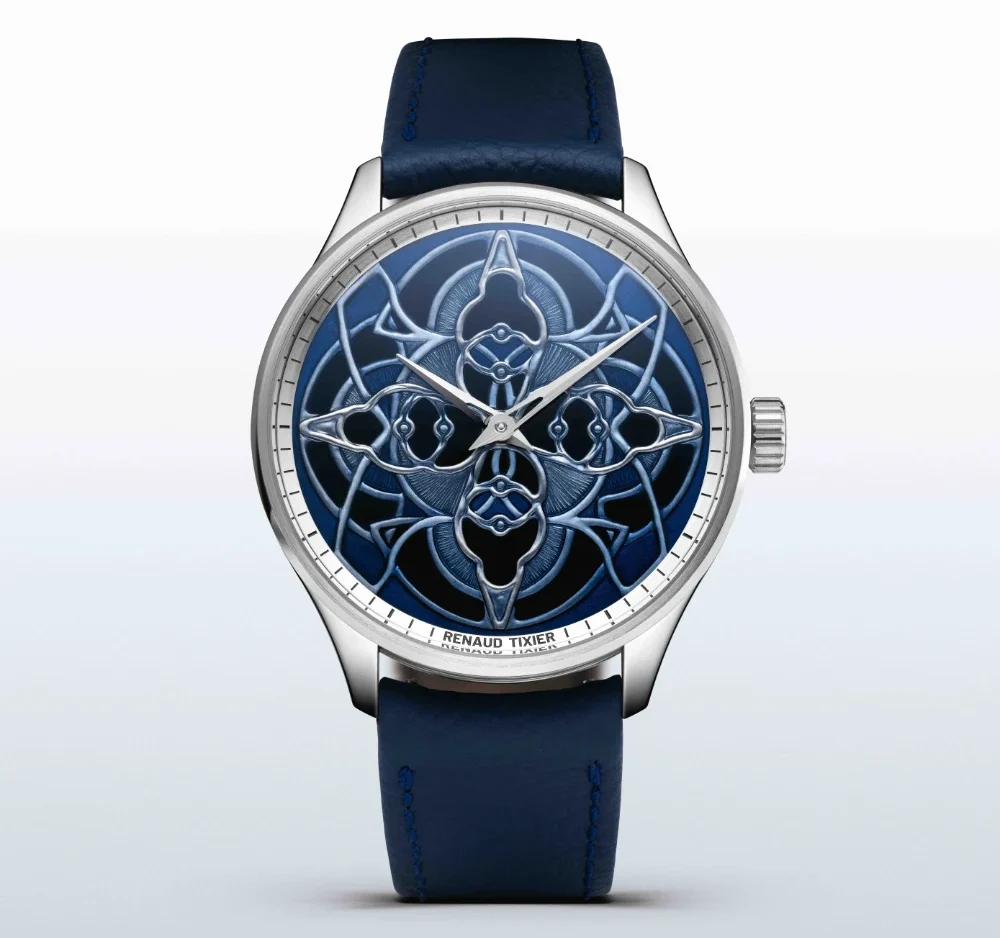
Your correspondent has extensive practical experience of enamelling… OK, that’s a lie – I did a bit of enamelling in O level metalwork lessons, and the only thing I learned was how to swear when yet another piece cracked in the kiln. Armed with this detailed, expert knowledge, I asked Commercial Director, Maud Aeberli, how many attempts it took to produce a grand feu dial like this one. She looked a little puzzled, smiled and then patiently explained that it took just one; their craftspeople hadn’t found it a problem. It seems a little knowledge is indeed a dangerous thing.
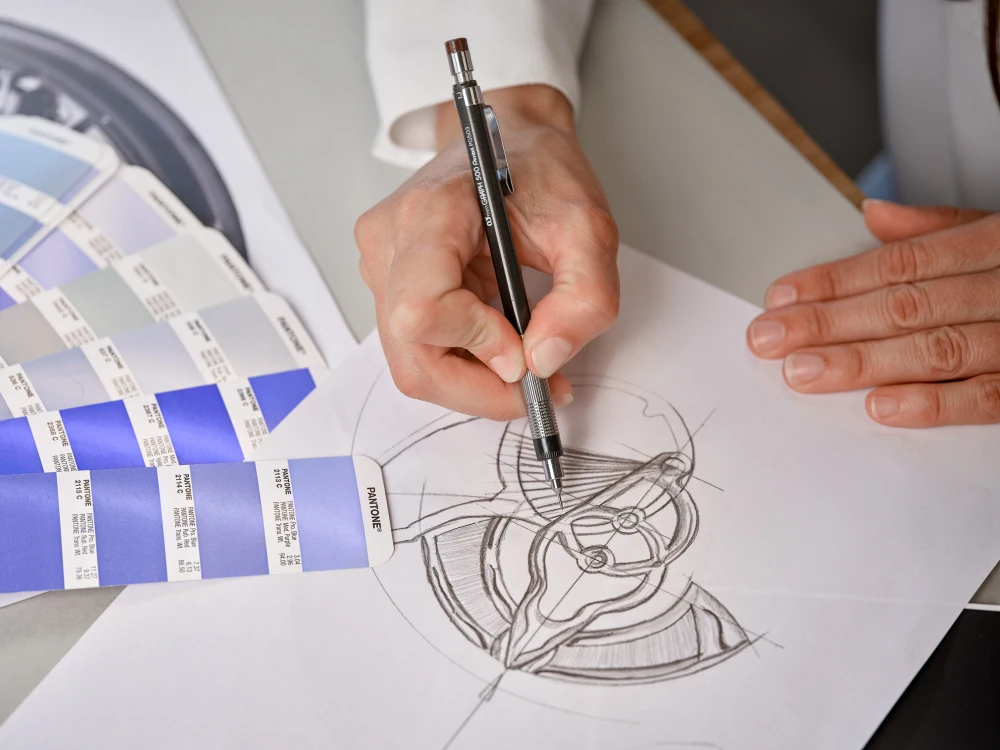
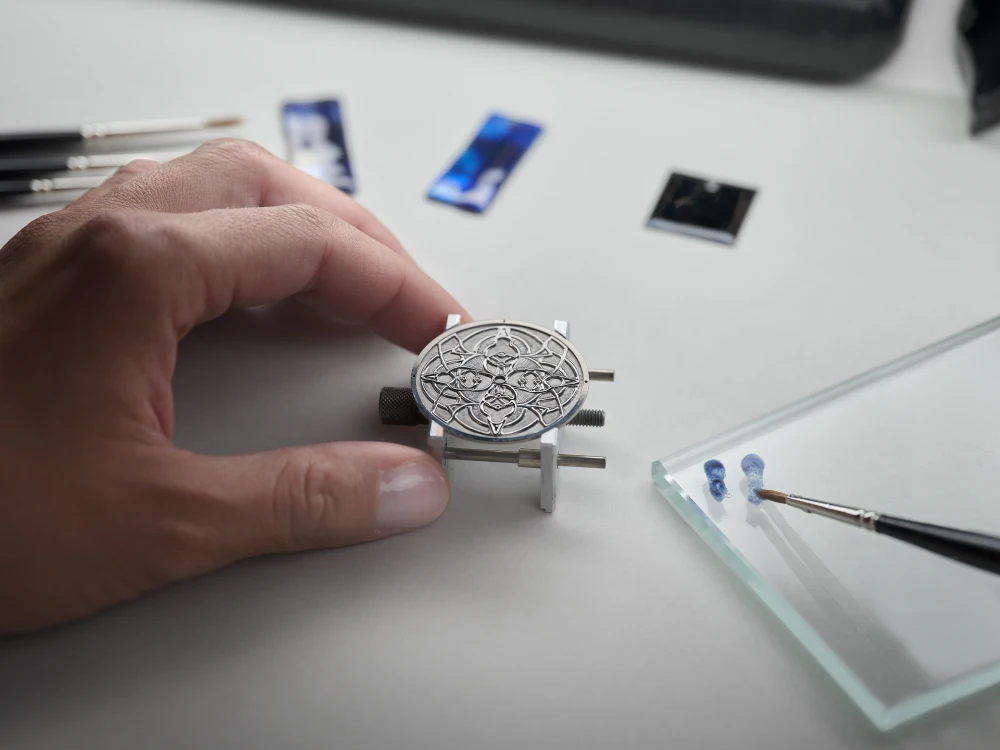
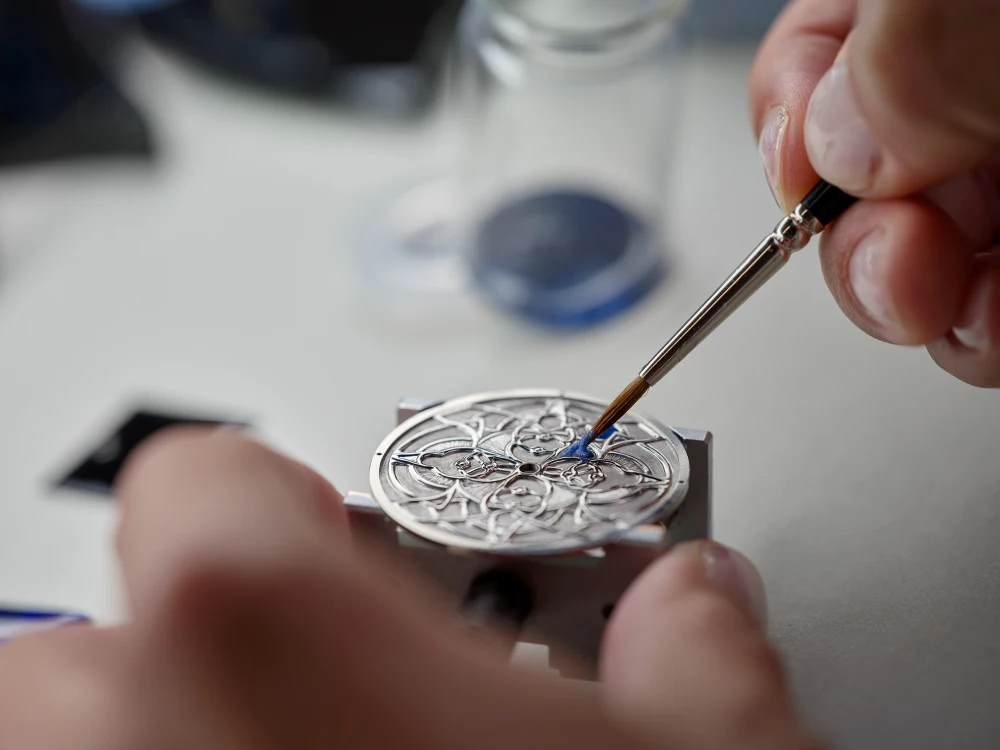
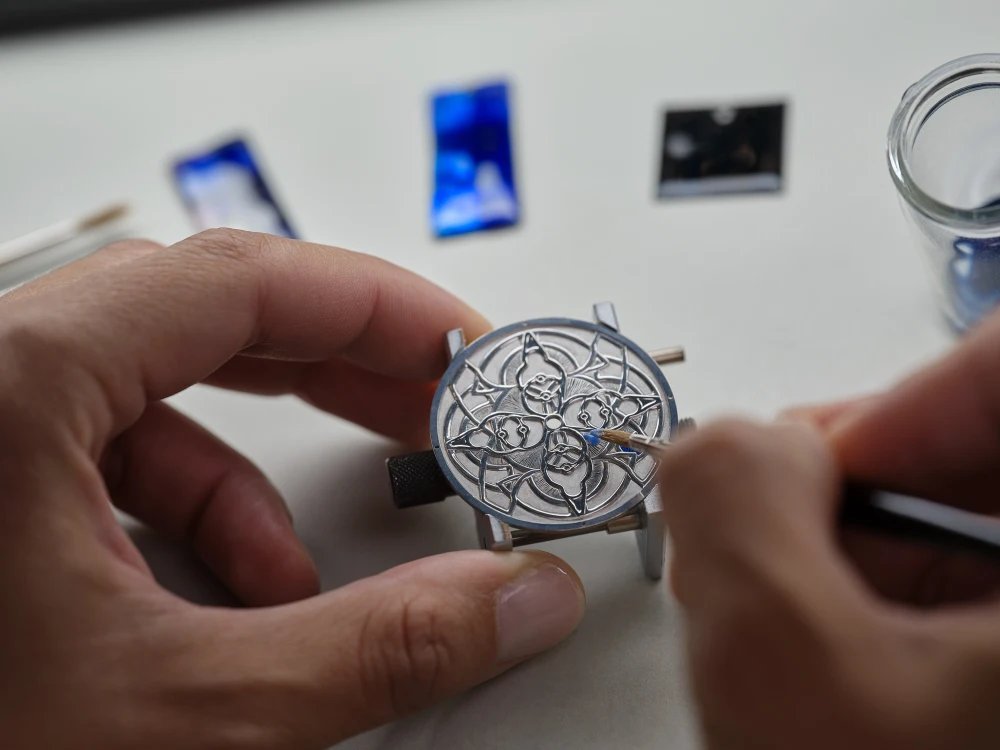
The 1:1 success rate is fortunate, as the Monday Organica’s dial takes 112 hours of work (it’s presumably a relief that production will be limited to 7 dials). The appearance of the dial looks as though it took considerably more time to execute. The skills range from cutting a dial blank to hand engraving it across a range of levels to create a landscape, applying different enamels, firing them and finishing. The only pity is that the watch’s dial has to sit behind a crystal – it’s wonderfully tactile and beautiful enough to hang on a wall.
Renaud Tixier Monday Organica – enamel work on ratchet wheel
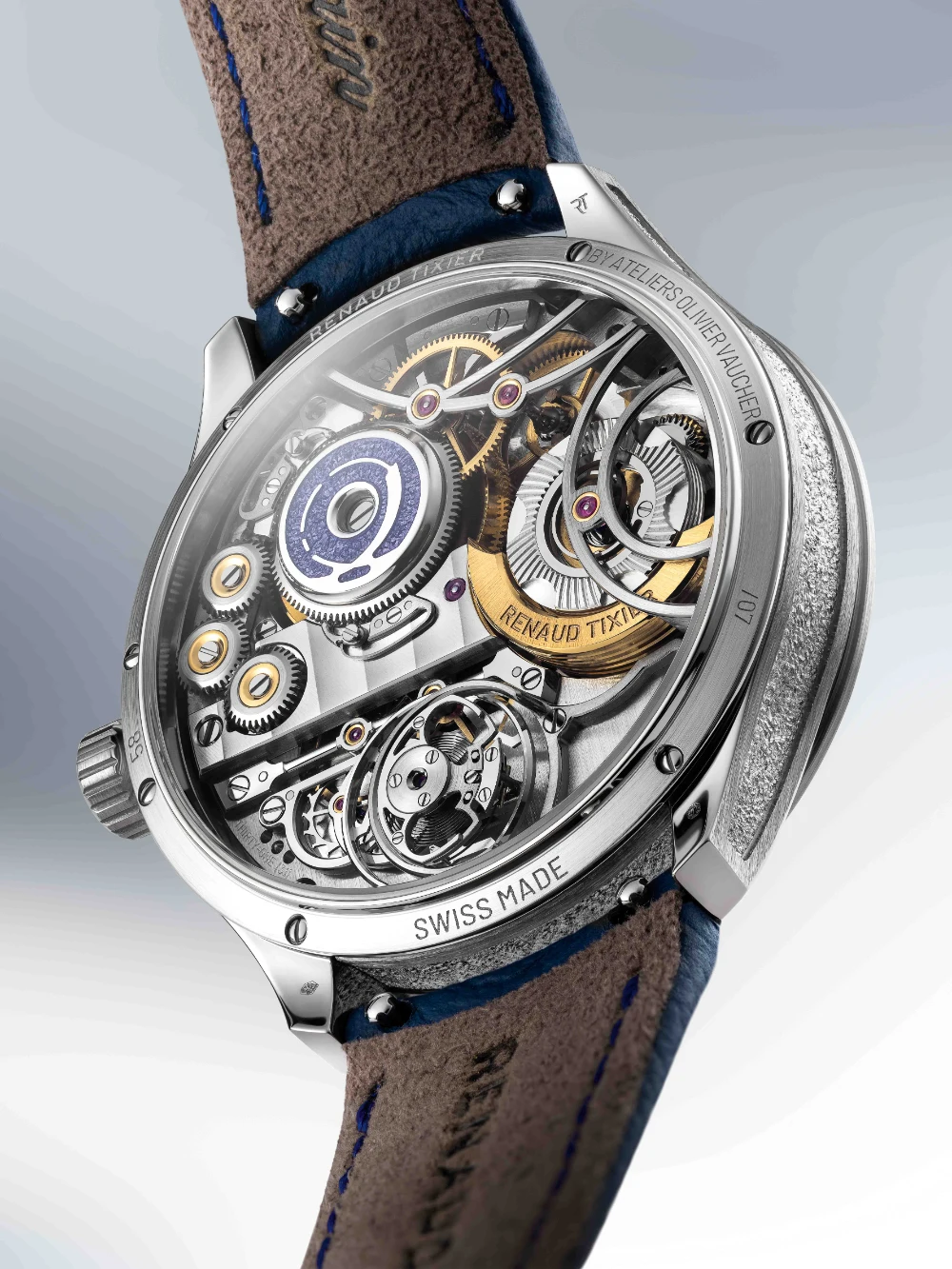
Enamelling isn’t just restricted to the dial, though. Turn the watch over, view the movement and discover more hand-cutting and enamel work adorning the barrel ratchet wheel cover. Apparently, you can even specify your preferred colour.
This is enameller Maëlle Constant’s work. Originally a special needs professional, she retrained in watchmaking and discovered a gift for enamelling. Calling it ‘a gift’ doesn’t, in any sense, diminish the hours of work, training and love she puts into her work.
Renaud Tixier RVI2023 movement
Energising the mainspring, courtesy of an efficient micro-rotor, is central to the way Renaud Tixier’s RVI2023 movement operates. When designing a movement, watchmakers are faced with a choice of how they can power the mainspring. They can handwind or use an automatic system that converts everyday motion to energy. If they go down the automatic route, there’s a further choice – a centrally mounted rotor or an inset micro-rotor (we’re ignoring Gosteli’s peripheral winding system for now).
Centrally-mounted rotors are the norm simply because they’re easier to produce and more efficient. Even a small movement of your arm spins the rotor and imparts power to the mainspring. The downsides come from the stress the rotor’s weight places on the rotor pivot (the inertia of a heavy mass orbiting at speed), the way the rotor itself obscures the movement and the thickness the winding mass and gear train add. Of course, you can gussy up a rotor, make it look splendid and use a heavier metal to thin it down, but it’s still going to get in the way.
Micro rotors solve all these problems, but they do present other obstacles. The clue is in the name – a smaller rotor means less inertia, so small movements don’t generate the same winding power as a larger rotor. Subtle wrist movements are less likely to awaken the micro-rotor, meaning less energy serves the barrel. This can be a particular problem if you’re pecking at a keyboard.
These mechanical challenges mean most watchmakers steer away from micro-rotors, with a few notable exceptions, such as the Patek Philippe cal. 240, the Chopard L.U.C. 1.96 (just 3.3mm thick, to prove the point) and the unusually baroque for A. Lange & Söhne, the cal. L921.4. Beautiful as they are, there’s a compromise there – and one that the movement in Renaud and Tixier’s Monday kicks firmly into the weeds.
Directly opposite the crown and underneath a slim, skeletonised bridge with a single chaton and jewel, you’ll see the RVI2023’s micro-rotor. You’ll also see what looks like a small turbine with a series of cutaways sitting inside its radius.
That ‘turbine’ is actually a platinum inertia wheel. The metal is unusually dense, so it’s efficient at converting small movements to power. Even moving your wrist to hit the spacebar on your laptop will shift it. As the gold outer rotor spins one way, the inertia wheel spins in contra-rotation, imparting power to the mainspring through a train of gears.
This is clever enough, but the system is also able to absorb and convert shocks to power without damaging the movement. The spiral you can see within the inertia wheel is a spring, connected to the wheel’s centre pivot. If the movement gets a shock, there’s a tang on the spring that moves to snug against a flat face on the inner weight, letting the spring absorb the shock and then re-impart it to the wheel. The firm describes it as being like the strings of a tennis racket that will absorb the impact of a ball, then re-impart it to propel the ball back.
It’s an elegant solution both in terms of engineering and efficiency (a remarkable 60 hours of power from around 4 hours movement) and aesthetics – you can happily spend time just watching the system work.
‘Movement architecture’ as a term sometimes gets overused. Not here. Each function – power generation, power storage and power control – have their own clearly defined spaces under the caseback. The thin, arcing, cutaway bridges afford wonderful, unimpeded views of numerous movement components
Renaud Tixier Monday Organica – finishing
Every inner angle is hand bevelled – all 187 of them – and titanium components are highly polished. The central ‘spine’ of the movement is decorated with Côtes de Genève, while other surfaces are straight brushed. The bridge holding the going train needs a special mention. Rather than a solid plate, it’s been reduced to a single highly polished bar, held at both ends, with two jewels mounted in chatons along its length.
As ever, it’s the small details that make the difference on a watch like this. Ratchet springs are one of those utility parts that seldom get much love. Not here. For a start, the design isn’t a single spring held with a screw at one end. Instead, the ratchet tooth arm and the spring are two separate parts. The tooth arm – tiny as it is – is still hand-chamfered and straight brushed. The spring itself is anchored on two polished posts with a mirror-polished screw holding it in place. And yet more anglage and straight brushing. Given the complex curves within all four parts required, that’s a serious amount of fiddly, painstaking, coffee-requiring work.
Renaud Tixier Monday Organica by Ateliers Olivier Vaucher – case
The movement sits in a platinum case with a diameter of 40.8 mm and a thickness of 12.6 mm. Turn the watch on its side and you can see more evidence of métiers d’art – the flanks of the case and the space between the lugs are hand-engraved by specialist Coralie Mercier.
You might assume that a watch with this level of craft invested in it would be fragile. Admittedly, you probably won’t wear it in the pool; however, it is water-resistant to 30m and would certainly survive getting its hair wet without worrying.
Closing remarks
It would be easy for a métiers d’art watch like this to be fussy and a bit overblown – lots of technique for technique’s sake. That would have been an easy trap to fall into, especially given the number and skill of the collaborators. But here, everything has a purpose and a place. Yes, the dial is a piece of art, but you can tell the time at a glance. Yes, the micro-rotor system is bogglingly clever and finished to within a fraction of an inch of its life, but it’s proper, functional engineering. This is one of those watches where the craft doesn’t overwhelm; it enhances. It’ll be fascinating to see what Tuesday looks like.
Further reading
Technical specifications
- Model: Renaud Tixier Monday Organica by Ateliers Olivier Vaucher
- Case: platinum, diameter 40.8 mm, thickness 12.6 mm (with crystal), water resistance 3 ATM (30 metres), domed sapphire crystal to the front, exhibition caseback.
- Functions: hours, minutes
- Movement: RVI2023 caliber, automatic, frequency 18,000 vph (2.5 Hz), 31 jewels, power reserve min. 60 hours
- Strap: blue or black grained, hand-stitched calf leather strap.
- Price: CHF 125,000 (RRP as of September 2025)
- Limited Edition: 7 pieces