
Roger Dubuis Orbis in Machina Watch Review
Just unveiled at Watches & Wonders 2024, the Roger Dubuis Orbis in Machina is the latest expression of ‘Hyper Horology’ from the Geneva-based Manufacture. A brand known for its innovative mindset, Roger Dubuis has positioned a flying tourbillon at the centre of an openworked display, with hours, minutes and seconds displayed on concentric rings. Conspicuously contemporary to the front, the Calibre RD115, visible to the rear, exudes a period charm. Angus Davies invites the reader to discover a watch that proves a consummate performer.

In the world of Haute Horlogerie, the tourbillon, a gravity-defying high complication originally conceived to augment precision, is now often selected for its spectacular dynamic performance. It perpetually dances, pirouetting on its tiptoes to the accompaniment of a perpetual tick-tock beat.
Roger Dubuis Flying Tourbillons
Roger Dubuis, the Swiss Manufacture located in Meyrin on the outskirts of Geneva, is synonymous with crafting expressions of Haute Horlogerie, or as the brand prefers to say, ‘Hyper Horology’. Founded in 1995, the Maison has an impressive back catalogue.
During its reign, the brand has produced all four high complications, namely the double-split chronograph (rattrapante), minute repeater, perpetual calendar and the tourbillon. It unveiled its first tourbillon back in 2003 and has since gained a reputation for its preferred interpretation of this much-coveted mechanism, releasing several flying tourbillons over the years. A speciality of the house, the flying tourbillon eschews the customary upper bridge found on ‘regular’ tourbillons and is supported solely from below. This arrangement affords superior views of the escapement, regulating organ and tourbillon cage in motion.
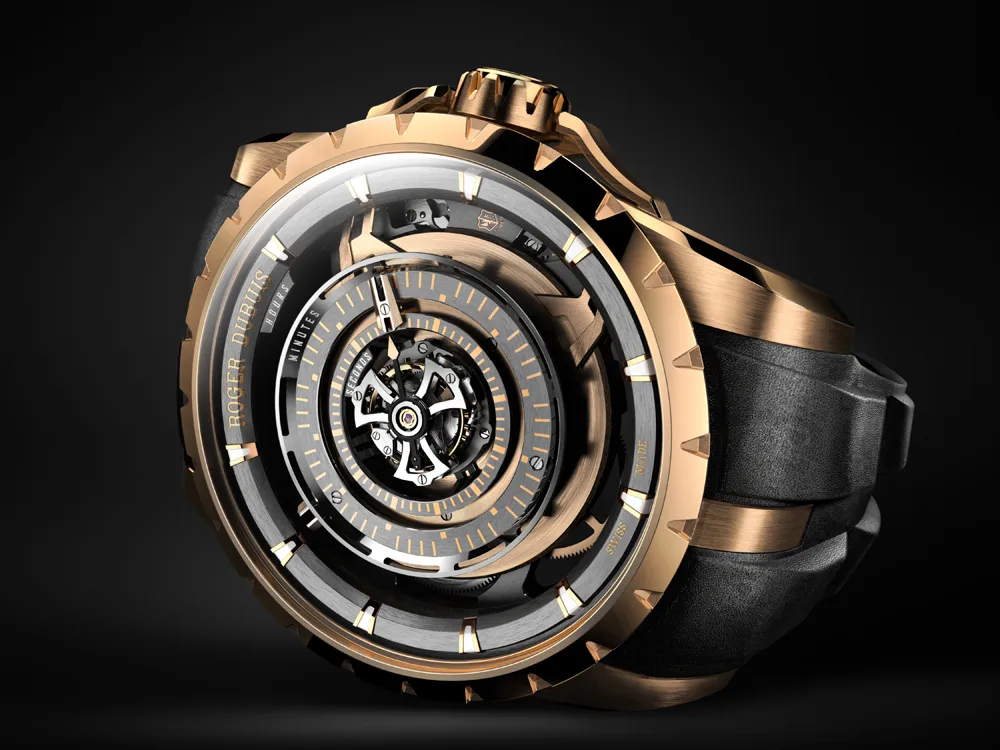
Roger Dubuis Orbis in Machina – Watches & Wonders 2024
Sometimes a flying tourbillon forms one half of a duet, while on other occasions it performs alone. A mechanism that captivates all audiences, the flying tourbillon usually sits in the wings, typically at 4, 6 or 8 o’clock. However, at Watches & Wonders 2024, Roger Dubuis unveiled the Orbis in Machina, a watch like no other, with a flying tourbillon positioned centre stage. Visually striking and highly original, the new Roger Dubuis Orbis in Machina invites the audience to enter a new world, where time is indicated in a non-conformist way and the senses are awakened with a breathtaking performance. Allow me to elaborate.

Roger Dubuis Orbis in Machina dial
Before reading any further, set aside any preconceptions of how a watch should look because the new Orbis in Machina does not follow the pack. On the contrary, this watch reimagines time, presenting it in a very different way.
As previously mentioned, the flying tourbillon on this new timepiece sits front and centre. The lower part of the cage is formed of lightweight, anti-magnetic titanium, while the upper section of the cage is presented in mirror-polished Cobalt Chrome. This latter material is, once again, light and antimagnetic. The featherlight mass of the cage helps mitigate energy consumption, a fact that is evident with the stated power-reserve of 72 hours, an impressive figure for a tourbillon.
Over the years, I have talked about the technical challenges of working with Grade 5 titanium; however, Cobalt Chrome is even more demanding. A few months ago, I chatted with Sadry Keiser from the Manufacture about the difficulties in machining and polishing Cobalt Chrome. While I appreciate the aesthetic and functional benefits of Cobalt Chrome, its use does evoke thoughts of self-flagellation. However, having visited the Manufacture on several occasions, it is clear the brand is willing to take an arduous route in its quest for excellence.
The balance, positioned at the centre of the flying tourbillon, is regulated using inertia weights, a system termed a ‘variable-inertia balance’. The effective length of the hairspring is fixed and the rate is altered by tightening / loosening the screws set in the rim of the balance wheel. This form of regulation is superior to an index-regulated balance as it can be set more precisely. Moreover, should the watch be subjected to a shock, it is less likely to require remedial regulation.
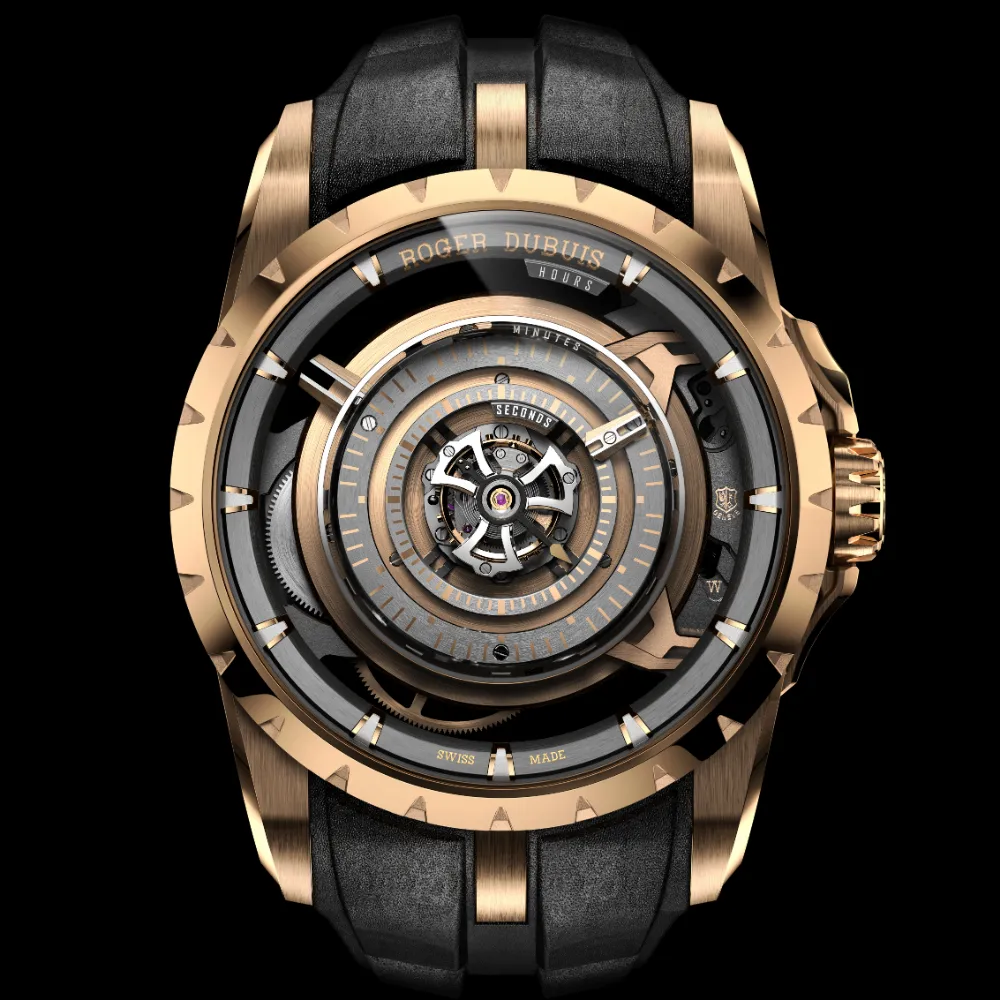
Interestingly, unlike some contemporary variable-inertia balance systems which have inertia weights (masselottes) positioned on the spokes of the balance wheel, Roger Dubuis has used traditional timing screws. This hints at the traditional movement execution visible to the rear of the watch (see later).
Another point to note is the extraordinary finishing found on the tourbillon and associated components. As previously mentioned, the three wings that form the upper section of the flying tourbillon cage are beautifully mirror polished. Close inspection reveals they are endowed with faceted sides that step down as they near the shock absorber. Polishing each of these angles necessitates much time and expertise. All the screws are also mirror-polished and sit within polished sinks. The stud holder is embellished with a circular grained finish. Everything is refined to the highest order.
A black hand endowed with a golden tip sits atop the tourbillon cage. It points to a brushed grey track marked with golden strokes, indicating the running seconds.
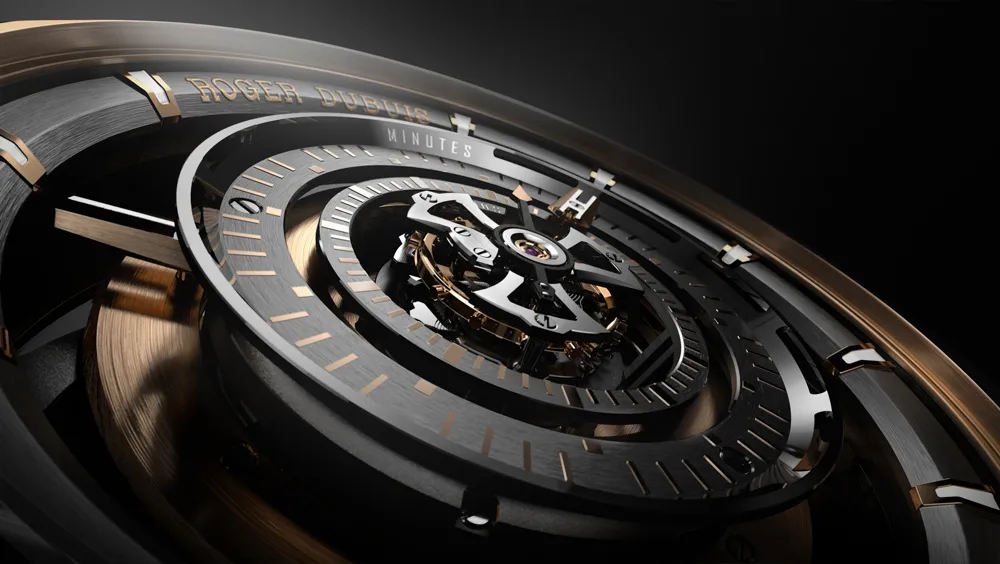
The seconds, minutes and hours are arranged in three concentric circles, emanating from the centre. Three neat cartouches, one located adjacent to each track, identify the role of each function in lucid block capitals. Positioned above golden circlets, located between each track, openworked hour and minute hands rest upon ball bearings, imparting meaning as they slowly advance. The hour track is presented on a flange encircling the display and is adorned with the Manufacture’s name and country of origin.
The innovative display necessitated the brand inventing a system (patent pending) that ‘safely disengages the hands and allows the watch to be set with assured stability’.
Upholding Roger Dubuis tradition, the Orbis in Machina embraces an openwork design. Some movement components are exposed along with sections of the model’s skeletal framework. While this model is unequivocally original, it still subscribes to the brand’s familiar design language. Indeed, its creator should be obvious to any self-respecting horophile.
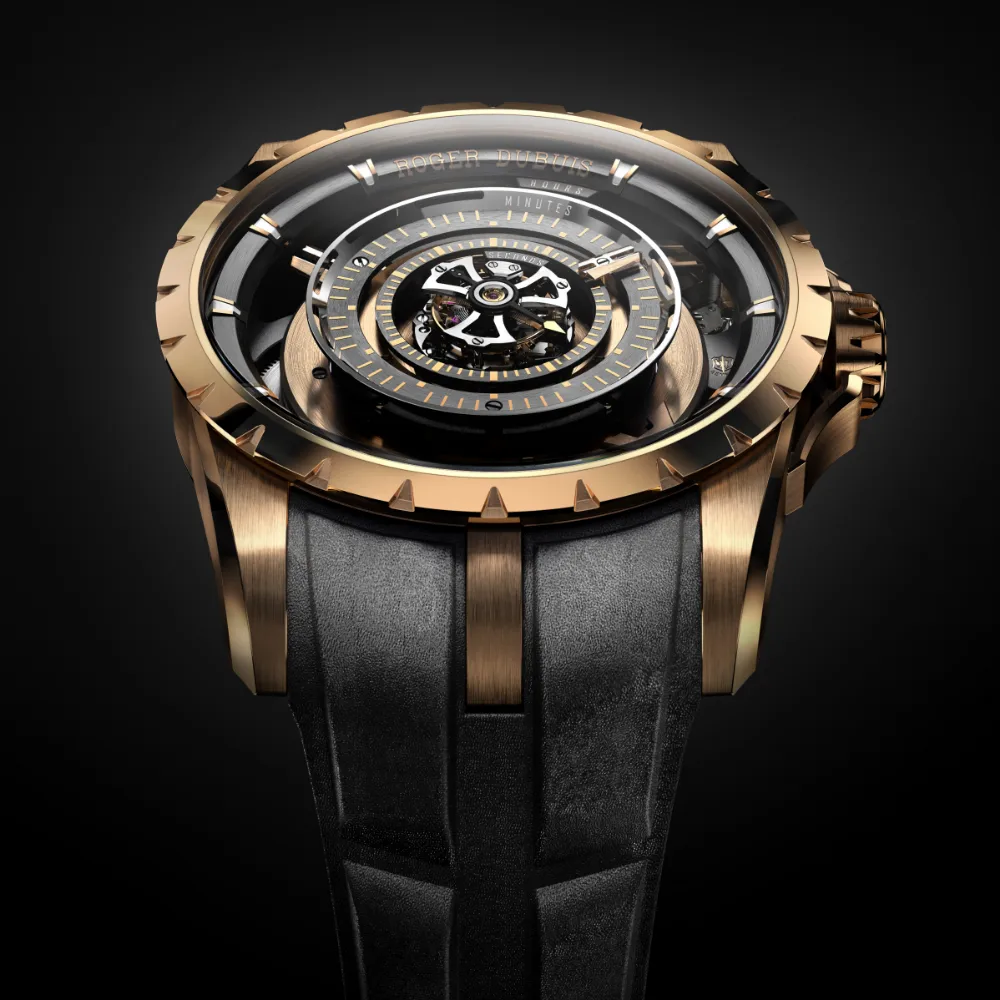
Roger Dubuis Orbis in Machina case
The secret to many successful products is they often share some degree of aesthetic commonality with their siblings. In this instance, the case of the Orbis in Machina resembles that of several Excalibur models. The bezel has the familiar notched edge and the watch is endowed with the brand’s distinctive triple lug design.
Housed in a 45 mm, 18K pink gold case, the watch is presented on a black leather strap and is fitted with the Maison’s ‘quick release system’. This provides a user-friendly means of swapping the strap for an alternative without the need for tools.
To the rear of the watch is a transparent caseback, granting sight of the hand-wound Calibre RD115 movement.
Roger Dubuis Calibre RD115 movement
When viewed from the front, the Orbis in Machina looks conspicuously contemporary, save for the aforementioned timing screws. And it is this latter detail which provides a clue to the design of the movement within.
The Manufacture Calibre RD115 movement subscribes to a delightfully retro design. As a self-confessed horological voyeur, I love vintage watch movements because they shun oversized plates and tend to show more components interacting with one another.
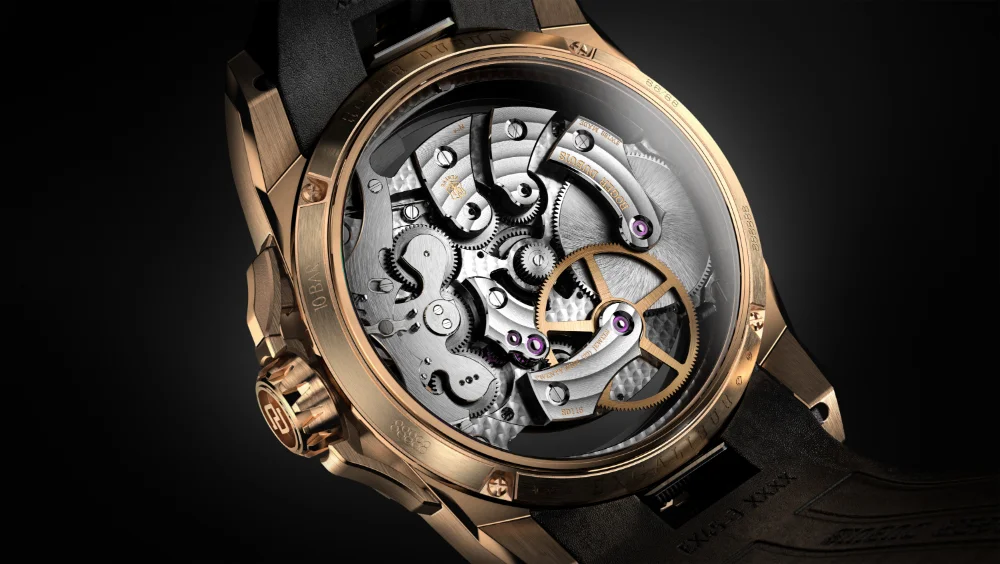
In this instance, the barrel, adorned with a snailed motif, interacts with a large wheel. This is not the customary centre wheel driving the hour wheel above. Instead, the large brass-hued wheel engages with a grey gear at the centre of the movement. It’s this non-standard approach that provides a hint to the extraordinary execution of Calibre RD115.
A series of finger-like bridges, each embellished with Côtes de Genève motif, hold various components in position. Consistent with the vintage-theme, the bridges have gently arcing sides, each beautifully adorned with anglage. Once again, Roger Dubuis reveals it has masochistic tendencies. Each bevelled edge, positioned at 45° to the flank, is executed by hand, using a series of files, abrasive pastes and, ultimately, the careful application of gentian wood. It’s a challenging undertaking when performed on a straight-sided bridge but a sinuously curved component; well, that’s just plain torture.
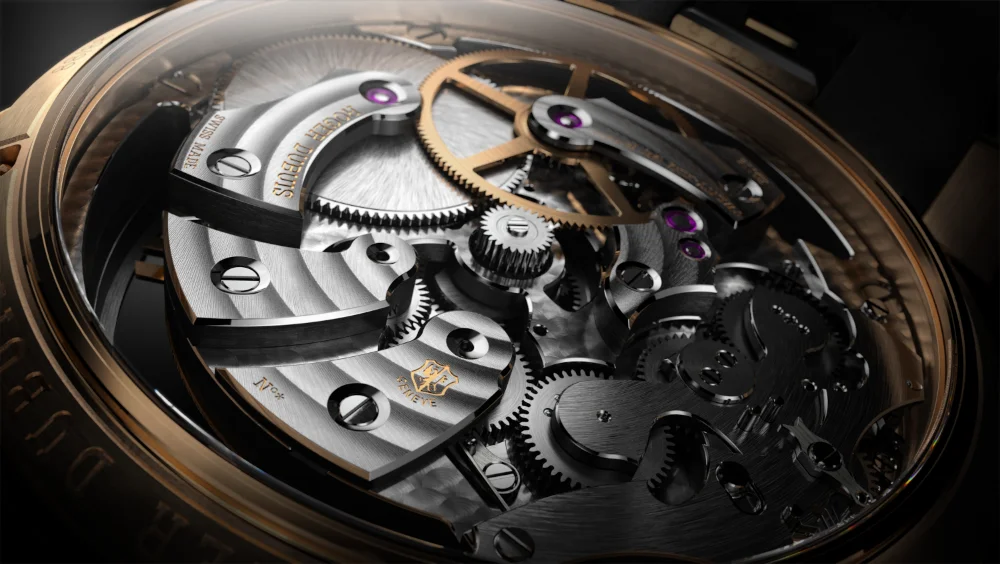
Note how the screws and the tops of the pinions, peeping beyond the rubies, gleam resplendently. Likewise, note how the jewels and screws sit in polished sinks. Then cast a discerning eye over the perlage, with each overlapping circle perfectly arranged, or the finely grained lines gracing plates, levers and said brass-hued wheel; everything is flawless. Within the confines of the Manufacture’s walls, nobody watches the clock; peerless finishing is the order of the day.
Located to the front of the watch, close to the crown, you will see the Poinçon de Genève. This prestigious hallmark, sometimes termed the ‘Seal of Geneva’, also graces the movement. Enshrined in law since 1886, the Poinçon de Genève is one of the most onerous certifications in watchmaking. It is an independent guarantee of provenance, craftsmanship, quality and extraordinary watchmaking expertise.
For a watch to bear the Poinçon de Genève it must be assembled, cased and adjusted within the Canton of Geneva. Moreover, while the mainplate and bridges are executed using modern methods such as CNC machines, any traces of machining must be removed using various finishing techniques. All the requirements of the Poinçon de Genève are rigorously enforced by TimeLab and its team of independent auditors.
Roger Dubuis Orbis in Machina – closing remarks
The new Roger Dubuis Orbis in Machina is neoteric to the front and classical to the rear. Ordinarily, this duality would spell disaster; however, this model proves the exception. The arrangement of the time indications is highly original, yet eminently logical. Indeed, Roger Dubuis has not sacrificed intelligibility on the altar of style.
Turn the watch over and even the most die-hard traditionalist will smile with appreciation. Brimming with mechanical virtue and blessed with artisanal beauty, there is much to love about the Calibre RD115. The craftspeople working at the Geneva-based Manufacture have endowed each component with a refined finish. This is not marketing hyperbole. On the contrary, the brand subjects its work to the independent, and unyielding, scrutiny of TimeLab, the custodians of the coveted Poinçon de Genève.
Patented in 1801, the ‘regular’ tourbillon ameliorates gravity’s adverse influence on the rate of the movement. While the mechanism continues to augment precision, these days it is often selected for its choreographed rotation. The Roger Dubuis Orbis in Machina places the brand’s beloved flying tourbillon centre stage, a place where it can enact its synchronised dance and captivate audiences, especially horophiles, with a solo performance par excellence.
Further reading
Technical specifications
- Model: Roger Dubuis Orbis in Machina
- Reference: DBEX1119
- Case: 18K pink gold, diameter 45 mm, height 14.41 mm, water resistance 10 ATM (100 m), sapphire crystal to the front and exhibition case back.
- Functions: hours, minutes, small seconds (on top of tourbillon cage)
- Movement: RD115 calibre, manual-winding movement, 29 jewels, power reserve 72 hours.
- Strap: black leather strap interchangeable with Quick Release System – QRS.
- Price: £191,500 (RRP as of 9.4.2024)
- Limited Edition: 88 pieces – boutique exclusive