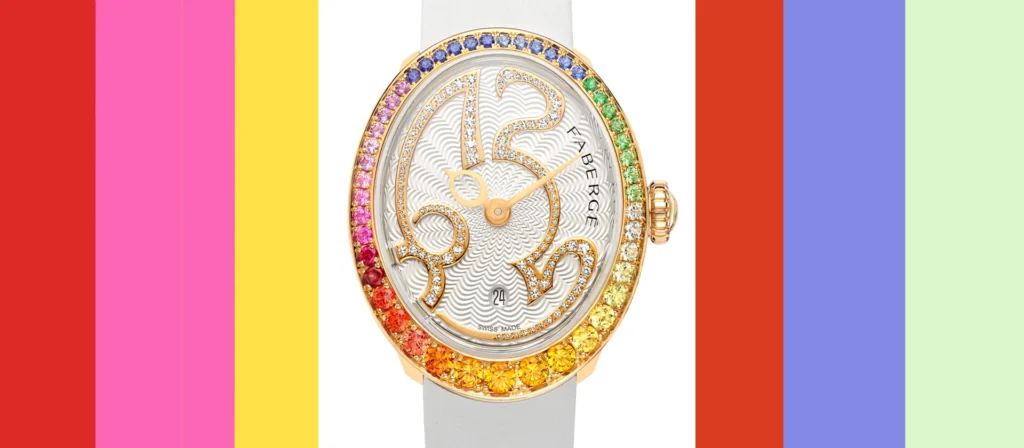
Fabergé Colours of Love Eggsistence
Fabergé Colours of Love Eggsistence Watch Review Fabergé, a name steeped in history and byword for indulgence, has…




Similar to a hand-wound timepiece, automatic watches feature a barrel (or barrels) that store the energy necessary to power various functions, including the hour and minute hands, as well as complications such as a chronograph. Moreover, like a hand-wound watch, the wearer can energise the mainspring(s) by manually rotating the crown. However, an automatic watch proffers additional convenience.
Equipped with a ‘rotor’ or ‘oscillating weight’, automatic watches, when worn, harvest kinetic energy from the natural motion of the wearer’s wrist. The motion of the rotor, often formed of a dense material, such as gold or tungsten, drives gears that ultimately tension the mainspring.
If the watch is removed from the wrist and left unattended, it will cease to function once the mainspring has fully relaxed. Prior to using the watch, it should be set and manually wound. Do not shake the watch to get it going as shocks can adversely affect precision.
One disadvantage of having a timepiece fitted with a full-size rotor is that its presence often obscures the view of a beautifully decorated watch movement. As its name implies, a ‘micro-rotor’ is much smaller than a full-size or regular oscillating weight and sits flush with neighbouring bridges. This confers two distinct benefits: it typically reduces the thickness of the movement, hence the timepiece, and it allows the wearer to see more of the finishing/decoration.