
F.P.Journe Astronomic Souveraine Watch Review
Even in the esoteric world of Haute Horlogerie, the F.P.Journe Astronomic Souveraine stands out as an exceptional creation. It is endowed with a total of 18 complications and functions encompassing not only several astronomical functions but also highly complex mechanisms such as a Remontoir d’égalité, a tourbillon and a minute repeater. By any measure this highly sophisticated wristwatch is worthy of the terms, ‘grand complication’ and ‘magnum opus’. Angus Davies explores this remarkable composition in close detail.

François-Paul Journe frequents the highest ground
On a clear day, adventurous types may decide to climb the tallest hills they can see. Alternatively, some intrepid types, attired in serious mountaineering apparel, may choose to ascend to even greater heights. And then there is a small group of highly proficient mountaineers, who battle with altitude sickness and navigate perilous obstacles, eager to scale the likes of K2, Kilimanjaro, Mont Blanc or Everest. Likewise, in the world of watchmaking, François-Paul Journe frequents the highest ground, exploring new territories few have seen. He is, without doubt, a man who resides in the upper echelons of Haute Horlogerie.
Over the years Journe’s inventive mind has conceived numerous watches equipped with high complications and endowed with ingenious mechanisms. Notable examples of his work include the Chronomètre Optimum, the Chronomètre à Résonance, the Répétition Souveraine and the Tourbillon Souverain. Arguably, this quartet is the horological equivalent of Everest, K2, Kilimanjaro and Mont Blanc, and François-Paul Journe has conquered them all.
Given the extreme complexity of the F.P.Journe Astronomic Souveraine, François-Paul Journe is clearly a man who seeks to surpass established norms. Unveiled in November 2019, this timepiece is equipped with 18 complications and is worthy of the title ‘grand complication extraordinaire’. To use my earlier analogy, it is the equivalent of scaling Everest, K2, Kilimanjaro and Mont Blanc in rapid sequence. Few mortals would ever contemplate such an arduous feat.
Only Watch 2019
In 2019, François-Paul Journe unveiled a prototype watch, the Astronomic Blue. Sporting a bewitching blue dial and housed in a 44mm tantalum case, this prototype was donated to Only Watch.

This charity is dedicated to raising funds in support of research into Duchenne muscular dystrophy. To date, the nine editions of the Only Watch auctions have raised CHF 100 million. When the F.P.Journe Astronomic Blue was sold at the 8th Edition in 2019, it raised CHF 1,800,000 for the worthy cause. Shortly after the sale of this charity watch, a production version was unveiled, the F.P.Journe Astronomic Souveraine.

While this latter serially produced model shares many similarities with the Only Watch unique piece, there are notable differences. For example, the inscriptions are different, the hand on the power reserve display is a different colour and the case is made of a different material. Indeed, the F.P.Journe Astronomic Souveraine is housed in a 44mm case, made of stainless steel, a metal that Journe often selects for chiming watches as it confers an impressive sound, surpassing the performance of noble metals due to the crystalline structure of steel.
Astronomy and horology
The histories of astronomy and horology are entwined. In the beginning, there was no form of time measurement, however, academics believe that humans eventually began to make astronomical observations, placing stones on the ground as a primitive means of time measurement. Indeed, the famous stones of Stonehenge, England have been linked to this theory, albeit there are a number of alternative theories as to the reason for the stone circle in Wiltshire.
The Nebra Sky Disc (circa 1600 BC) depicts the sky above Germany. It features 32 heavenly bodies, including the Sun, the Moon and the Pleiades constellation. Scientists believe the Nebra Sky Disc was used to predict the summer and winter solstices, allowing farmers to predict the optimal times for sowing crops and subsequently harvesting them.

Galileo Galilei (1564–1642), often described as the ‘father of observational astronomy’, challenged accepted wisdoms. When viewing the moon, he used the length of shadows to estimate the height of lunar mountains, dispelling the previous idea that the moon was smooth. His inquiring mind led to him making many additional discoveries. For example, he observed a bronze chandelier swinging in Pisa’s cathedral and noticed that each swing always took the same amount of time to complete, irrespective of its amplitude. This discovery pre-dates the production of the first working pendulum clock by Christiaan Huygens (1629-1695). It is clear that astronomers, physicists, scientists and watchmakers all breathed the same air.
In the 19th century, the first chronograph, the Louis Moinet Compteur de Tierces (1816), was invented. This was used to time the movement of heavenly bodies when viewed from Earth. It was used in conjunction with a telescope fitted with crosshairs and calibrated to measure precise distances. The instrument’s frequency was 30Hz, a dizzying cadence allowing seconds to be divided into sixtieths, thereby conferring a high degree of precision.
F.P.Journe Astronomic Souveraine – a grand complication
As its name implies, the F.P.Journe Astronomic Souveraine is equipped with numerous complications linked to astronomy, eg the moon phases, sidereal time and the times pertaining to sunrise and sunset. However, the Maison also describes the watch as ‘entirely devoted to the contemplation of the stars.’ Indeed, when reading the company’s press release, the model invites the wearer to view the stars and embrace their poetic charms. At first, one could dismiss Journe’s statement, ‘that of losing oneself in the stars in order to better find one’s way on Earth’ as mere romanticism. However, prior to discovering the means of determining longitude, mariners would measure the angle between the horizon and the North Star, using an astrolabe, in order to establish the latitude of their position. On reflection, the Genevan firm’s statement is both factual as well as philosophical.

However, not all of the Astronomic Souveraine’s complications are dedicated to stargazing, some proffer alternative uses. Allow me to elaborate.
F.P.Journe Astronomic Souveraine – terrestrial time and sidereal time
‘Terrestrial time’ is the measure of time defined by the Earth’s orbital motion. The sun revolves around the Earth every 24 hours. On the other hand, ‘sidereal time’, also known as ‘celestial time’, equals the rotation of Earth relative to the stars rather than the sun. The celestial vault scrolls past the Earth in 23 hours and 56 minutes.
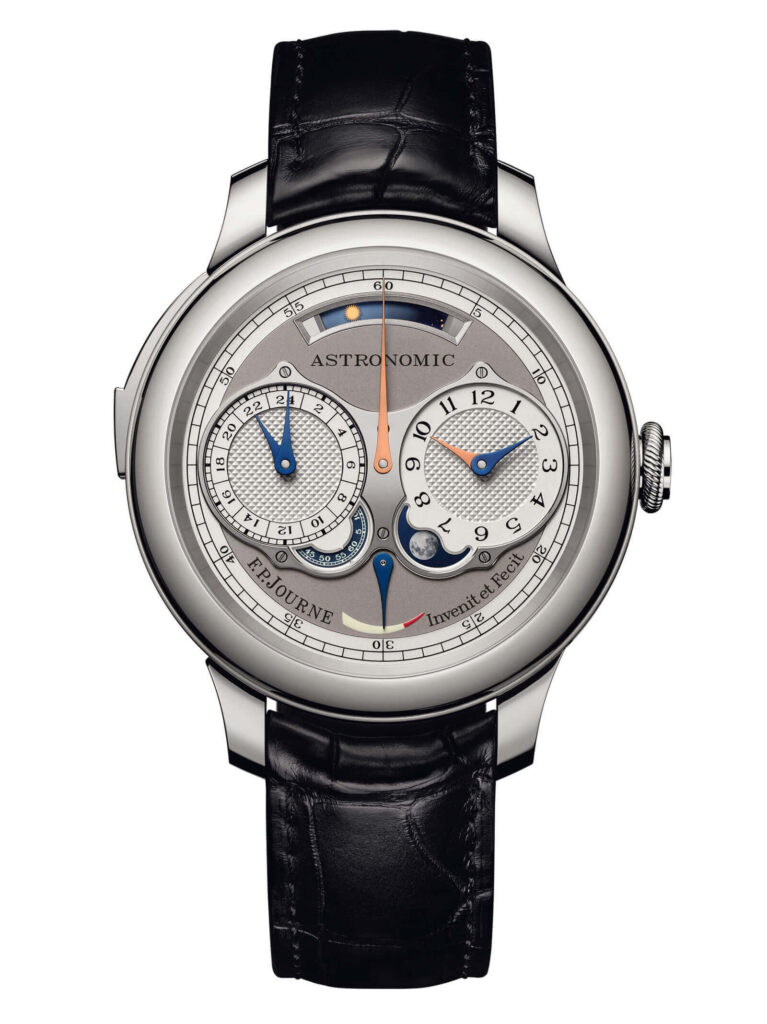
The dial of the F.P.Journe Astronomic Souveraine features two subdials, positioned at 3 o’clock and 9 o’clock. The dial positioned to the right shows the prevailing hour (local time) with a hand formed of 5N gilt steel and the prevailing hour (home time) using a blued steel hand. The minutes are shown with a lone, centrally-positioned hand, similar to that found on a regulator watch.
The second subdial, located on the left side of the dial features an hour and minute hand and displays the sidereal time. The blued hands interact with an hour track marked with Arabic numerals and a chemin de fer.
F.P.Journe Astronomic Souveraine – other dial details positioned front of house
Both subdials feature Clous de Paris decoration and are conjoined courtesy of Journe’s patented screwed steel frame. A photorealistic moon phase sits at 5 o’clock, positioned beneath the hour display to the right (terrestrial time).
F.P.Journe skillfully employs symmetry throughout the composition. An arc-shaped aperture, similar, in terms of scale and shape, to the moon phase, resides at 7 o’clock. This aperture reveals a natural dead-beat seconds display in revolving disc form.

A power-reserve indicator is positioned at 6 o’clock and employs a blued hand to express meaning. Beneath noon, a curved opening reveals the sunrise and the sunset. The slender minute hand converses with Arabic numerals, positioned at 5-minute intervals, and a lucid chemin de fer.
Consistent with other Journe creations, all indications can be adjusted via the crown. This is far simpler than making adjustments with a stylus and numerous correctors, however, such user-friendliness is the product of much skill on the part of the Maison.
F.P.Journe Astronomic Souveraine – equation of time
The equation of time is the difference between the true solar time (the time taken for the Sun to return to the local meridian) and mean solar time (one day = 24 hours). Typically, this difference ranges from -16 minutes to +14 minutes (approximately), varying through the year owing to the elliptical orbit of the sun. Put simply, the equation of time shows the difference between the time displayed on a clock or watch and the time indicated with a sundial.

The F.P.Journe Astronomic Souveraine displays the equation of time to the rear of the watch using a crisp scale set atop a white track. A blued hand affixed to a dedicated elliptical wheel, positioned to the centre of the movement, imparts meaning.
F.P.Journe Astronomic Souveraine – annual calendar
A ‘regular’ watch, fitted with a simple date display, often requires the wearer to adjust the date based on the length of the month. For example, November has 30 days, therefore the wearer would need to pull out the crown and manually advance the date to the 1st of December.
On the other hand, an annual calendar possesses a notable degree of mechanical intelligence, recognising the length of each month and automatically advancing the date as required. In the aforementioned example, the date would jump from the 30th of November to the 1st of December without wearer intervention. The only time when the wearer of an annual calendar is required to adjust the date is on the 1st of March, as February contains 28 or 29 days depending on whether it is a leap year.

The Astronomic Souveraine features an annual calendar shown on a track to the rear of the watch. The signs of the zodiac, encircle the annual calendar.
F.P.Journe Astronomic Souveraine – tourbillon
In 1801, Abraham-Louis Breguet, widely considered the greatest watchmaker of all time, patented his invention, the tourbillon. This ingenious mechanism was designed to counter the adverse influence of gravity on a pocket watch’s regulating organ. Breguet’s solution involved placing the escapement and regulating organ within a rotating cage. As the cage revolved, any potential gains in rate were subsequently negated, thereby augmenting precision.

F.P.Journe has miniaturised Breguet’s invention allowing it to be incorporated within a wristwatch. Whilst other firms produce watches fitted with Breguet’s invention, few of these timepieces feature as many complications in such a comparatively modest space (see later).
The Astronomic Souveraine’s tourbillon rotates 360° every 60 seconds.
F.P.Journe Astronomic Souveraine – ‘remontoir d’égalité’
With most conventional wristwatches, the power from the mainspring is transferred via the gear train to the escapement. However, a fundamental weakness of most watches is that the force diminishes as the mainspring becomes increasingly relaxed. The result is that the amplitude of the balance drops, causing the rate to increase, thereby impairing precision.
The F.P.Journe Astronomic Souveraine features several refinements to enhance precision. Firstly, it employs twin barrels that are fitted with supple mainsprings, delivering a more stable source of power to the escapement than one lone barrel. Moreover, despite the complexity of this watch with its numerous complications, it has an impressive power-reserve of 40 hours.
The ‘Remontoir d’égalité’ (constant force device) features an additional wheel positioned between the fourth wheel of the gear train and the escapement. This wheel features a short-duration spring which pulses energy every second. This spring is very different to a regular mainspring which is made to harness vast amounts of energy, often delivered over a number of hours or even days, not seconds. This is not the first time that Monsieur Journe has equipped a watch with a ‘Remontoir d’égalité’, it first featured on the company’s Tourbillon Souverain (introduced in 1999).
F.P.Journe has equipped the movement with a free-sprung balance. Unlike an index-regulated balance, the effective length of the hairspring remains constant. The watchmaker regulates the movement by rotating four inertia weights, positioned on the four spokes of the balance wheel, altering the moment of inertia, thereby, making the watch run faster or slower.
This system is far superior to an index-regulated balance, proving less susceptible to positional errors and conferring superior rate stability. Interestingly, by placing the inertia weights in-board, instead of using traditional timing screws set in the rim of the balance wheel, the balance wheel is more aerodynamic, creating less air turbulence and, as a result, making the movement, the Calibre 1619, more precise.
The Maison has also equipped the balance with a Breguet overcoil, making the hairspring breathe more concentrically, thereby, enhancing isochronism.
F.P.Journe Astronomic Souveraine – minute repeater
In the modern era, society has grown accustomed to electric streetlights, however, it was only in the late 19th century that such illumination appeared, initially in the city of Paris. This often presented the watch owner with a problem, namely, how to ascertain the time beneath a cloak of darkness?

The advent of the minute repeater allowed the watch owner to determine the time using a sequence of chimes. This chiming sequence was actuated by a lever or slide on the side of the watch’s case. The timepiece would sound the hours, quarters and minutes using a combination of two gongs and two hammers.
Typically, the arrangement of gongs and hammers takes up much room, however, with the arrival of the F.P.Journe Répétition Souveraine, this notion was swept aside. Measuring a mere 40mm in diameter and 8.50 mm in height, the dimensions of this timepiece are similar to many ‘regular’ models sans complications. It is this capacity to create complex watches with comparatively diminutive proportions that has become one of the distinguishing features of François-Paul Journe’s creations. Indeed, despite having 18 complications and functions, the Astronomic Souveraine measures a modest 44 mm in diameter and is a mere 13.70 mm in height. To place this in context, watches equipped with a similarly long inventory of functions are usually worn on a chain and exhibit behemoth proportions.
Calibre 1619 – additional comments
At the heart of the F.P.Journe Astronomic Souveraine sits the Calibre 1619, a hand-wound movement crafted to a no-compromise conclusion. Consistent with many of the Maison’s movements, the Calibre 1619 is made from 18-carat rose gold. This noble metal is one of the least reactive materials, obviating the need for plating. Inevitably, when a surface is plated it will eventually deteriorate and will ultimately require stripping and replating. Journe has clearly thought about the longevity of his watches, something that can be readily discerned again and again.

The bridges are adorned with circular Côtes de Genève motif, while the mainplate is partially embellished with perlage. Polished screw heads with chamfered slots sit in close proximity to pegs with polished rounded ends. However, the pièce de resistance is, unequivocally, the peerless mirror polishing presented on a plethora of movement components. This finishing technique, the finest expression of finissage, involves using a tin plate smeared with a fine-grain abrasive. The part is then polished against this surface until it is perfectly flat. The resultant appearance of the part can appear as uniformly black, grey or white depending on its prevailing angle.
F.P.Journe Astronomic Souveraine – closing thoughts
There are watches, there are examples of Haute Horlogerie and then there are creations produced by François-Paul Journe and his eponymous company. In my opinion, this son of Marseille sits on the highest plane and thrives in an elevated world where many of his contemporaries would struggle to breathe. Monsieur Journe is not simply a dreamer, but a consummate creator of horological art. He has spendt several years researching and developing ideas, something which is manifest in his track record and summed up with the Maison’s slogan ‘Invenit et Fecit’ (Invented and Made).
Unlike the Astronomic Blue, the F.P.Journe Astronomic Souveraine is not a pièce unique, however, by virtue of its protracted creation, the model will remain very rare. Indeed, such is the complexity of this watch that only a few are produced each year.
The Astronomic Souveraine is a remarkable wristwatch, crafted to Monsieur Journe’s legendary, exalted standards. However, whilst I admire this remarkable watch, I cannot help wondering what future Journe creations await the cognoscenti and, more pertinently, what new heights will he reach next?
Further reading
Technical specifications
- Model: F.P.Journe Astronomic Souveraine
- Case: Stainless steel; diameter 44 mm; height 13.70 mm; sapphire crystal to front and rear
- 18 complications and functions: Day/Night in sapphire glass; Sunset; Minutes; Hours; 2nd time zone; Moon phases in sapphire glass; power reserve; natural dead-beat seconds; Minutes sidereal; Hours sidereal; Minute repeater; Sunrise; Tourbillon 60 seconds; ‘Remontoir d’égalité’; Double barrel; Date, annual calendar; Equation of time; all settings adjusted by the crown.
- Movement: Calibre 1619; hand-wound movement; frequency 21,600 vph (3 Hz); 68 jewels; power reserve 40 hours; 758 movement components without dial / 817 components when cased and presented on a leather strap.
- Price on application