
Grand Seiko ‘Cosmo Blue’ Limited Edition Spring Drive Chronograph SBGC249
The Grand Seiko ‘Cosmo Blue’ Limited Edition Spring Drive Chronograph SBGC249 and its sibling, the SBGC251, are two new additions to the ever-expanding Grand Seiko Evolution 9 Collection. Unveiled at Watches & Wonders 2022, both models combine a GMT function with a fully integrated chronograph. A super-precise Spring Drive movement sits at the heart of each reference. Angus Davies takes a look at these new models and shares his thoughts.

Image – SBGC251
The ‘chronograph’ – an introduction
The word ‘chronograph’ is a combination of two Greek words ‘chronos’ (time) and ‘graphein’ (write). It is a highly popular complication, used to measure an elapsed period of time.
In 1821, Nicholas Rieussec unveiled a chronograph at Champs de Mars in Paris. It was designed to time horse races. Using two rotating discs and an ink filled marker, it effectively ‘wrote’ the elapsed times. For many years, this timing device was thought to be the first ever chronograph. However, this changed in 2013 when Louis Moinet’s ‘Compteur de Tierces’ came up for sale at auction.
The ‘Compteur de Tierces’ was produced in 1816 and according to the Guinness World Records Organisation, it is the ‘World’s First Chronograph Ever’. Designed for astronomical observation, Louis Moinet’s creation was used for timing the passage of stars and planets.
In the 20th century, the chronograph appeared within a wristwatch (Longines, 1913). Two years later, in 1915, Gaston Breitling patented a wrist-worn chronograph with a dedicated chronograph pusher located at 2 o’clock. Later, in 1934, Willy Breitling invented the second independent pusher at 4 o’clock. This latter pusher was responsible for resetting the chronograph hands. This two pushpiece arrangement has changed little over the years and remains in widespread use today.
Chronographs were always hand-wound until 1969, when three new movements burst onto the watch scene, each pairing a chronograph with a self-winding mechanism. Breitling, Buren, Dubois-Dépraz and Heuer formed an alliance and worked on ‘Project 99’, a movement that ultimately appeared in various Breitling and Heuer models. Around the same time, Zenith released its ‘El Primero’ movement and Seiko unveiled the 6139 movement. All three movements appeared in the same year. There is much debate as to which of the aforementioned companies was first, however, all of the parties should be proud for delivering this advance in horology.

Image – Seiko Automatic Chronograph with 6139 movement (1969)
Over the years, chronographs have been used for a myriad of reasons beyond astronomical observation and timing horse races. For example, in the past, artillery regiments used chronographs equipped with a telemeter scale. By measuring the time taken from hearing a shell being fired to the point it struck its target, the artillery could ascertain how far away they were from their enemy.
Nowadays, a chronograph proves useful for timing athletic events or ascertaining the speed of objects over a known distance eg a car’s average velocity over a measured mile. Indeed, there are numerous scenarios where a chronograph comes in handy. Quite simply, it’s a very useful complication.
Grand Seiko – a history of making chronographs
A few years ago, I affixed a Grand Seiko Spring Drive chronograph SBGC001 to my wrist. Measuring 43.5mm in diameter, it not only looked very different from its German and Swiss counterparts but its Spring Drive movement also proved unique.

Image – SBGC001
The SBGC001 featured a date display, GMT function and a power-reserve, a combination seldom found on most European chronographs.
Typically, a bi-compax chronograph has two counters, positioned at 3 and 9 o’clock, while a tri-compax chronograph has three counters, located at 3, 6 and 9 o’clock. The SBGC001 proved very different. It had a 30-minute register, positioned between 1 and 2 o’clock, a 12-hour register located between 4 and 5 o’clock and, lastly, a small seconds display at 9 o’clock. The appearance of the Japanese watch, with its asymmetric layout, proved very different from its European rivals. Moreover, the screw-down pushpieces at 2 and 4 o’clock were incredibly large, delivering another notable point of difference.
The styling of the SBGC001 would inevitably polarise opinion with its idiosyncratic design language. In 2016, Grand Seiko released the Black Ceramic Limited Edition SBGC015. Dressed in a combination of zirconia ceramic and ‘high-intensity titanium’, this limited-edition model retained the same dial layout but incorporated ‘Western-style’ pushpieces.
The following year, Grand Seiko released the Spring Drive Chronograph GMT SBGC221. Again, the case encompassed both ceramic and high-intensity titanium. The model came on a bracelet pairing the two latter materials, imbuing the overall composition with a characterful aesthetic.
Ever since the Grand Seiko brand was born in 1960, the company has released a stream of new models. Indeed, the Japanese marque never stands still, its policy of continuous improvement is manifest with each new creation.
Evolution 9 Collection – two new chronographs
In 2020, Grand Seiko introduced its new Evolution 9 Collection with the release of the SLGH002. These models feature either ‘Hi-Beat’ or Spring Drive movements. They include time-only options as well as chronographs. However, irrespective of the model selected, all members of the Evolution 9 Collection incorporate the same design codes.

Image – SLGH002 (2020)
The hands are now more prominent and feature unusual truncated tips. Each index features a greater number of facets and exhibits an alluring depth to its profile. Grand Seiko states ‘the lugs are wider and the bracelets are more robust….’ .Furthermore, the brand points out that, with the advent of this new styling, the cases now ‘have a low centre of gravity to ensure that the watches sit comfortably and securely on the wrist.’
Grand Seiko ‘Cosmo Blue’ Limited Edition Spring Drive Chronograph SBGC249 – part of the Evolution 9 Collection
At Watches & Wonders 2022, Grand Seiko unveiled five new additions to the Evolution 9 Collection, including two new chronographs, the Grand Seiko ‘Cosmo Blue’ Limited Edition Spring Drive Chronograph SBGC249 and the SBGC251. Limited to just 700 pieces, the Grand Seiko ‘Cosmo Blue’ Limited Edition Spring Drive Chronograph SBGC249 sports a blue dial and features the Caliber 9R96.

Image – SBGC251 (2022)
As for the SBGC251, this shares much in common the SBGC249, save for three clear differences. Namely, it is not a limited-edition, has a black dial and is equipped with the Caliber 9R86 (I’ll explain the difference in due course).

Personally, I favour the Grand Seiko ‘Cosmo Blue’ Limited Edition Spring Drive Chronograph SBGC249 and have chosen to focus upon this reference hereafter.
The dial
As stated earlier, the SBGC249 features a blue dial. However, it would be more precise to describe the hue as ‘midnight blue’ on some occasions and ‘indigo blue’ at other times. The colour transitions from one shade to another very easily, depending on the prevailing light. A characteristic common to all Evolution 9 models is that numerous surfaces delightfully toy with light, creating pockets of brilliance and shade and every tone in between.

Historically, Grand Seiko has favoured classical dauphine-style hour and minute hands, however, the hands on the new Evolution 9 models differ. They resemble plump dauphine-style hands with truncated tips. This styling is particularly noticeable with the hour hand. Likewise, the counterweight on both hands is also truncated. Lastly, Grand Seiko has applied ‘Lumibrite’, a luminescent treatment, to both hands.
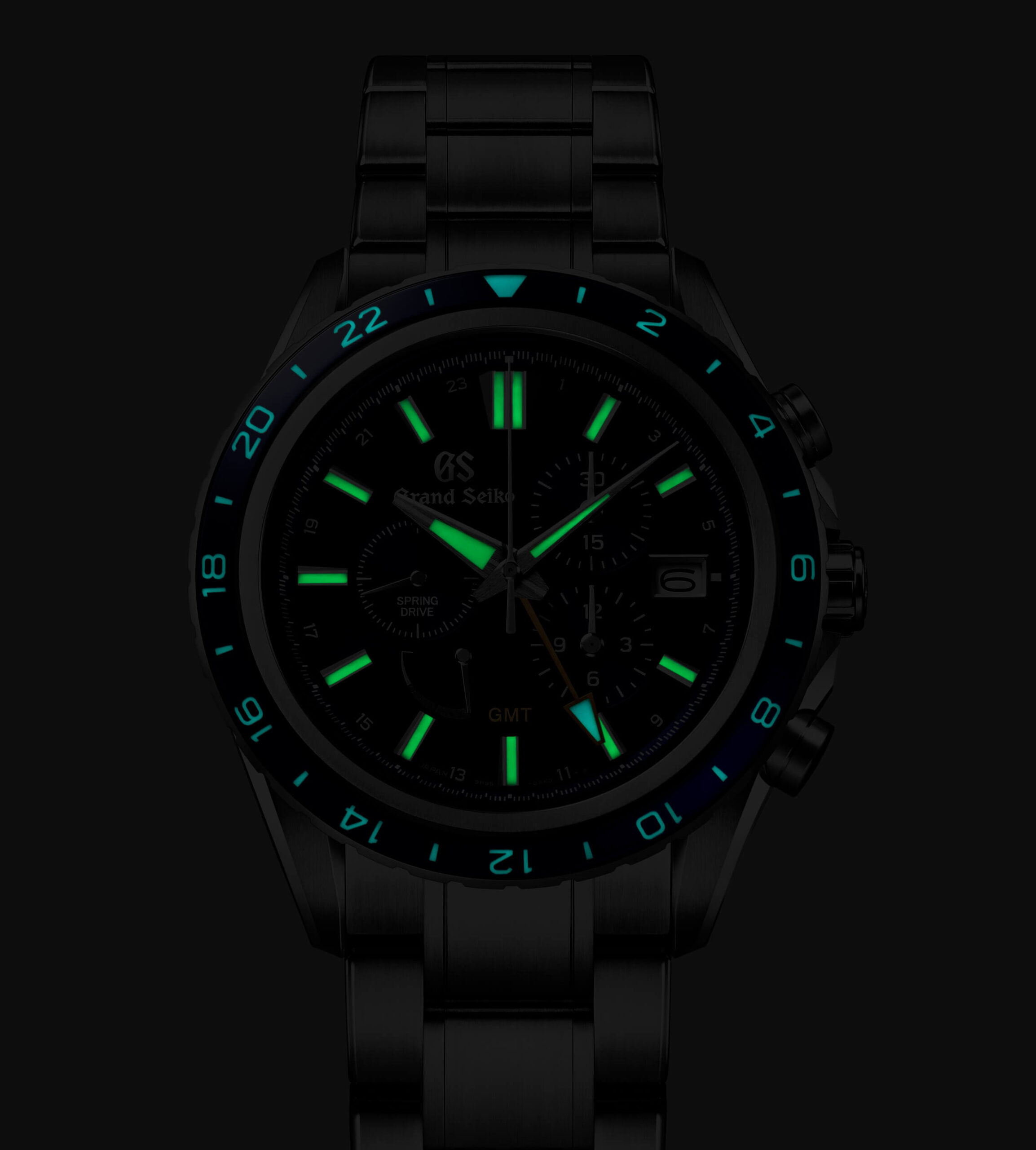
Consistent with other members of the Evolution 9 Collection, the indexes on the SBGC249 are notably wide and high, thereby granting excellent legibility. The central section of each index is, once again, lined with a liberal application of luminescent treatment. The index at noon is double-wide.
This up-to-the-minute model shares the same dial topography as the aforementioned SBGC001 with three counters, one to the left and two to the right. Likewise, the date display, GMT function and a power-reserve all remain in exactly the same dial positions.
Each of the three counters is snailed. A 30-minute register is located between 1 and 2 o’clock, while a 12-hour register sits below, positioned between 4 and 5 o’clock. Finally, a small seconds display resides at 9 o’clock.
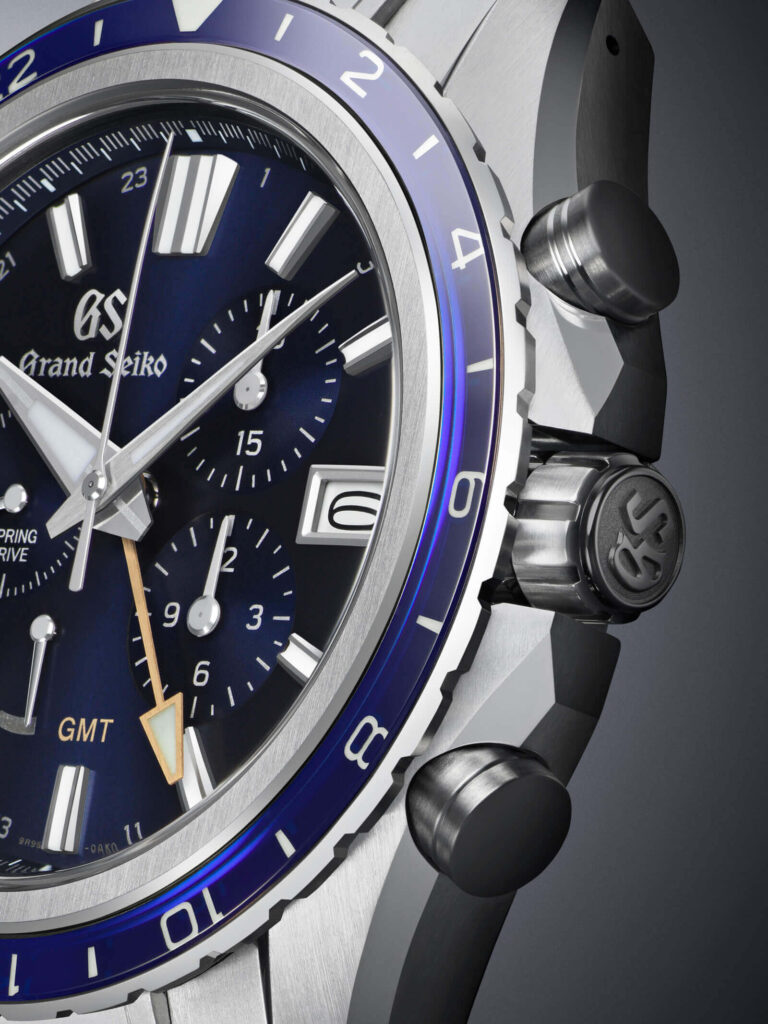
A date aperture is positioned adjacent to the crown. Each of the 31 values applied to the date disc have been optimally designed. Indeed, Grand Seiko selects the best font style and size of typeface for each date value in order to ensure ease of read off.
A yellowy-gold GMT hand, featuring a luminous tip, allows the wearer to display the ‘home time’. The ‘local time’ is shown with the dominant hour and minute hands. The GMT hand can be used in conjunction with the 24-hour track shown on the bezel as a day/night indicator (home time). Alternatively, the bezel can be used to indicate the time in a third time zone.

While the Spring Drive movement features a crystal oscillator (quartz) it does share some things in common with a conventional mechanical movement fitted with a Swiss lever escapement. One component both types of movement share is the spring barrel, effectively the fuel tank of the watch. A power-reserve indicator, located at 7 o’clock reveals the status of the mainspring within the spring barrel, indicating whether the wearer needs top up the movement with a few turns of the crown.
The central sweep seconds hand features an ultra-thin tip which points to a flange-mounted track. The markings allow the wearer to read off both seconds and parts thereof.
The dial of the Grand Seiko ‘Cosmo Blue’ Limited Edition Spring Drive Chronograph SBGC249 imparts much information. However, the scale of the watch allows each dial component sufficient room to breathe.
The case
Measuring 45.3mm in diameter, the Grand Seiko ‘Cosmo Blue’ Limited Edition Spring Drive Chronograph SBGC249 confers much wrist presence. It may sound a comparatively large watch, however, the distance from the top of the watch head to the bottom (12 to 6 o’clock) is comparatively short, hence the watch wears smaller than its stated dimensions may suggest. Moreover, the curved profile of the case forms an ergonomic union with the wrist, coaxing the bracelet to envelop the arm. As stated earlier, the cosseting embrace of the case and bracelet ensemble is a characteristic common to all models within the new Evolution 9 Collection.
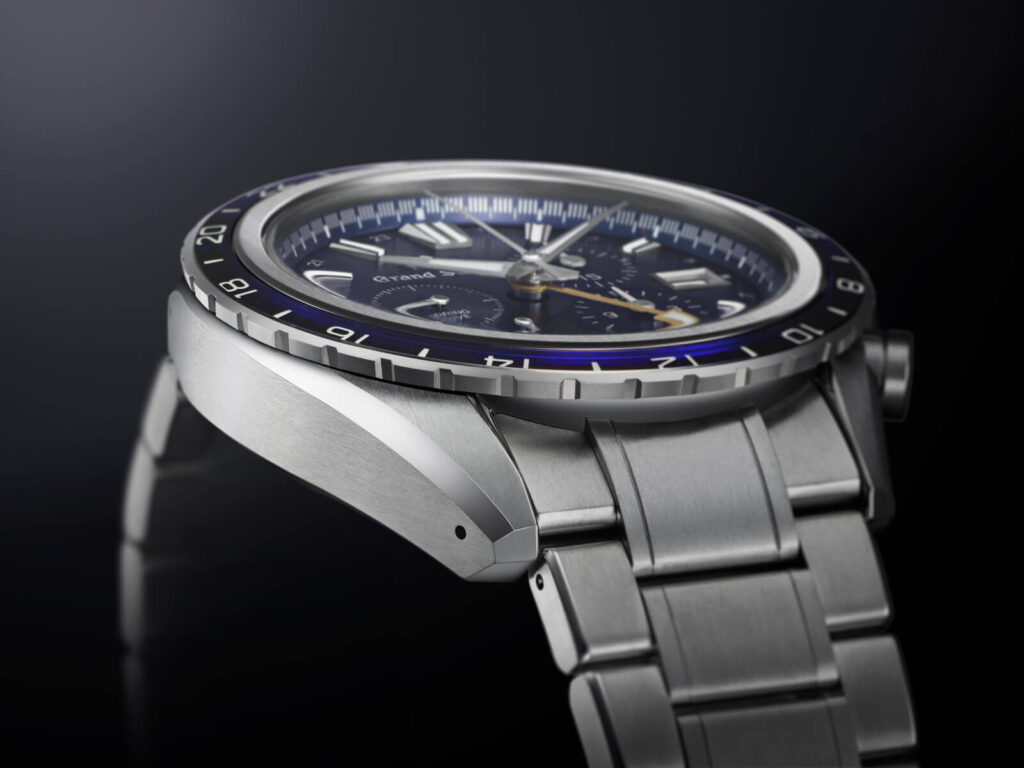
The case is endued with numerous facets, no doubt heightening production costs but delivering a sumptuous appearance. The right flank of the case features a crown protector, mitigating the risk of impacts harming the winding stem. Meanwhile, the pushpieces are partially recessed, reducing the likelihood of them snagging on clothes or other objects.
A dual-curved sapphire crystal is fitted to the front of the watch, while to the rear a see-through caseback affords sight of the self-winding movement. Most surfaces are delivered in a brushed finish. However, there are a number of highly polished accents throughout. Once again, this detail will have heightened production costs, but the resultant appearance delivers a becoming contrast.
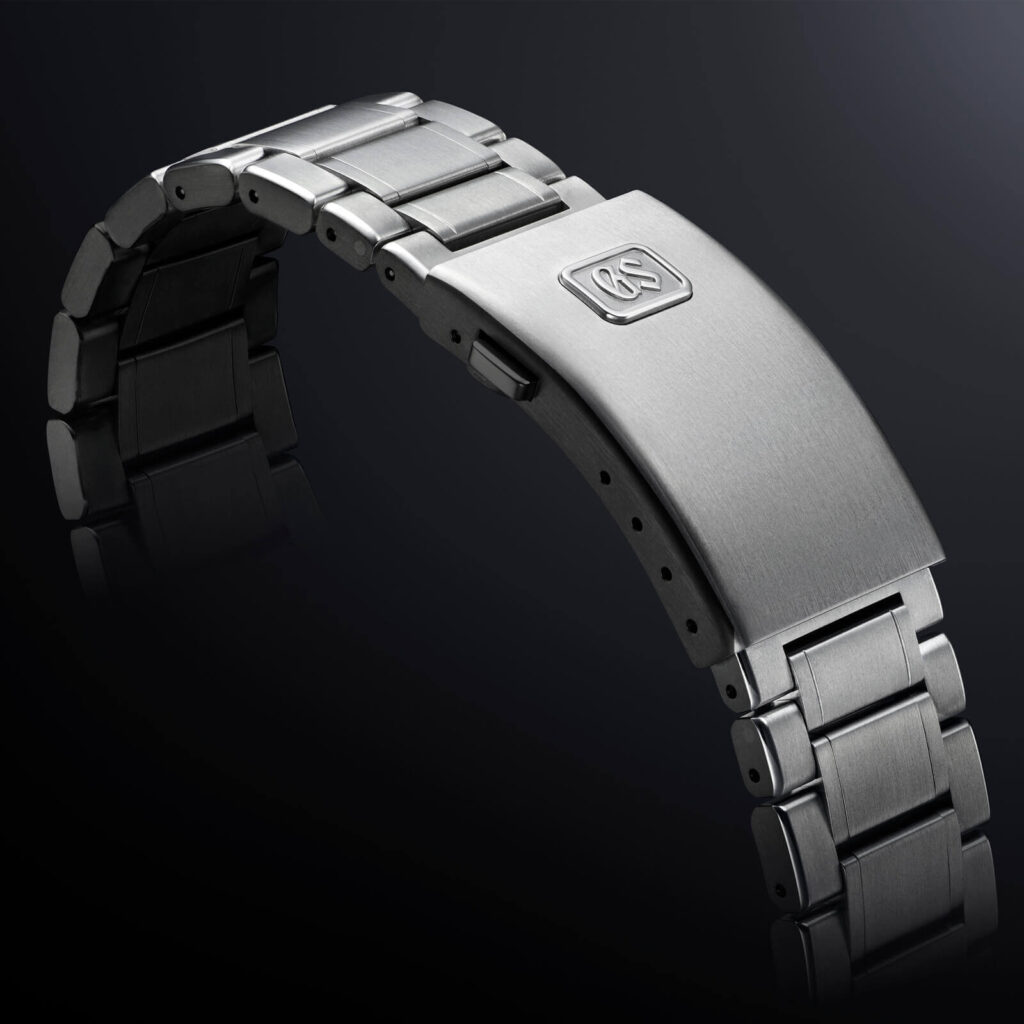
Grand Seiko has chosen to use high-intensity titanium for the case and bracelet. The material is lightweight, corrosion resistant and non-magnetic. Most notably, it is hypoallergenic, a benefit applicable to those wearers with a nickel allergy.
The SBGC249 is water resistant to 10 bar (100m) and has an impressive magnetic resistance of 4,800 A/m.
The movement
Seiko spent over 25 years developing the ‘Spring Drive’ system before it appeared in the brand’s first Seiko-branded model in 1999. Five years later, Grand Seiko released its first watch equipped with a Spring Drive movement. The uniqueness of the Spring Drive concept is that it unites two seemingly different worlds, namely traditional watchmaking and electronic technology.

Image – Caliber 9R86
Similar to a watch equipped with a Swiss lever escapement, the mainspring is tensioned either manually or using an oscillating weight (automatic). The torque generated is then transferred by a series of wheels termed the ‘gear train’. However, this is where the similarities end.
With a conventional mechanical watch, the torque from the gear train is sent to the escapement. The escapement fulfils two roles: providing an impulse to the balance wheel, causing it to oscillate, and locking/unlocking the gear train, thereby controlling the flow of time.
The Spring Drive system is incredibly ingenious. Some of the torque from the mainspring is sent to the ‘Tri-Synchro Regulator’, a component which converts mechanical power into electrical power before sending it to a crystal oscillator (quartz). The oscillator then sends a signal to an electromagnetic brake which in turn controls the ‘glide wheel’. This latter wheel rotates eight times per second, controlling the flow of time. The benefit of a Spring Drive system is that it delivers far superior precision when compared with a conventional Swiss lever escapement. Furthermore, while the central sweep seconds hand on a watch fitted with a Swiss lever escapement has a busy gait, advancing forward in short steps, the hand on a Spring Drive watch glides smoothly, appearing wonderfully serene.

Image – Caliber 9R86
Focussing on the SBGC251 for a moment, this model is fitted with the Caliber 9R86 movement which has been in production since 2007. Justly described as tried and trusted, the accuracy of this movement is stated as ‘± 1 second per day (±15 seconds per month)’. This is impressive, bearing in mind, that some expressions of Haute Horologerie equipped with a precision-enhancing tourbillon, are unable to deliver the same level of accuracy as the Caliber 9R86, despite costing a six-figure sum.
Nevertheless, should you desire superior chronometric performance, then the Grand Seiko ‘Cosmo Blue’ Limited Edition Spring Drive Chronograph SBGC249 may well prove the perfect choice. This model is fitted with the Caliber 9R96 movement. Essentially, this latter movement is identical to the Caliber 9R86 movement, but it is ‘specially adjusted to deliver an even higher level of precision’. Grand Seiko state this movement’s accuracy is ‘± 0.5 second per day (±10 seconds per month)’.

Image – Caliber 9R96
Basically, the chronograph mechanism draws power from the gear train in order to drive an additional train when the wearer wishes to measure an elapsed period. The 9R86 and the 9R96 feature a column wheel and vertical coupling. This combination provides the optimum means of uniting the two trains. For example, unlike inferior chronographs, when the 9R86 is actuated, the central chronograph seconds hand doesn’t stutter or wobble. On the contrary, it leaves the starting gate without any hesitation. Furthermore, the pushpiece feel is silky-smooth, sometimes described by watch afficionados as ‘buttery’.
The Grand Seiko ‘Cosmo Blue’ Limited Edition Spring Drive Chronograph SBGC249 contains 50 jewels. Assuming the mainspring is fully wound, the watch will run autonomously for up to 72 hours.
Closing remarks
With the advent of the recent dual impulse escapement and the Spring Drive movement, Grand Seiko has shown it has an incredible prowess for making watches. But, more notably, it doesn’t subscribe to accepted watchmaking norms. Rather, it embraces innovation and conceives different technologies where these deliver progress. Indeed, the notion of continuous improvement is alive and well at the Japanese marque.

Image – Caliber 9R86
The Caliber 9R86 delivers the benefits of mechanical watchmaking coupled with the benefits of using a Tri-Synchro Regulator and crystal oscillator (quartz). There is no requirement for a battery, the seconds hand has its own unique gait and the degree of precision surpasses that of many watches costing substantially more.
The new bold hands and prominent indexes bestow the SBGC249 with an extraordinary degree of lucidity. Furthermore, despite featuring numerous indications, including a date display, power-reserve indicator, small seconds, two chronograph registers and a GMT hand, the dial remains simple to interpret.
Grand Seiko has expended much effort refining the design of the case and bracelet. In particular, the ergonomic interface between the SBGC249 and its wearer is clearly the product of prolonged consideration. Moreover, the judicious blend of brushed and polished surfaces augments the overall sense of luxury.

Returning to my earlier comment regarding continuous improvement, the introduction of the new Evolution 9 Collection provides horophiles with a fresh alternative to the firm’s other collections. The Grand Seiko ‘Cosmo Blue’ Limited Edition Spring Drive Chronograph SBGC249 blends this new contemporary design language with the proven and dependable Caliber 9R96 movement. This form of fusion horology, makes a strong case for itself while upholding the original aims of the brand, ‘precision, legibility and beauty’.
Further reading
https://www.grandseikoboutique.uk/
Technical specifications
- Model: Grand Seiko ‘Cosmo Blue’ Limited Edition Spring Drive Chronograph SBGC249
- Case: high-intensity titanium case; diameter 45.3mm; height 15.8mm; water resistance 10ATM (100 metres); dual-curved sapphire crystal to front; sapphire caseback.
- Functions: hours; minutes; small seconds; chronograph; date; power-reserve indicator; GMT
- Movement: Spring Drive GMT 9R96; Self-winding movement; 50 jewels; power reserve 72 hours.
- Strap: high-intensity titanium bracelet with 3-fold clasp with push button release.
- Price: £10,500 – SBGC249 (RRP as at 30.3.2022)
- Price: £9,860 – SBGC251 (RRP as at 30.3.2022)