
Chronométrie Ferdinand Berthoud cylindrical balance spring Watch Review
A cylindrical balance spring breathes more concentrically than a flat spiral hairspring when it’s in a vertical position, but when held in a horizontal position, its chronometric performance is impaired. It is for this reason that the flat spiral hairspring has become the go-to oscillator for a wristwatch. However, Chronométrie Ferdinand Berthoud had different ideas and embarked on an ambitious 3-year research and development programme. The resultant watch, the FB 3SPC, is the ‘first and only wristwatch with a cylindrical hairspring that has been officially certified as a chronometer by the Contrôle Officiel Suisse des Chronomètres (COSC)’. Angus Davies chronicles the Maison’s arduous route to achieving chronometric excellence.

The pursuit of precision
Throughout his life, Ferdinand Berthoud (1727-1807), a scientist and watchmaker of great renown, was unwavering in his pursuit of precision. In the 18th century, he was a leading light in the production of marine chronometers used to determine longitude at sea. Berthoud must have always been mindful that the ramifications of poor timekeeping could have potentially grave consequences.
COSC-certified chronometers since 2015
Having acquired the Ferdinand Berthoud name in 2006, Karl-Friedrich Scheufele, Co-President of Chopard, set about reviving the illustrious name. After a lengthy gestation period, Chronométrie Ferdinand Berthoud unveiled its inaugural timepiece, the FB1 in 2015.

The watch, presented in a gimbal-inspired case, was equipped with a suspended fusée and chain transmission system, a stopwork system and a direct drive tourbillon. Featuring much patented know-how and hand-finished to an exalted level, the FB1 demonstrated to the watch-collecting community the brand’s no-compromise mindset.
The FB1 was a COSC-certified chronometer, a benchmark set by the Maison in 2015 and a characteristic common to every reference the firm has subsequently released.

The Chronométrie Ferdinand Berthoud FB 3SPC
In October 2022, the prestigious marque unveiled a new timepiece, the FB 3SPC. Unlike the previous references produced by Chronométrie Ferdinand Berthoud, the FB 3SPC eschewed said fusée and chain transmission system, stopwork system and direct drive tourbillon.
Instead, the FB 3SPC was fitted with a cylindrical hairspring endowed with two hand-crafted terminal curves.

Berthoud’s Marine Chronometer No.54 featured a cylindrical hairspring
Most mechanical watches are fitted with a flat spiral hairspring; hence the use of a cylindrical hairspring is very unusual. However, this form of unusually-shaped hairspring was actually employed on Berthoud’s Marine Chronometer No.54 back in the 18th century.
The benefit of using a cylindrical hairspring within a marine chronometer is that it can deliver a high degree of precision due to its superior stability and isochronism (see later). However, this only applies when the hairspring is held in a vertical position, as in the case of Berthoud’s gimbal-mounted marine chronometer.
When a cylindrical hairspring is held in a horizontal position, for example, within a wristwatch, the additional mass of the cylindrical hairspring compared with its flat spiral hairspring counterpart, accentuates chronometric errors, making it unsuitable. In particular, when a cylindrical balance spring is held in a horizontal position, supported at each end, the middle section will bend under gravity and hang down, adversely affecting chronometric performance.
Nevertheless, undeterred Chronométrie Ferdinand Berthoud embarked on a three-year journey, endeavouring to overcome any potential drawbacks of using a cylindrical hairspring in its pursuit of achieving chronometric excellence.
Prior to discussing this protracted research and development process, it is important to look at the theory behind regulating organs and, specifically, isochronism.
What is isochronism?
In 1657, Christiaan Huygens, the Dutch astronomer, mathematician, physicist and watchmaker, invented the pendulum clock. The pendulum was the first harmonic oscillator. The arc of the pendulum, as it swings backwards and forwards, is referred to as the amplitude and is measured in degrees. If the clock is isochronous, the period taken for the pendulum to swing backwards and forwards is the same irrespective of the amplitude.
A regular mechanical wristwatch usually features a Swiss-lever escapement and regulating organ or balance, comprising a flat spiral hairspring and balance wheel. Like the pendulum, the balance rotates backwards and forwards.
For a watch to be precise, the hairspring must breathe concentrically ie it must be isochronous. This requires that the coils of the hairspring are equidistant from one another and are perpendicular to the balance staff.
The cylindrical hairspring – realising its potential
The reason why a cylindrical hairspring delivers superior isochronism in a vertical position is that its coils form a helix which develops more concentrically than a flat spiral hairspring. As stated previously, by breathing more concentrically, the hairspring delivers superior isochronism.
Unfortunately, when held in a horizontal position, the increased mass of the cylindrical hairspring amplifies any chronometric error.
At this juncture, most companies would accept this horological wisdom and pursue an alternative form of oscillator. However, since the prestigious name was revived, it has never countenanced the notion of making life simple; horological pre-eminence has always been the firm’s raison d’être.

Decimal Watch no.26, Louis Berthoud, 1793
Back in the 18th century, Louis Berthoud, Ferdinand Berthoud’s nephew, created a pocket chronometer equipped with a cylindrical hairspring.
The Decimal Watch no.26 was produced during the French Revolution (1787-1799), a period of political and societal change that ultimately led to the ideals of liberty, equality and justice. It was during the French Revolution that the decimal system emerged, albeit it never replaced the sexagesimal system that we continue to use today. Nevertheless, this pocket chronometer inspired the modern-day company to explore the cylindrical hairspring further.

Making a viable wrist-worn chronometer equipped with a cylindrical hairspring
As stated previously, to equip a wristwatch with a cylindrical hairspring which also delivers a high degree of precision represents a huge challenge. Moreover, the Maison determined from the outset that the FB 3SPC had to be an officially certified chronometer (COSC). This was a bold undertaking as it had never been done before.

A few companies have used cylindrical hairsprings within a wristwatch in combination with a tourbillon. As the tourbillon cage rotates it negates any positional variations. However, from the outset, Chronométrie Ferdinand Berthoud sought to achieve high precision without using a tourbillon escapement.
The Maison began its long journey trying to enhance isochronism and ameliorate the variations in the behaviour typically found with a cylindrical hairspring held in a horizontal position. At all times, the prestigious marque needed to ensure that it did not lose sight of the rationale for using a cylindrical hairspring, namely to improve accuracy.
With little empirical data available, the team at Chronométrie Ferdinand Berthoud embarked on a protracted process of experimentation, observation and evaluation. Initial tests suggested adding terminal curves to the cylindrical hairspring, albeit as I go on to explain later, this was no simple feat.
Chronométrie Ferdinand Berthoud cylindrical balance spring – terminal curves
Back in the 18th century, John Arnold (1736-1799) produced a helical hairspring (cylindrical hairspring) with upper and lower terminal curves, while Abraham-Louis Breguet (1747-1823) applied a terminal curve, the Breguet overcoil, to a flat spiral hairspring.
In 1860, the French engineer and mathematician, Edouard Phillips (1821-1889), established that there was a relationship between the period of oscillation, the balance’s moment of inertia, the length of the hairspring and the ‘elastic moment’ (the force the spring exerts multiplied by the radius).
The objective of applying a terminal curve to a hairspring is to augment its capacity to breathe concentrically. Usually, terminal curves are applied to the outer coil of a flat spiral hairspring; however, they can be applied to the inner coil, albeit this is rare due to the difficulty of forming such a tiny curve.
Collet and pin
Initial tests conducted by Chronométrie Ferdinand Berthoud showed the terminal curves applied to the cylindrical hairspring performed as expected but once pinned to the collet, the hairspring breathed asymmetrically ie it was biased to one side. Left unaddressed, this would introduce a variation in the daily rate.
In order to address this problem, the team based in Fleurier had to find a way of reducing the mass of the collet, bringing the centre of gravity closer to the balance wheel axis. Unfortunately, as any watchmaker will attest, making one adjustment invariably necessitates making another! By way of an example, when a timing screw, mounted on the rim of the balance wheel, is rotated, its counterpart positioned opposite has to be adjusted as well.
Edouard Phillips’ formula shows that the centre of gravity of the curve situated on a line AB (from the centre to 9 o’clock should be perpendicular to a line AC (from the centre to 12 o’clock) and the centre of the spring A=AC²/L (where L is the length of the curve measured from C to the stud).

After reducing the weight of the collet, the Maison had to revisit the geometry of the terminal curves in order to bring the centre of gravity close to the balance wheel axis/balance staff. Numerous calculations were made and the team at Chronométrie Ferdinand Berthoud selected a hairspring design featuring two terminal curves, one at each end, each incorporating three bends (six in total).
As part of their work in this field, Résal and Caspari established that the attachment point of the hairspring to the collet and the point of attachment to the stud must be perpendicular to one another in order to achieve isochronism.
Ultimately, after exhaustive tests, the final design of the cylindrical hairspring satisfied the technical requirements identified in the work undertaken by Résal and Caspari as well as Phillips.
Chronométrie Ferdinand Berthoud cylindrical balance spring – countering the effect of gravity when held in different positions
Back in the 18th century, Ferdinand Berthoud’s Marine Chronometer No.54 was mounted in a gimbal system, ensuring the cylindrical balance spring always remained in a vertical position ie its optimal position. However, when a watch, equipped with a cylindrical balance spring, is worn on the wrist, it will be held in a multitude of positions, some of which will inevitably impair precision. For instance, when placed in a horizontal position, secured at each end, gravity will cause the middle part of the balance spring to bow or hang down. The R&D team at Chronométrie Ferdinand Berthoud embarked on a research project, seeking to address the balance spring’s tendency to bow. It eventually succeeded in creating a balance spring that delivers precision in every position.
Chronométrie Ferdinand Berthoud cylindrical balance spring – a variable inertia balance
Most mechanical watches are fitted with a curb regulator. The hairspring passes through two curb pins mounted on a ‘raquette’. By moving the raquette towards or away from the stud, the effective length of the hairspring becomes longer or shorter, thereby altering the rate (slower/faster, respectively).
The movement in the FB 3SPC is fitted with a variable inertia balance. With this form of regulator, the effective length of the hairspring is fixed. The rate is adjusted by tightening or loosening timing screws affixed to the rim of the balance wheel. In the case of this movement, there are 4 fine adjustment screws fitted to the rim of the balance wheel which are used to alter the rate (moment of inertia).

This form of regulating system not only offers greater precision but also means that should the watch experience a minor shock it is less likely to require remedial regulation. The variable inertia balance takes longer to regulate but then as you have probably realised, the team at Chronométrie Ferdinand Berthoud are driven by excellence rather than simply making life easy.
The balance wheel is also fitted with 8 load screws which are used to poise the balance, ensuring it runs true and free of wobble. This is a similar scenario to adding weights to the rim of a wheel after a new tyre is fitted.

Using a variable inertia balance increased the overall mass of the balance wheel, which adversely affected the amplitude. The Maison increased the torque of the barrel, but with due to consideration to other factors. For example, excess torque could lead to banking, again impairing precision. Likewise, the force reaching the escapement may vary too much, impairing rate stability.
All factors had to be considered in minute detail, ensuring one perceived advance did not adversely affect something else.
Chronométrie Ferdinand Berthoud cylindrical balance spring – handcrafted
In a world where watch components are mass-produced using CNC, stamping, spark erosion and bar-turning machines, it may come as a surprise to hear that the aforementioned terminal curves are formed by hand.

To impart curves to a three-dimensional hairspring is no simple feat. The hairspring is placed under a projector with the desired profile superimposed over the top. Magnified 20 times, the watchmaker has to precisely bend the hairspring into the desired shape. If he/she fails to adhere to the precise outline shown, the timepiece will not be to specification and will not deliver the desired precision.

The poising of the balance is done by hand using a poising tool and a soft brush. The watchmaker entices the balance wheel to rotate with the brush in order to identify any heavy spots and adjust the load screws.

While Chronométrie Ferdinand Berthoud was unwavering in its quest to achieve high levels of precision, it did not abandon aesthetics. The FB 3SPC is glorious to behold. Furthermore, its design blends functionality with the opportunity to see various mechanical parts in motion.
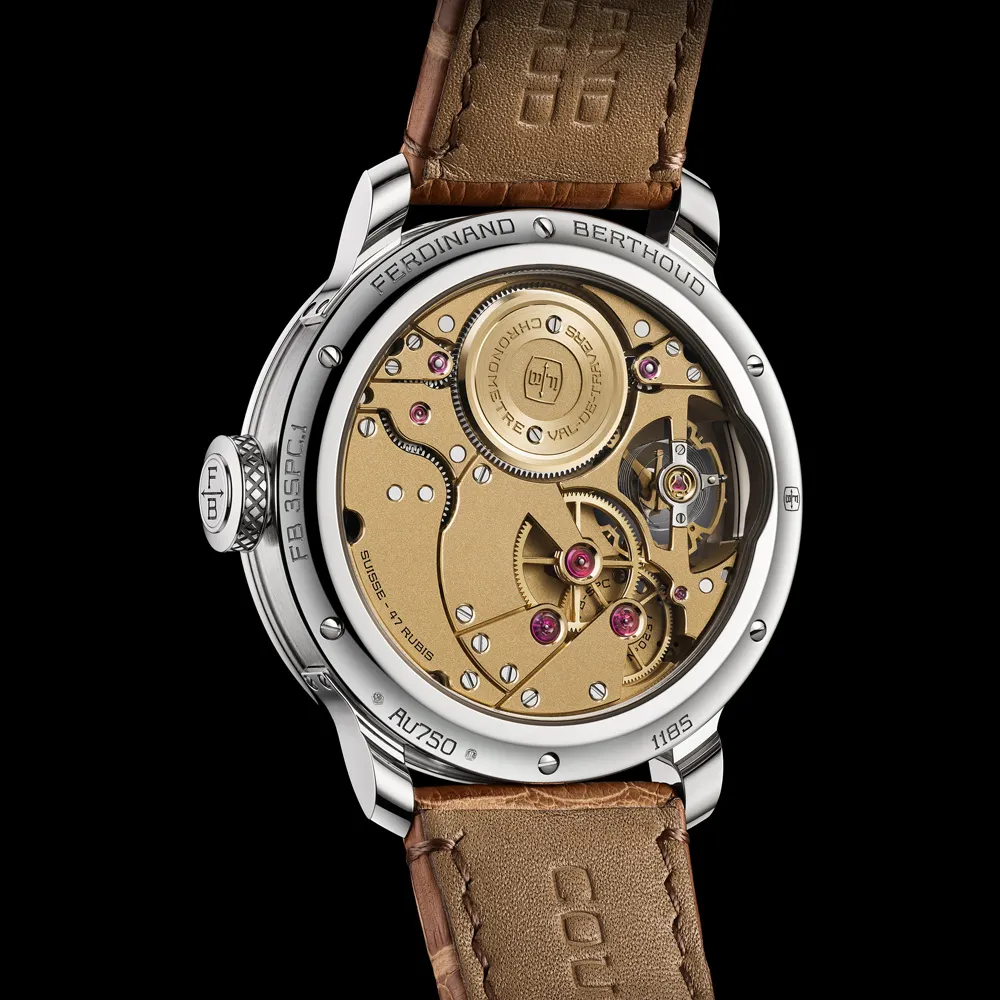
To the front of the watch, the escape wheel, pallet lever and cylindrical hairspring are revealed for the delectation of the purist. These components, presented on two raised cocks, are juxtaposed with sandblasted bridges and matching mainplate, ‘hand-finished to the highest watchmaking standards’.
Chronométrie Ferdinand Berthoud cylindrical balance spring – closing remarks
Whilst inspired by the Decimal watch no.26 of 1793 created by Louis Berthoud and the famous marine chronometers made by his uncle, the decision by the Maison to produce a modern-day wristwatch equipped with a cylindrical balance spring was very courageous.
Chronométrie Ferdinand Berthoud could have elected to combine the hairspring with a tourbillon or may have been tempted to experiment with using silicium. However, Mr Scheufele’s brief was clear. He wanted a wristwatch incorporating a cylindrical balance spring sans tourbillon that would meet the requirements of COSC.

To date, at the time of writing this article, 40 movements have passed the criteria stipulated by COSC, exhibiting a rate variation of 2.08 seconds per day. To provide some context, the COSC standard is -4 to +6 seconds per day. The Fleurier-based atelier also states, ‘On an individual basis, the daily variation for 80 per cent of the tested movements is between -1 and +3 seconds per day, exceeding COSC precision standards by a factor of 2.5’.
Since unveiling its inaugural timepiece in 2015, Chronométrie Ferdinand Berthoud has shown it respects the legacy of the eponymous watchmaker and his descendants, taking inspiration from past creations while simultaneously embracing the present. But beyond the beauty and the craftsmanship, today’s Maison has also shown it is willing to tackle numerous technical obstacles in the pursuit of precision, just like the great man himself.