
Carl F. Bucherer Manero Minute Repeater Symphony – Part One
The Carl F. Bucherer Manero Minute Repeater Symphony is the most technically ambitious watch to be produced by the Lengnau-based Manufacture. In the first part of this two part feature, Angus Davies looks at this new model’s remarkable movement.

To be a Manufacture
When appraising the upper echelons of Haute Horlogerie it would be wrong to assume that the most prestigious Maisons have always made all of their own movements. Quite simply, this is not the case. Indeed, the most venerated companies were previously établisseurs, procuring ébauches and various components from third-party specialists. Établisseurs finish parts, assemble movements and ultimately regulate watches.
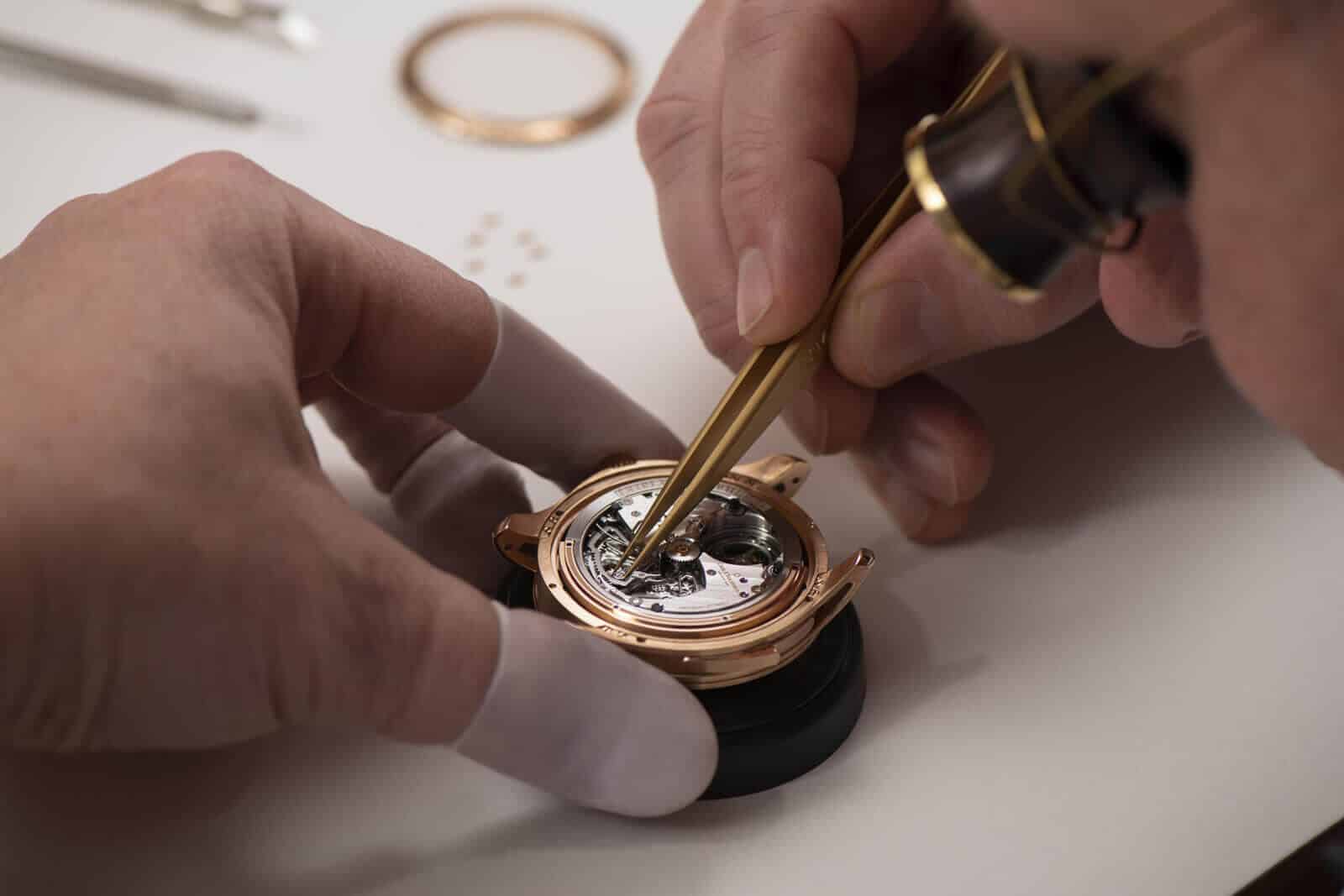
An ébauche comprises of the mainplate, bridges and barrel. It can also include jewels, but not always, and is supplied without the regulating organ, mainspring, dial or hands. This approach was common until a few years ago.
Producers of more accessible watches often draw on the expertise of movement specialists such as ETA, Sellita, Soprod et al. In this instance, movements are supplied as complete units, with the level of finishing specified by the individual watch brands. Most Maisons adopting this approach, choose to focus on habillage, essentially all watch components except the movement.
To transition from using third party ébauches or complete movements to become a fully-fledged Manufacture represents a huge undertaking. It necessitates recruiting staff with the appropriate skills and purchasing a variety of expensive machines. This inventory of plant often includes CNC, profile-turning and wire erosion machines.
CNC machines are used for making mainplates, bridges and cocks. Profile-turning machines are used to produce screws, pinions and gear wheels. Wire erosion machines are needed to make the smallest bridges, levers and springs. However, the asset register extends beyond the aforementioned plant and includes CAD systems as well as small, seemingly incidental pieces of equipment such as micrometres, movement holders, oscillating weight presses, etc. Indeed, the capital investment needed to make in-house movements is significant.
Carl F. Bucherer – a desire for independence
Carl F. Bucherer founded his eponymous company in 1888. Today, it is owned by Jörg G Bucherer, the third generation of the family to be actively involved in the business. Unusually, the company is located in Lucerne in what is often termed ‘The Heart of Switzerland’, far away from where the majority of watch brands are based in the French-speaking parts of the country. Certainly, the location of the brand’s headquarters has influenced the character of its watches, infusing them with a unique character all of their own.

CFB A1000 calibre
Therefore, it was a surprise when the company chose to acquire a business in Sainte-Croix, a French-speaking municipality within the canton of Vaud, far away from home. The company’s objective was clear, it wanted to produce its own in-house movement. An extensive process of research and development began in 2005. Three years later, in 2008, the prestigious firm unveiled its inaugural movement, the CFB A1000 calibre. Unusually, the movement featured a peripheral rotor. This endowed the calibre with a slim profile and bestowed uninterrupted views of the regulating organ and angular bridges. Over subsequent years, the firm has created five modules and several patented innovations, including the firm’s dynamic shock absorption system.
Lengau Manufacture
In 2016, the Manufacture relocated to Lengnau, its current home. Located just one hour from Lucerne, Lengnau is a German-speaking area of Switzerland, arguably more consistent with the firm’s culture. Shortly after it opened, I was invited to tour the facility. Despite having visited dozens of watch factories, I was struck by its clinical and orderly approach to watchmaking. Benches were not strewn with tools, tidiness was the order of the day.

Over the years, Carl F. Bucherer has not ceased innovating, releasing the CFB A2000 calibre in 2016, again fitted with a peripheral rotor, and the CFB T3000 calibre in 2018. Most recently, at Watches and Wonders 2021, Carl F. Bucherer unveiled its most technically impressive movement to date, the MR3000 Manufacture Calibre.
MR3000 Manufacture calibre – a Grand Complication
The MR3000 Manufacture calibre features within the Carl F. Bucherer Manero Minute Repeater Symphony, a horological tour de force best described as a ‘Grand Complication’. I will discuss this watch and its movement in due course, but first I wish to return to the CFB T3000 calibre, a movement that has clearly influenced the design of the new MR3000 Manufacture calibre that eventually followed.
CFB T3000 calibre
The CFB T3000 calibre was initially used in the Carl F. Bucherer Manero Tourbillon Double Peripheral. The following year (2019), the same movement appeared in the Carl F. Bucherer Heritage Tourbillon Double Peripheral Limited Edition, an exquisite watch limited to just 88 pieces. It features a peripheral rotor and a peripherally suspended floating tourbillon.
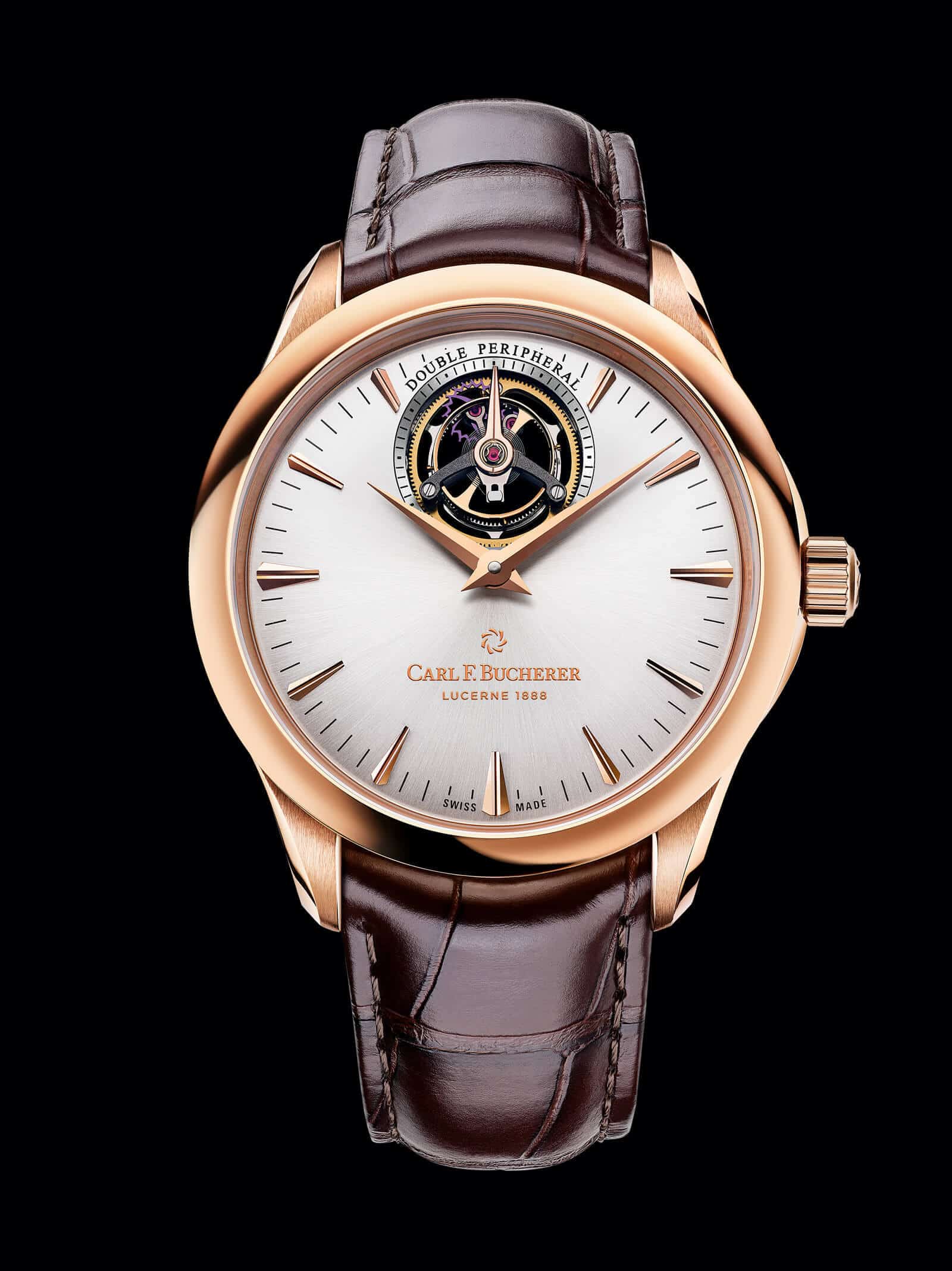
Image – Carl F. Bucherer Manero Tourbillon Double Peripheral
The tourbillon was patented in 1801 by Abraham-Louis Breguet. This ingenious device places the escapement and regulating organ within a rotating cage, mitigating the adverse influence of gravity on the balance, thereby aiding precision. The cage is held in place with an upper and lower bridge.
In 1920, Alfred Helwig invented the Flying Tourbillon. Its purpose was the same as Breguet’s device but it eschewed the upper bridge, thereby affording superior views of the escapement and regulating organ in motion.
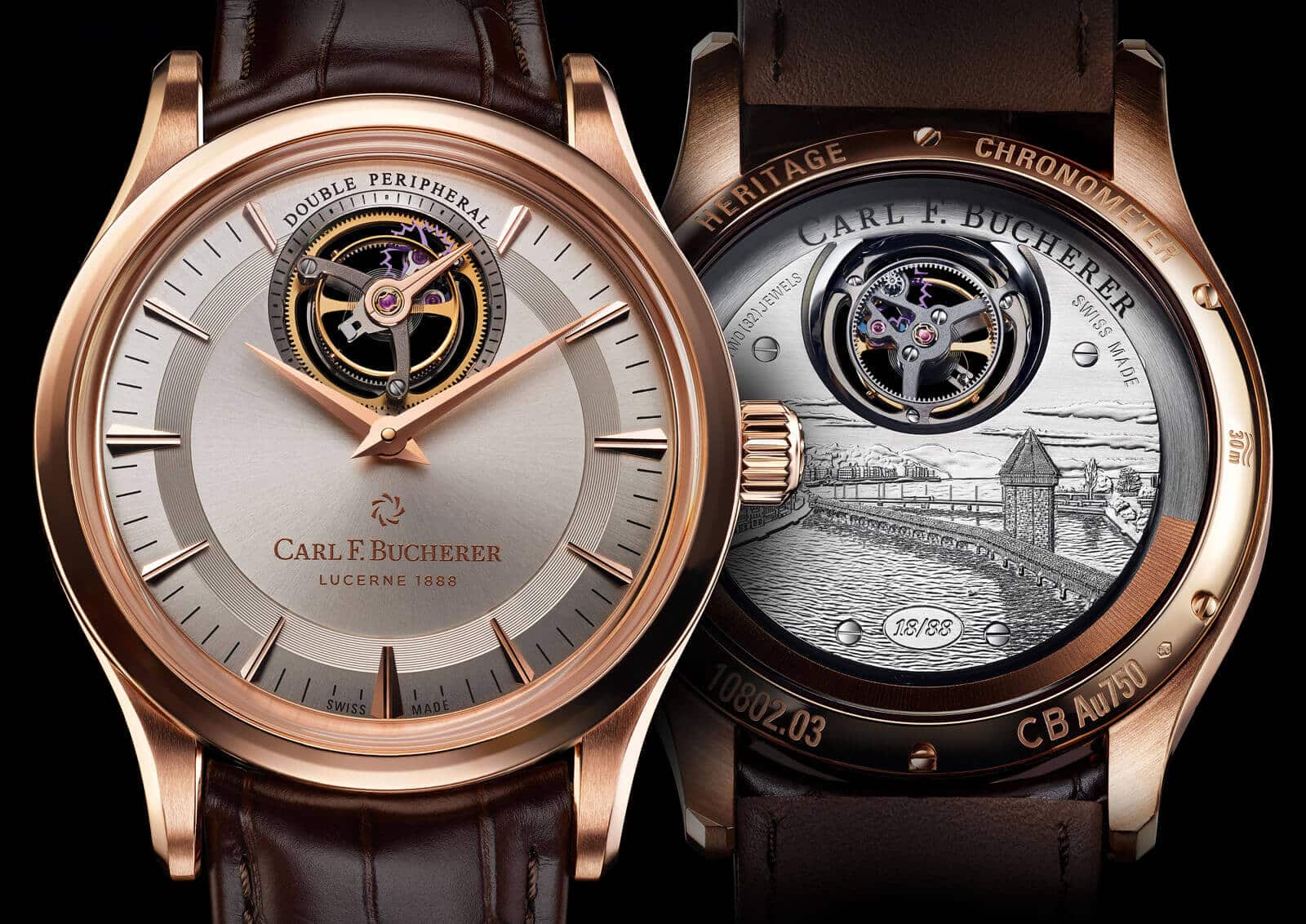
Image – Carl F. Bucherer Heritage Tourbillon Double Peripheral Limited Edition
Peripherally suspended floating tourbillon
The CFB T3000 calibre pairs a peripheral rotor with a ‘peripherally suspended floating tourbillon’. The tourbillon cage rests on three ceramic ball bearings that are positioned out of view. In effect, the cage is supported from the side instead of above and below or just below. The result is the cage appears to levitate within the case, bestowing sublime views of various components in motion.
Silicon escape wheel and pallet lever
Carl F. Bucherer has also equipped the movement with a pallet lever and escape wheel made of silicon. This glass-like material is lightweight and has low-frictional characteristics, two factors that contribute to the movement’s impressive 65-hour power reserve.
Silicon is not influenced by magnetism or changes in temperature. It is also not liable to corrosion. Again, these characteristics are also beneficial when making watches.
Although the purpose of a tourbillon is to enhance precision, most examples lack the facility to halt the seconds function and synchronise the movement with a reference clock or watch. Carl F. Bucherer has addressed this issue, allowing the wearer to halt the rotation of the cage and lock it in position merely by pulling out the crown. Pushing the crown home causes the cage to burst back into life and recommence its spinning behaviour.
COSC-certified movement
The CFB T3000 calibre is a certified chronometer (COSC), providing independent assurance of its timekeeping prowess.
When it released the CFB T3000 calibre in 2018, best described as ‘high complication’, Carl F. Bucherer demonstrated to watch aficionados its remarkable watchmaking expertise.
Carl F. Bucherer Manero Minute Repeater Symphony – MR3000 Manufacture calibre
The recently launched MR3000 Manufacture calibre shares much in common with the CFB T3000. Like its older sibling, the new MR3000 Manufacture features a peripheral rotor and a peripherally suspended floating tourbillon. However, it also combines this latter high complication with a second high complication, a minute repeater.

Carl F. Bucherer Manero Minute Repeater Symphony – gongs and hammers
The minute repeater can trace its origins to a time when streets were usually unlit. The owner of a pocket watch, unable to see the time displayed on the dial, could slide a lever on the caseband and actuate a mechanical chiming sequence. Two hammers would strike two gongs, chiming the hours, quarters and minutes in sequence, thereby imparting the prevailing time aurally.
Today, wristworn minute repeaters are more popular than their pocket watch counterparts.
Typically the gongs are made of steel and formed into two discrete circlets. Each steel circle is made from wire that is formed by hand, heated and quenched. Some brands have quenched gongs in horse urine to achieve the desired hardness and perfect sound, however, few Maisons share trade secrets and the making of gongs is shrouded in secrecy. Once the two gongs are complete, they are tuned by removing superfluous material with a file. However, great care is needed to avoid too much material being removed.
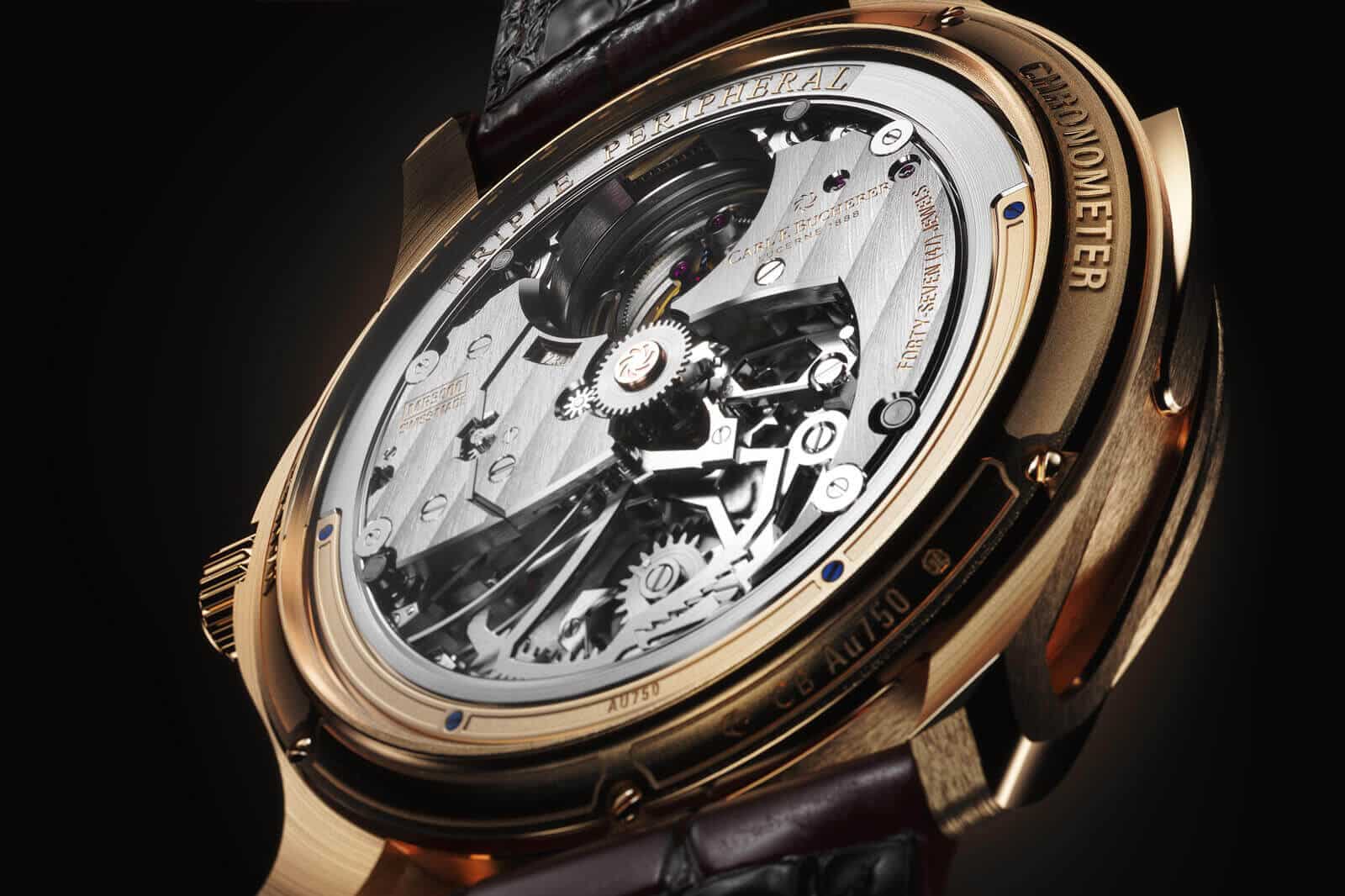
Thereafter, the gongs are affixed to the case using a ‘plot’. Each gong emits a particular note and is struck with its own dedicated hammer. Normally, the chiming sequence starts with a low tone for the hour, a combination of both hammers striking the gongs (high and low tones) for the quarters, each strike slightly spaced apart, and lastly high tones for the minutes.
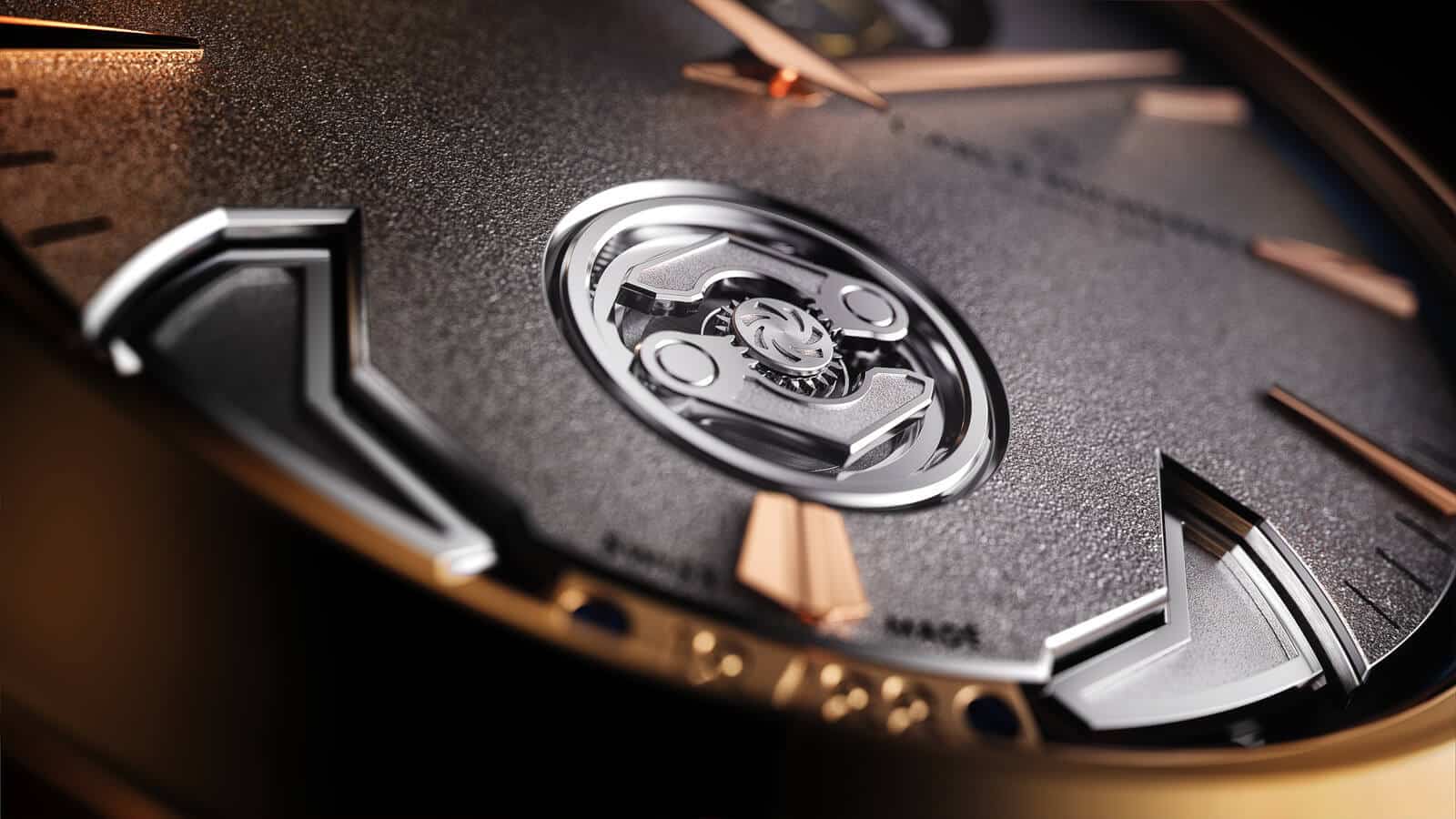
Three snails, which are semicircular-shaped cams, one for the hours, one for the quarters and a third for the minutes are connected to the motion works. The snails converse with racks and wheels, informing the hammers how many times to strike the hours, quarters and minutes. To ensure the hammer strikes are optimally spaced apart, the movement features a centrifugal governor. This spins silently to avoid marring the exquisite chiming experience.

The minute repeater is second only to the grande sonnerie in terms of complexity and usually requires the expertise of the most experienced Master Watchmaker. The creation of a minute repeater is protracted, a fact that is often reflected in its price.
Carl F. Bucherer Manero Minute Repeater Symphony – the ultimate expression of Haute Horlogerie
Similar to a tourbillon, the minute repeater is described as a ‘high complication’. Often when a watch company combines two high complications within one timepiece, it is described as a ‘grand complication’, albeit there appears to be no formal definition. Certainly, the ‘grand complication’ is generally considered the ultimate expression of Haute Horlogerie.
During Watches & Wonders 2021, I was offered the opportunity to interview Samir Merdanovic, Chief Technology Officer of the Lucerne-based brand. I had many questions about the new Carl F. Bucherer Manero Minute Repeater Symphony and, more specifically, its highly technical movement, the MR3000 Manufacture calibre.
In conversation with Samir Merdanovic, Chief Technology Officer of Carl F. Bucherer

Can you tell me a little bit about yourself, including your role at Carl F. Bucherer?
I am a watchmaker and a watch engineer. I am in charge of the Manufacture in Lengnau.
Would you describe the new model as a ‘Grand Complication’?
The watch is more than simply a combination of a tourbillon and a minute repeater…there is much more going on inside.
We began using peripheral rotors in 2008 and wanted to include this feature within the new movement. Likewise, we wanted to use our peripherally suspended floating tourbillon. It was important to us that the new watch was a certified chronometer and we wanted the movement to have a stop seconds that halts the cage immediately.
In addition, we recognised that the potential for harm with most minute repeaters relates to the manipulation by the wearer. If a minute repeater is running and the wearer rotates the crown it can damage many parts. Therefore, we introduced a safety mechanism which prevents manipulation of the crown when the watch is performing a chiming sequence or vice-versa.
I have known some individuals activate the minute repeater and then during the chiming sequence, activate it again, causing much damage. Could this happen with your movement?
No, because we have fitted an ‘all or nothing’ system. When you press the pushpiece at 9 o’ clock to actuate the minute repeater, you have to press it fully to the end. This touches a blocked component which is then freed. Thereafter, while this component is free, you can press the pushpiece repeatedly and nothing more will happen. Once the mechanism has completed the chiming sequence, it will block again, ready for the wearer to press the pushpiece at some future point.
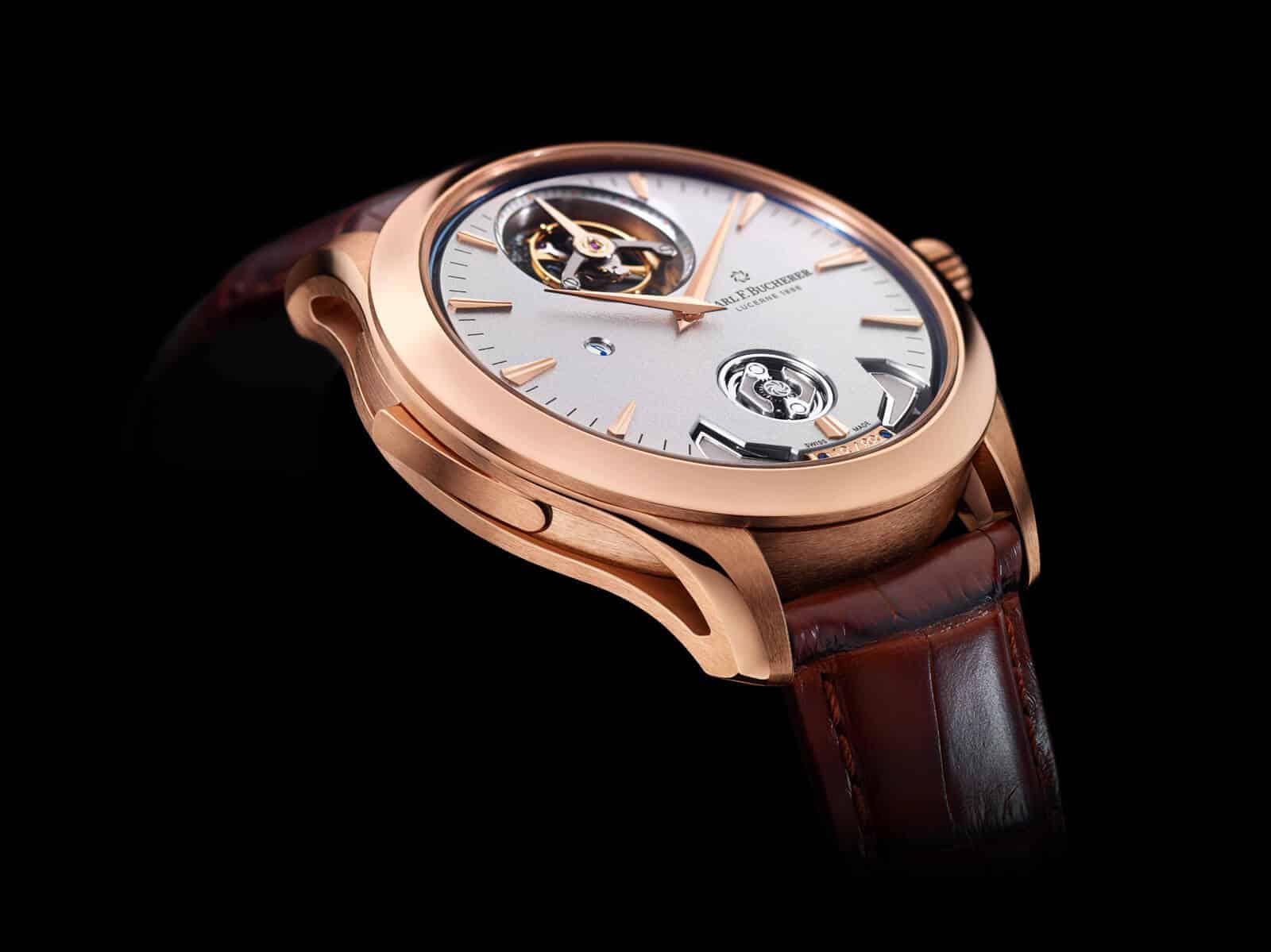
Returning to your original comment, it is all of these small details which make this, in our opinion, a true ‘Grand Complication’.
I know from speaking to other brands in the past that the ‘perfect sound’ cannot be measured, it is purely subjective. The ‘perfect sound’ for one person may not be the optimal sound for somebody else. How do you arrive at your ‘perfect sound’?
The customer can specify their preferred sound and have personalised gongs. After all, we are making a high-end watch with a number of personalisation opportunities. We are able to do this as the model is limited to just 88 pieces. Unusually, the gongs are presented in blue CVD, but they can be specified in red.

This brings me to another question. Can a watch be personalised to include artistic crafts such as hand-guilloché, gem-setting, miniature painting or other enamel techniques? Alternatively, could a client specify a different case material?
Yes, with pleasure. As watchmakers, we love to create unique pieces, especially when we are able to employ artisanal techniques. With the Manero Minute Repeater Symphony we have the perfect product for customisation.
Part Two
In the next part of this feature, I will look at the Carl F. Bucherer Manero Minute Repeater Symphony in detail, focussing on each element of the dial, case and movement.