
Ferdinand Berthoud Chronomètre FB 2TV Watch Review
Since its renaissance in 2015, Chronomètre Ferdinand Berthoud has created an impressive body of work. Respectful of its heritage, the forward-thinking brand has just announced the new Mesure du Temps 1787 Collection, named after one of the great man’s treatises. The inaugural ‘chapter’ is the Ferdinand Berthoud Chronomètre FB 2TV, a watch endowed with a plethora of mechanical refinements, including a flying tourbillon with constant force via a fusee-and-chain mechanism. Angus Davies provides an in-depth look at this horological masterpiece, pointing out its many refinements.
Ferdinand Berthoud – a pioneer
Throughout history there have been pioneers, rare individuals who reject the status quo in the pursuit of progress. These curious minds look to the horizon, choosing to embark on a journey of discovery, keen to break new ground. Ferdinand Berthoud (1727-1807), born in Plancemont, a verdant idyll located in the Canton of Neuchâtel, was one such individual. Berthoud was a master watchmaker, a rara avis, who became a ‘foreign associate member’ of the Royal Society in London (1764) and was subsequently appointed Watchmaker-Mechanic to the King and to the Navy (France – 1770).
During the 18th century, navigating the seas was fraught with risk. Sadly, many lives were lost with vessels mistakenly crashing into rocks in bad weather or the dark of night, hence the need to determine longitude at sea was of utmost importance. Famously, John Harrison (1693-1776), the English clockmaker, invented the first marine chronometer, H1 (completed in 1735). Thereafter, he would devote the remainder of his professional life conceiving increasingly precise marine chronometers, culminating in the H4 (circa 1751), a highly precise marine chronometer resembling a large pocket watch.
In France, Ferdinand Berthoud was engaged in writing various horological texts, including ‘L’Art de conduire et de régler les pendules et les montres’ (The art of operating and adjusting clocks and watches, 1759), ‘Mémoire sur les principes de construction d’une Horloge de Marine’ (A treatise on the principles of marine chronometer construction, 1760) and ‘Essai Sur L’Horlogerie’, (An essay on watchmaking, 1762), a two volume horological treatise.
Based on the principles outlined in the treatise of 1760, Ferdinand Berthoud produced his inaugural marine clock, the aptly named No.1 (completed in 1761). Like Harrison, Berthoud would continue in his quest to make increasingly precise marine chronometers.
In 1787, Berthoud published a further treatise, ‘De la Mesure du Temps ou supplement au Traité des horloges marines et à l’Essai sur l’horlogerie’ (On the Measurement of Time or Supplement to the Treatise on Marine Clocks and the Essay on Horology). In this text, he set out the principles of construction, execution and testing of small longitude clocks along with their application to pocket watches.
Inspired by Berthoud’s treatise of 1787, Chronomètre Ferdinand Berthoud has announced the creation of a new series of ‘chapters’ bearing the Mesure du Temps 1787 name. Marked by a new ‘architectural evolution that began in 2025 with the creation of the Naissance d’Une Montre 3’, the Swiss marque continues this creative journey with the newly released Chronomètre FB 2TV.
Ferdinand Berthoud – the rationale for innovation
Since the rebirth of Chronomètre Ferdinand Berthoud in 2015, the Maison has crafted timepieces incorporating various patented mechanisms. For instance, the inventive minds working within the brand’s R&D Department conceived the Calibre FB-T.FC, the firm’s inaugural movement, equipping it with a suspended fusee-and-chain mechanism, a mobile power-reserve cone and a direct-drive seconds. This extraordinary movement was housed within a distinctive octagonal case and sat beneath a sumptuous dial featuring an off-centre hour and minutes display. Named the Chronomètre FB1, the brilliance of this timepiece was widely recognised, culminating in it receiving the ultimate prize in watchmaking, the ‘Aiguille D’Or’, awarded at the Grand Prix d’Haute Horlogerie de Genève (GPHG) in 2016. In less than 12 months after the reemergence of the illustrious name, the luxury marque had become familiar to legions of watch obsessives around the globe.
Having created an exceptional timepiece, it became necessary to think about the all-important ‘second album’. The Swiss marque went on to release the Chronomètre FB 1R.6-1 in various executions, including one version housed in a patinated bronze case. Thereafter, Chronomètre Ferdinand Berthoud released several additional models, all imbued with patented know-how, sometimes housed in avant-garde materials.
Innovation is a prerequisite for progress. Without innovation, humankind would not have enjoyed the great strides in medicine, transportation and technology that we now take for granted. However, innovation is not an end in itself and should not be pursued for its own sake. Indeed, innovation should only be embraced when it yields progress. It is this philosophy that has underpinned every new FB release, including the company’s latest model, the Chronomètre FB 2TV.
Ferdinand Berthoud Chronomètre FB 2TV – front of house
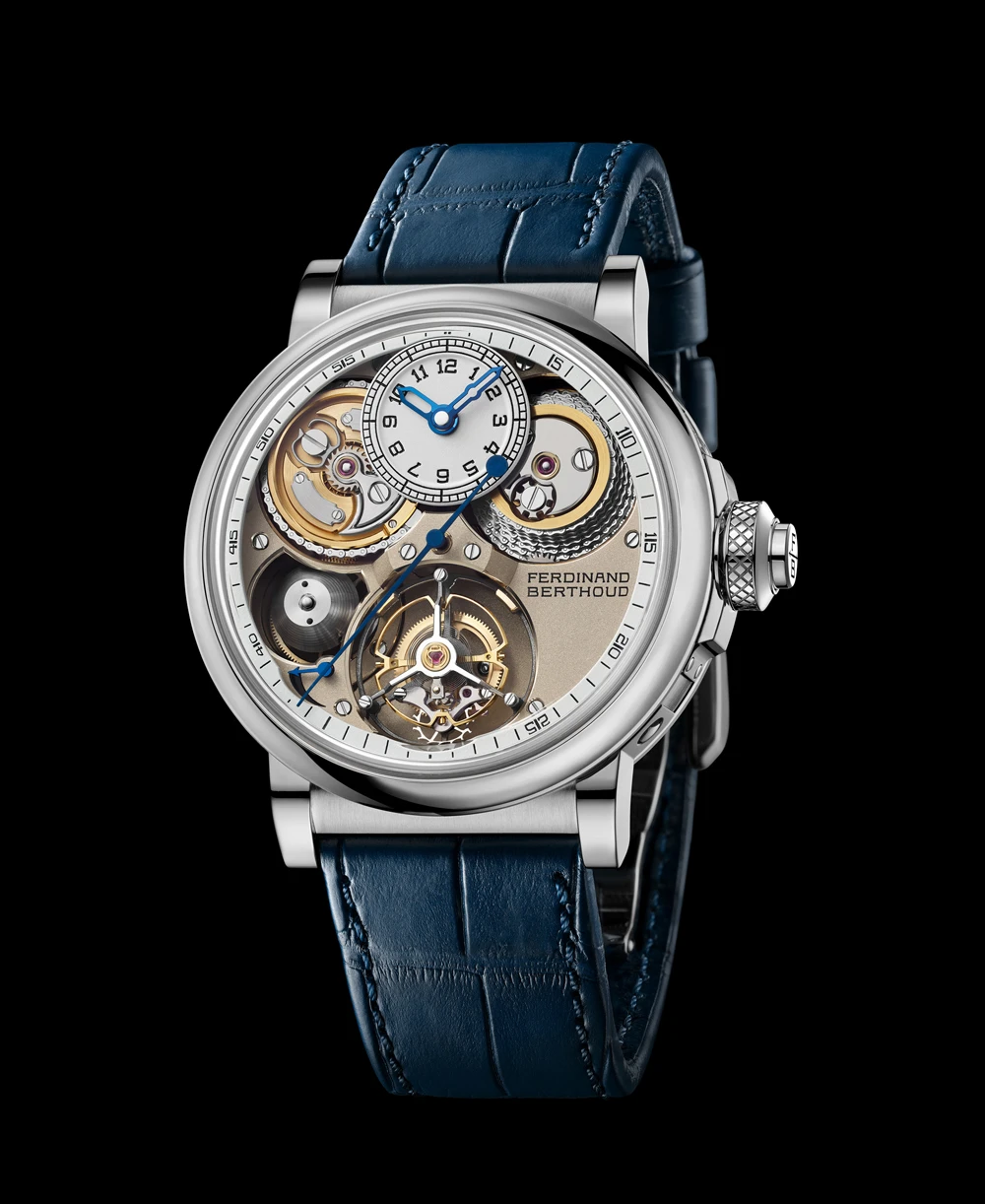
The brand’s first model, the FB1, featured a tourbillon and a fusee-and-chain mechanism, characteristics boosting chronometry and rate stability, respectively. The FB 2TV shares these features, yet its appearance is very different. The movement on this latest watch is inverted, showcasing many mechanical components front of house.
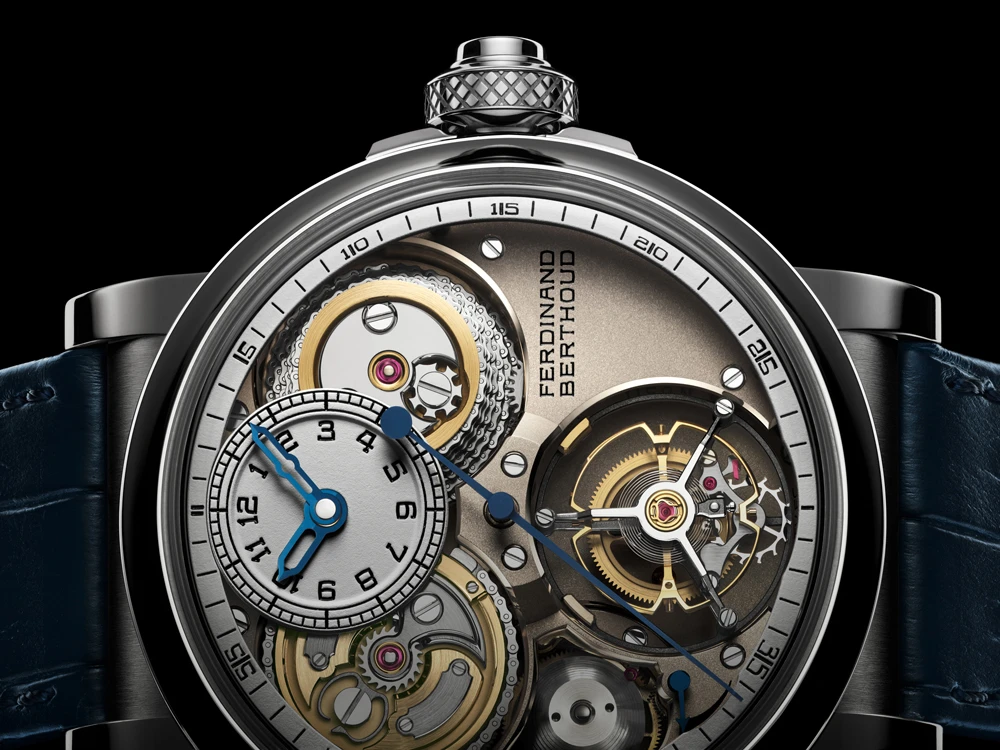
Like the FB1, the hours and minutes are indicated on an off-centre dial at 12 o’clock. Blue sword-shaped hands collaborate with Arabic numerals to denote the prevailing time. The matt white dial is fringed with a black chemin de fer, aiding interpretation. A central seconds hand, of monobloc construction, assumes a dominant position, its prominence no doubt inspired by 18th century marine chronometers when seconds were of huge importance (a measure of distance). Lastly, a power-reserve indicator resides at 07:30, featuring a patented mobile cone system (see later).
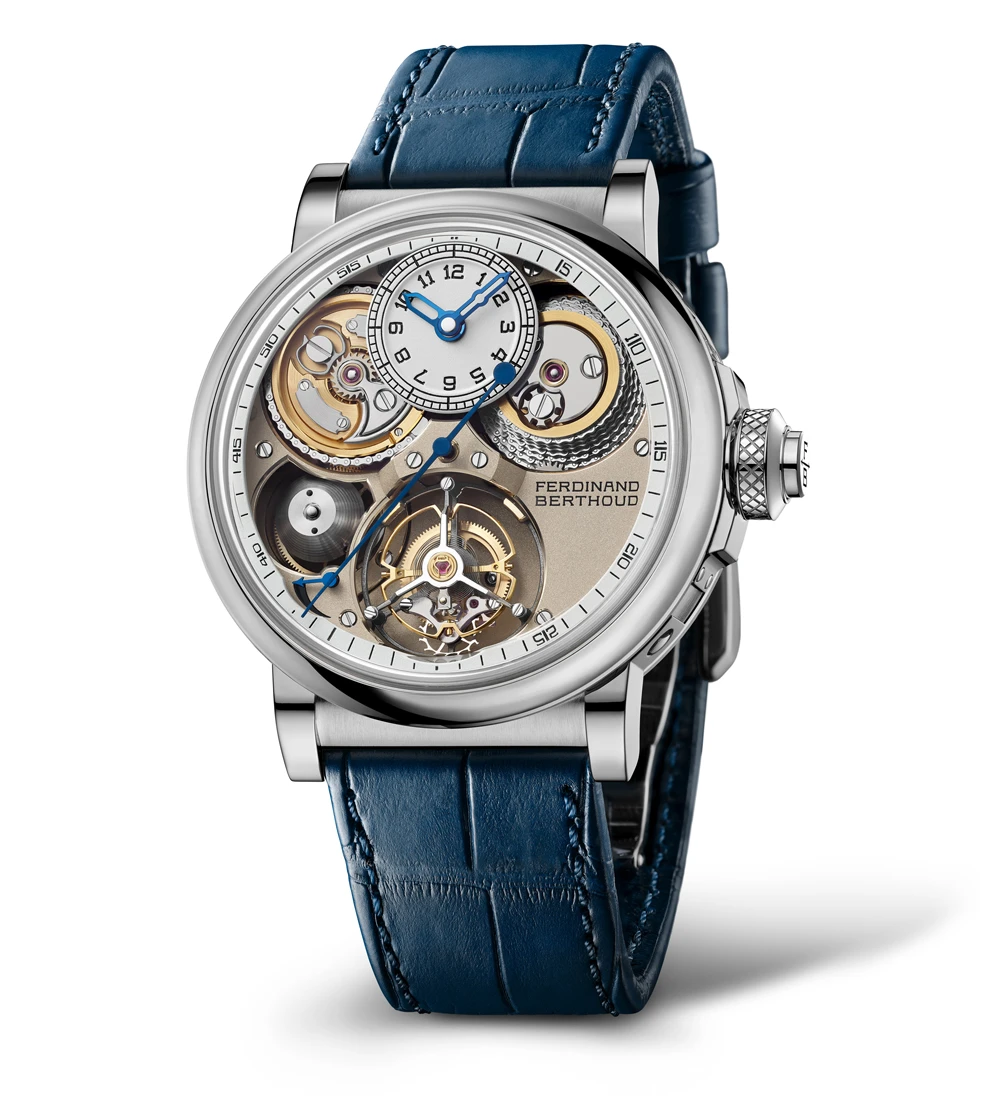 A domed sapphire crystal sits above the dial, drinking-in available light, aiding readability and showcasing the many intricate mechanisms to glorious effect. The design will sate the desires of many watch obsessives, disclosing numerous parts in motion. Despite the display encompassing an array of differently shaped elements, the overall layout proves surprisingly symmetrical.
While I would ordinarily talk about the dial and movement in discrete sections of an article, the architecture of the FB 2TV requires that I discuss these forward-facing elements at this juncture.
Ferdinand Berthoud Chronomètre FB 2TV – tourbillon
Abraham-Louis Breguet (1747-1823) identified that gravity would adversely affect the behaviour of the balance spring within a pocket watch. His solution was to place the escapement and regulating organ within a cage rotating 360° every 60, 240 or 360 seconds, ameliorating any positional errors.
The FB1 tourbillon featured two bridges, one positioned above the cage and the second below the cage, an arrangement consistent with Breguet’s original design, patented in 1801. However, the new FB 2TV is endowed with a flying tourbillon. Invented in 1920 by Alfred Helwig (1886-1974), a flying tourbillon eschews the upper bridge and is supported solely with a bridge positioned below. This approach affords superior views of the cage, escapement and regulating organ in motion.
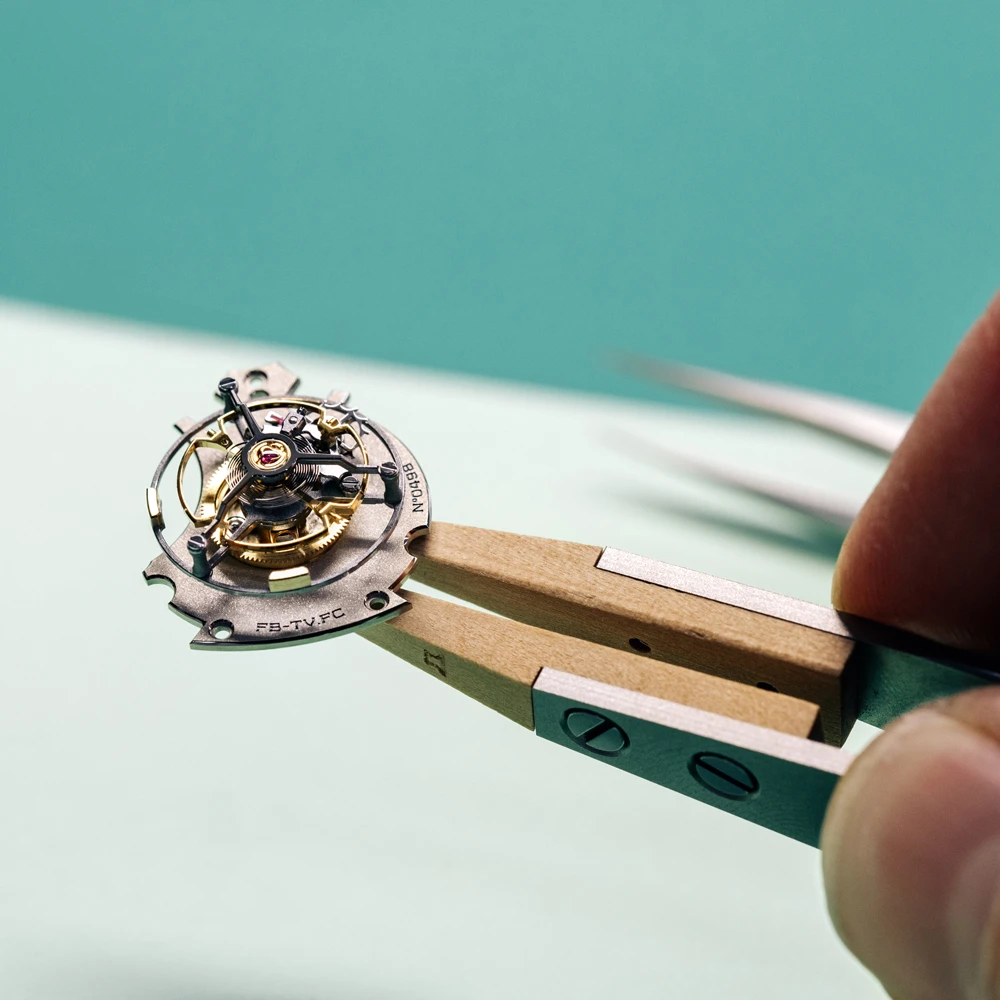
Chronomètre Ferdinand Berthoud has chosen to equip this latest model with a large cage, affording generous views of the escape wheel and pallet lever in conversation, the balance wheel oscillating back and forth and the balance spring pulse with life. This is a tourbillon that indulges horological fetishists with its delightful mechanical manoeuvres.
An additional refinement found on the FB 2TV is that the tourbillon has an ingenious stop-seconds mechanism, a rare feature on watches equipped with the gravity-compensating complication. The benefit of a stop-seconds function is that it allows the wearer to synchronise the watch with a reference clock (or watch). In this instance, the stop-seconds function doesn’t just halt the balance, it stops the entire cage from rotating.
Ferdinand Berthoud Chronomètre FB 2TV – flyback
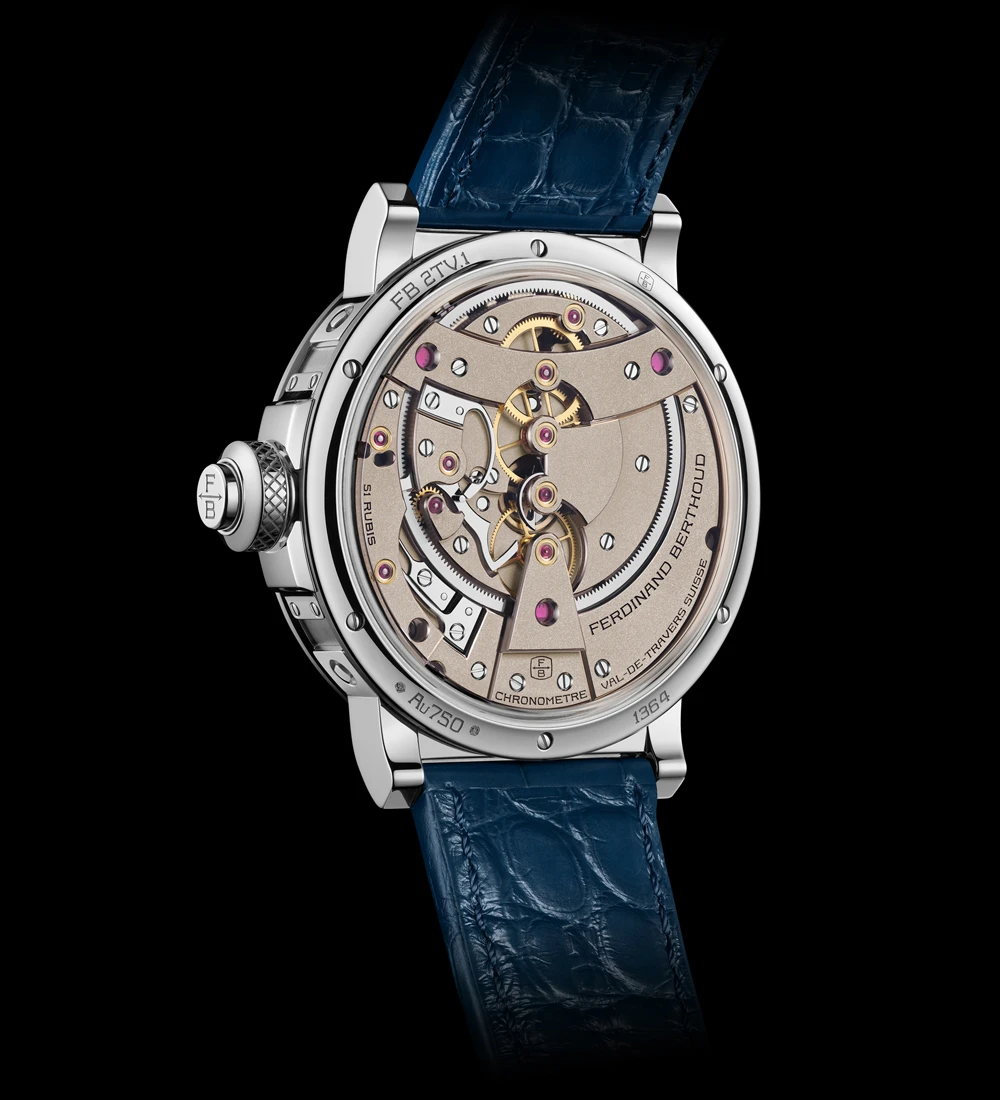
While many horophiles will be familiar with ‘flyback chronographs’, the FB 2TV is a rare take on the flyback idea. The wearer can press the pusher located within the crown and, in one single action, zero-reset the central seconds hand and restart it. According to Chronomètre Ferdinand Berthoud, ‘this new development – incorporated into the flying tourbillon and fusee-and-chain architecture of the Calibre FB-TV.FC – is of peerless complexity’. Interestingly, when chatting with a member of the FB team, I discovered that rather than resembling a flyback chronograph, the mechanism on this model shares more in common with a perpetual calendar and its snail cam. Similar to the finest chronographs, when the pusher is pressed and the hand zero-resets and starts anew, there is a welcome absence of stutter or hesitation, a characteristic that was essential for the watch to pass chronometer testing (COSC).
Ferdinand Berthoud Chronomètre FB 2TV – rate stability
A problem that afflicts most mechanical watches is the dwindling available energy held within the barrel(s). The force from the barrel, delivered via the gear train to the escapement, will diminish, affecting the amplitude of the balance and, by default, the rate. The fusee and chain counters this issue, delivering a constant force to the escapement.
The fusee is a conical pulley, typically incorporating a helical groove which plays host to a chain. The other end of the chain is connected to the barrel. When the mainspring is fully tensioned (maximum torque), it pulls the chain from the top of the cone (minimum circumference). As the mainspring relaxes (minimum torque), it pulls the chain from the bottom of the cone (maximum circumference). Plotting the torque of the force serving the escapement on a graph shows the force delivered by the fusee-and-chain mechanism is notably flat, a highly desirable quality for a movement.
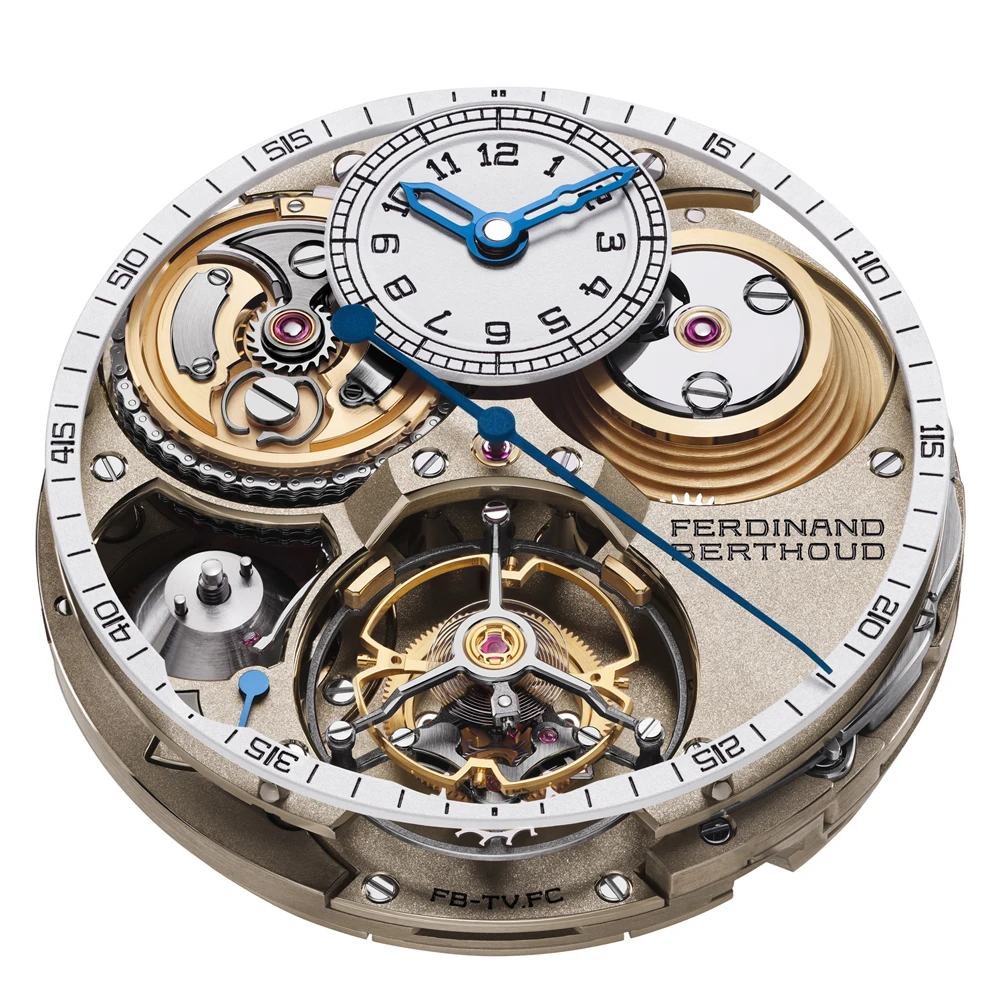 Interestingly, on the FB 2TV, the drum (barrel) eschews the usual grooves around its circumference, ‘thereby limiting friction when the chain is wound or unwound on its surface’.
Chronomètre Ferdinand Berthoud states that of the 1240 movement components, 777 elements are for the chain alone (465 links, 311 pins and a hook). These ‘require nearly 300 hours of manual finishing’.
An additional refinement found on the FB 2TV is the Maltese cross-type stopwork system. Visible from the front, sat atop the fusee, the stopwork prevents the mainspring from fully unwinding, ensuring only the most consistent torque is served to the escapement. Returning to my earlier comment, this is when the torque appears flat on a graph.
Ferdinand Berthoud Chronomètre FB 2TV – mobile power-reserve cone
At this juncture, you will have already ascertained there is nothing rudimentary about the Calibre FB-TV.FC ticking within this watch. This is perfectly demonstrated with the mobile power-reserve cone.
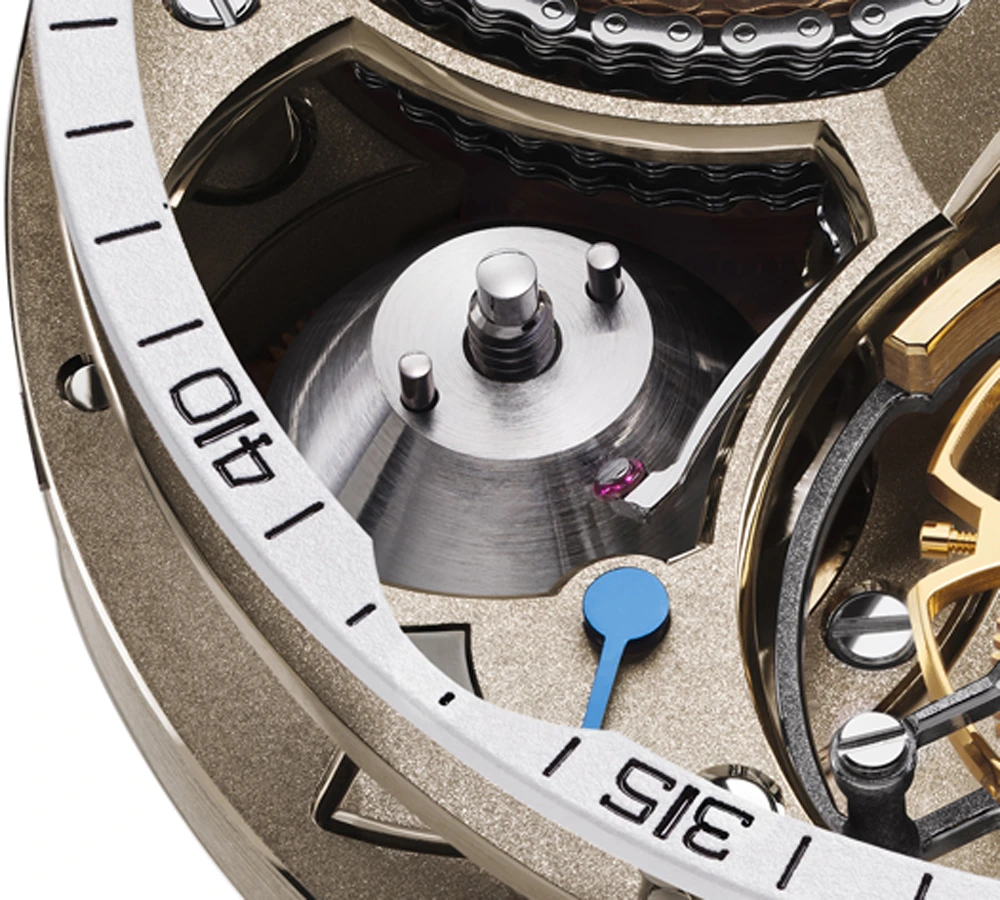
As the barrel winds, it turns a wheel, causing a cone on top to move vertically. A lever feels the cone, moving in or out depending on the amount of power held within the barrel. Specially configured for the new barrel and its position front of house, the amount of available energy is precisely indicated with the adjacent blue hand and arcing track.
Ferdinand Berthoud Chronomètre FB 2TV – regulating organ
While comparatively pedestrian watches are fitted with an index-adjusted balance, the FB 2TV is equipped with a variable inertia balance.
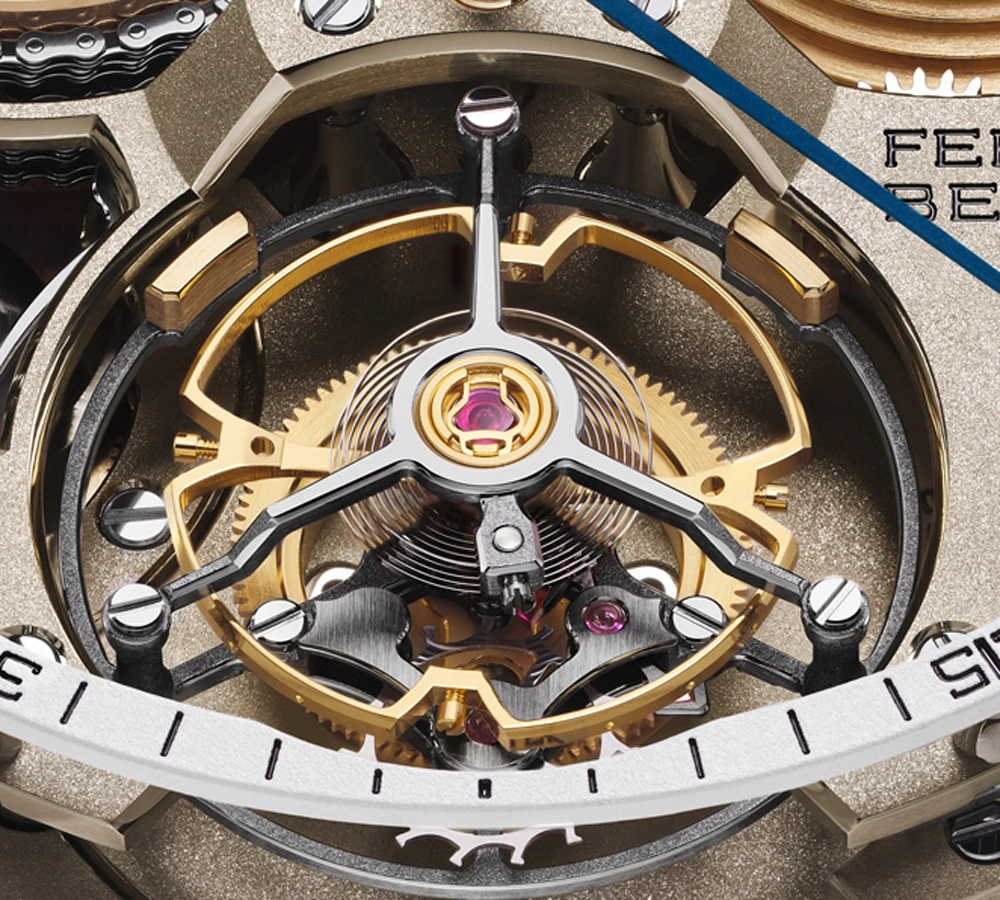
Irrespective of the type of regulating system, the balance spring is affixed to the balance staff at the fulcrum of the balance, while the outer coil (the opposite end of the balance spring) is attached to the stud.
With an index-adjusted balance, the balance spring passes between two ‘curb pins’ mounted on the index (aka raquettrie). Moving the index towards or away from the stud alters the effective length of the balance spring, thereby adjusting the rate (making the watch go faster/slower). In contrast, with a variable inertia balance, the effective length of the balance spring remains fixed. The rate is adjusted by rotating inertia blocks/screws affixed to the rim of the balance wheel, altering the moment of inertia. In this instance, the screws are recessed, mitigating air perturbation, enhancing isochronism.
It is more time-consuming to regulate a movement fitted with a variable inertia balance, hence it is often the preserve of fine watches. However, the benefits of this approach are that the rate can be set more precisely and the timepiece will keep its rate for longer. Moreover, unlike an index-adjusted balance, the geometry of the balance spring never changes, hence it will develop more concentrically.
A further refinement found on the FB 2TV is that the balance spring is fitted with a Phillips terminal curve. By raising the outer coil of the balance spring and reducing its curvature, it breathes (or develops) more concentrically, enhancing isochronism.
Ferdinand Berthoud Chronomètre FB 2TV – to the rear
Courtesy of an exhibition caseback, the wearer is indulged with views of multiple bridges crafted in natural nickel silver (aka untreated German silver). This material, an especially hard alloy comprising copper, nickel and zinc, is not liable to corrode, hence does not require plating. Furthermore, the material is highly prized by watch aficionados as it matures over time, developing a becoming patina. However, the natural nickel silver does require extra care on the part of the watchmaker. For instance, a fingerprint left on the alloy will develop, leaving an unsightly mark.
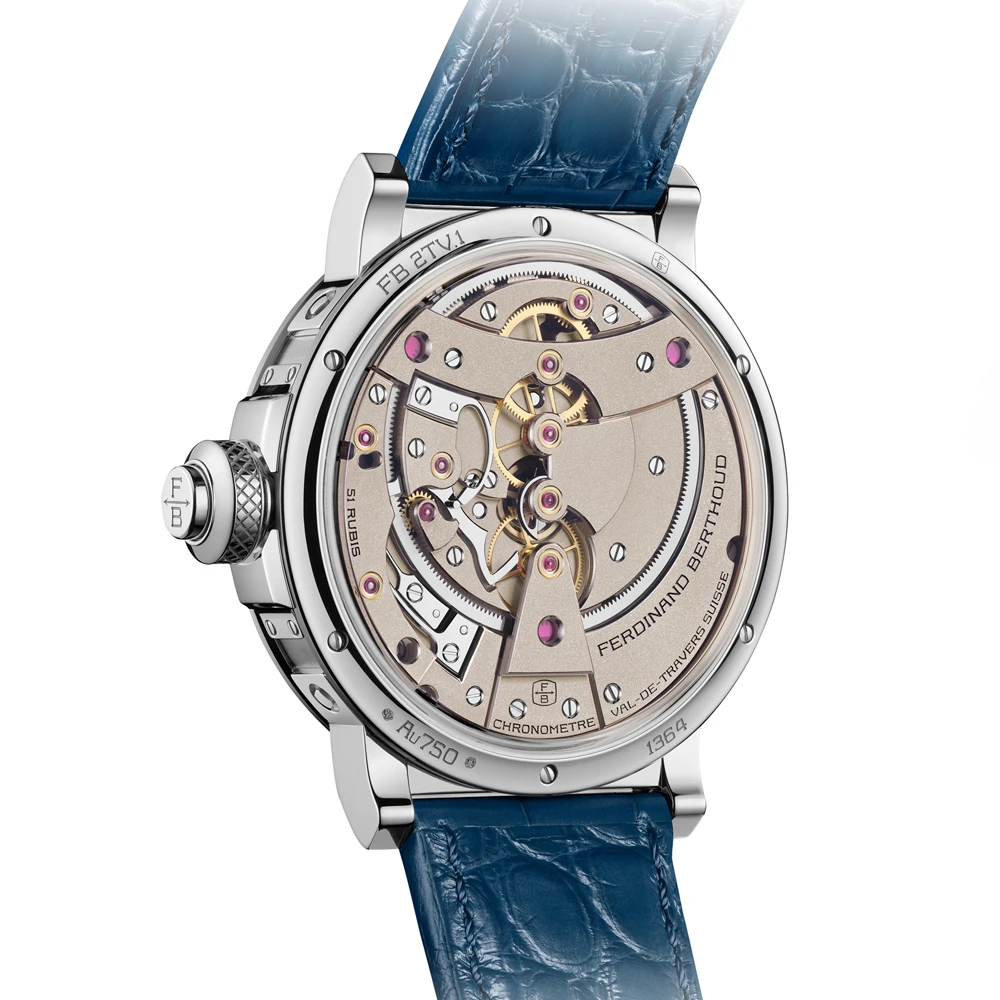
The bridges resemble steps, conferring a three-dimensional allure. Furthermore, the bevels gleam resplendently and sit in concert with polished screws and sinks, together with traditional gold chatons.
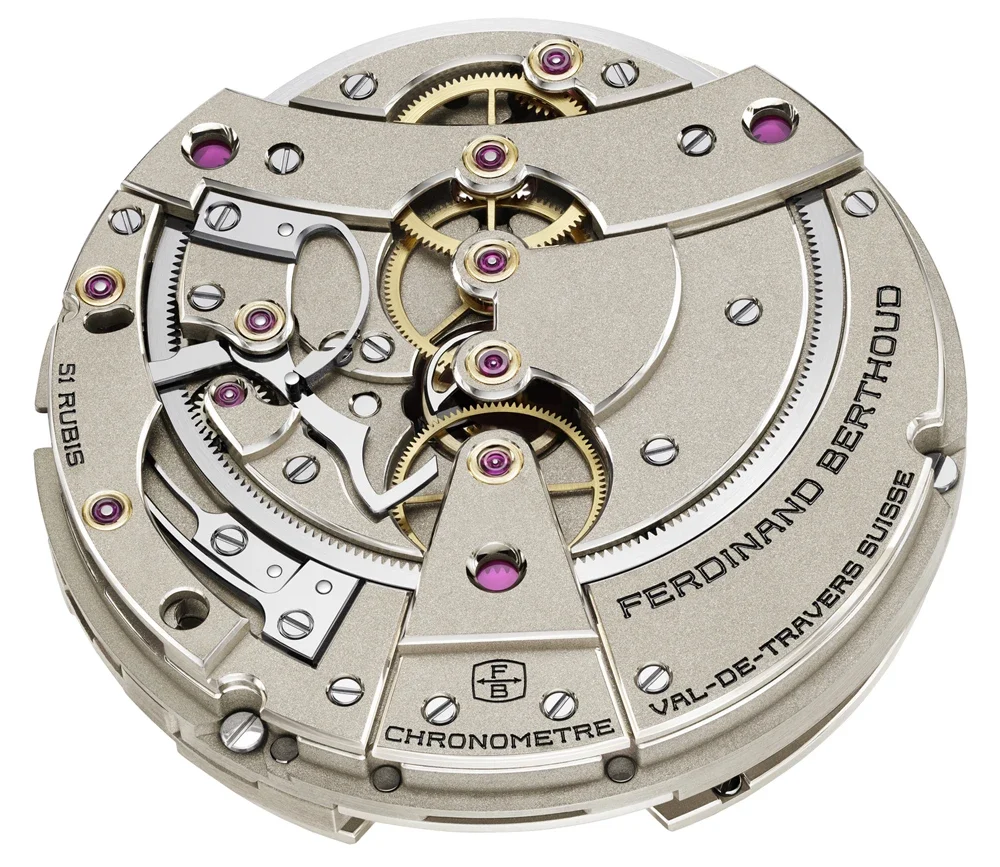
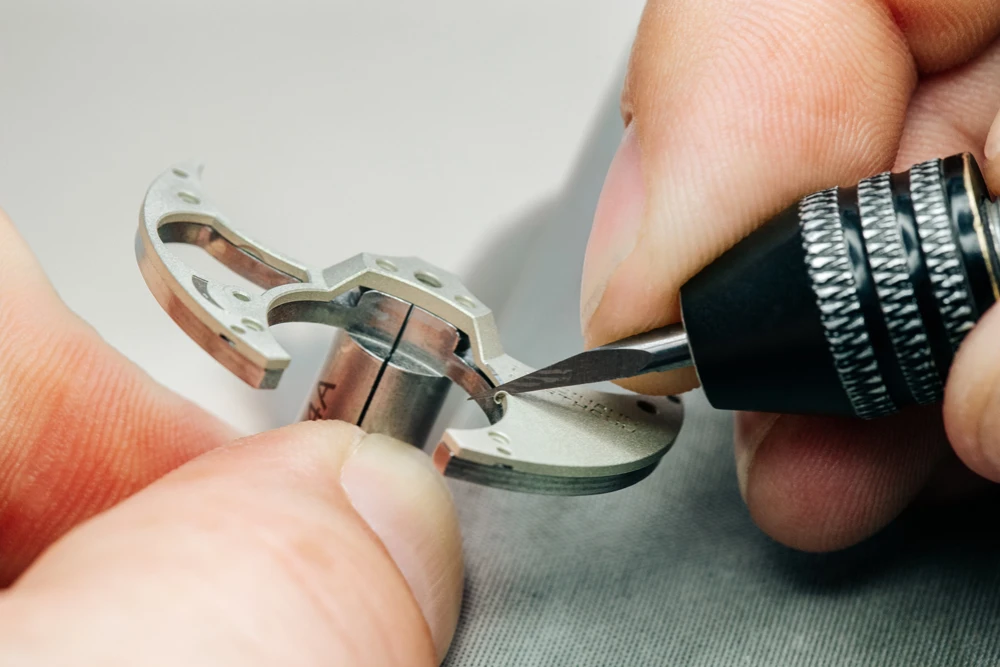
The dorsal view of the movement reveals the teeth of a large gear wheel, measuring some 28 mm in diameter, connecting the hour and minute display at 12 o’clock with the crown at 3 o’clock. It’s just one example of how Chronomètre Ferdinand Berthoud showcases its extraordinary horological prowess. Indeed, cradling the watch in gloved hands with a loupe to my eye, I could not fail to notice the arcing levers gracing the movement. Their appearance stand testament to the painstaking work of artisans polishing steel parts on a tinplate smeared with abrasive paste. As a result, these small parts transition from white to black depending on the relative position of the observer. It is this near-obsessive approach to finishing which distinguishes this timepiece as a true exemplar of Haute Horlogerie.
Ferdinand Berthoud Chronomètre FB 2TV – habillage
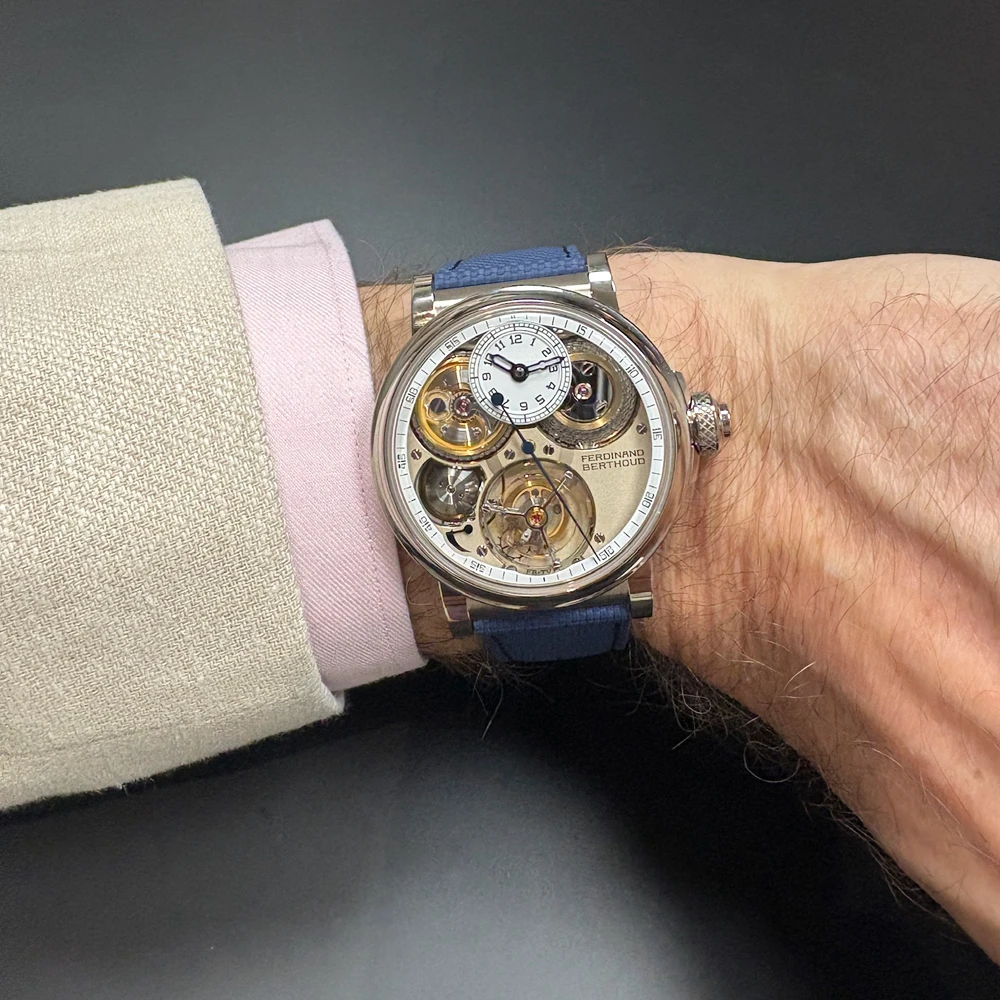
Unlike the octagonal FB1 of 2015, the shape of the FB 2TV is less polarising. While, I remain a fan of the FB1, I found the new FB 2TV particularly suited my wrist. Interestingly, the 44 mm case, formed of ethical white gold, feels smaller when affixed to the arm than its stated dimensions would suggest. One possible reason is that the lugs are comparatively short, projecting only slightly from the case. With their curving profile, the lugs envelop the wrist conferring a sublime ergonomic relationship with the arm.
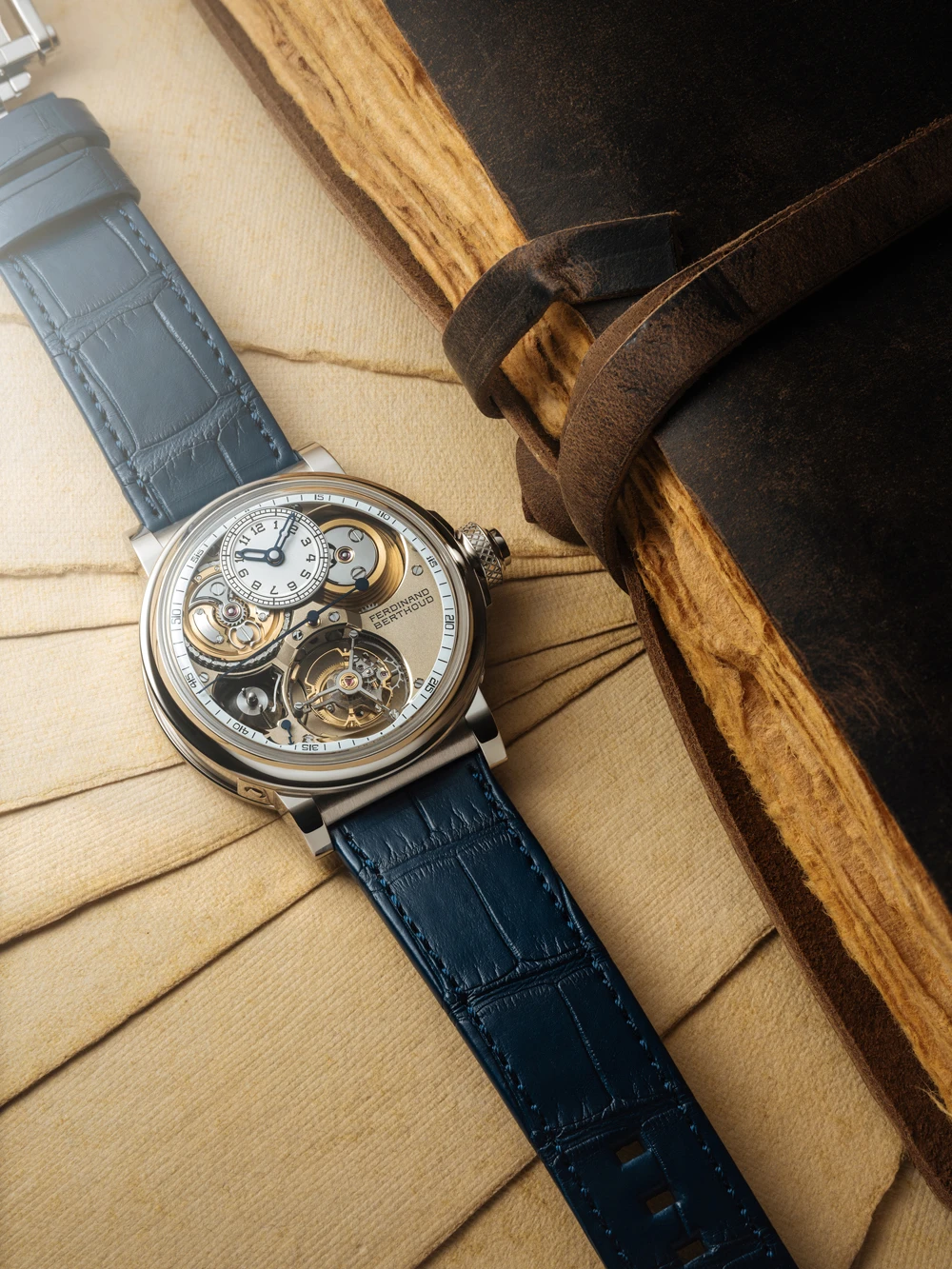
The Chronomètre FB 2TV is presented on a hand-sewn alligator strap that secures to the wrist with a white gold folding clasp.
Closing remarks
Since its renaissance in 2015, Chronomètre Ferdinand Berthoud has produced an impressive body of work. Each FB creation has championed artisanal craftsmanship and has proved incredibly precise, a characteristic independently backed-up with chronometer-certification (COSC).
As a confessed brand disciple, I have always appreciated the styling of each reference to date, but the latest Chronomètre FB 2TV is jaw-droppingly gorgeous when viewed in the metal and it’s currently my favourite FB model.
Back in the 18th century, Berthoud’s inventive mind helped determine longitude when at sea, mitigating the risks of those individuals transiting vast oceans. Quite clearly his quest for innovation was just.
In the sphere of Haute Horlogerie, brands should not pursue change unless it will yield progress and must remain mindful not to diminish what has gone before. Chronomètre Ferdinand Berthoud has always understood this, often releasing new variants of the same watch housed in different materials. Nevertheless, just like the 18th century master watchmaker, the eponymous brand has embraced new ideas, conceiving fascinating mechanisms in its quest to get ever-closer to horological perfection.
The brand’s detailed press release explains that it spent 6 years on research and development when creating the new movement within the FB 2TV and states that it delivers ‘three direct benefits’:
- ‘more constant torque, thus improving chronometry’
- ‘an increase in power reserve from 53 to 60 hours’
- ‘faster winding involving less turns to achieve full winding’
In this instance, the rationale for innovation is clearly justified.
To ensure that everything performs as intended, the watch has been subjected to accelerated ageing and tested for shock and wear resistance.
The Ferdinand Berthoud Chronomètre FB 2TV may be the first chapter of a new collection, but based on my observations, Mesure du Temps 1787 is destined to be a page-turner for many years to come.
Further reading
https://www.ferdinandberthoud.ch/
Technical specifications
- Model: Ferdinand Berthoud Chronomètre FB 2TV
- Case: ethical 18-carat white gold, diameter 44 mm, height 15.46 mm, water resistance 3 ATM (30 m), sapphire crystal to the front and exhibition case back.
- Functions: hours and minutes at 12 o’clock, central seconds, power reserve at 7:30, balance-stop function
- Movement: Calibre FB-TV.FC, hand-wound movement, frequency 21,600 vph (3 Hz), 51 jewels, power reserve 60 hours, chronometer-certified (COSC)
- Strap: hand-stitched,rolled-edge alligator leather strap. Handcrafted 18-carat white gold folding clasp
- Price on application