
Lineage is important
Dr. Edwina Davies reviews the Girard-Perregaux 1966 Small Second, a watch from the prestigious maison based in La Chaux-de-Fonds.

If there was an Alamanac de Gotha for watch houses then Girard-Perregaux would be in the first rank of Maison Seigneurales. Its lineage is impeccable and its name recalls a marriage. Ancestry has to be long and illustrious to achieve such an honour, impeccable, well connected and Girard-Perregaux is.
It can trace its line back to 1791 when a nineteen year old, Jean-Frances Bautte first signed a watch before establishing his reputation at the courts of Europe. The heirs to the tradition he was establishing, Jacques Bautte and Jean-Samuel Rossel were worthy successors.
In 1852 Constant Girard married Marie Perregaux and their union leant its name to their maison and they established their business at an appropriate address, one with credentials, La Chaux-de Fonds.
The alliance of the two lines came in 1906 when Girard-Perregaux took over Bautte’s firm.
Lineage goes hand in hand with tradition
Girard-Perregaux has a respect for tradition. With the rise of quartz watches in the seventies there was a challenge to traditional watch making. Courageously Girard-Perregaux took on the mantle of protector of tradition and the Manufacture returned to the making of traditional mechanical timepieces.
In 1995 it launched the Vintage 45 paying tribute to its 1945 Art Deco timepiece. Now it presents the 1966 Small Second recalling the launch of the first high frequency movement which offered exceptional performance and achieved remarkable success. The past is given due respect.
Now 220 years since the foundation the 1966 Small second has engraved on its solid case back its prestigious achievements; its foundation and two other dates. Firstly its winning of the Gold Medal at the Universal Exhibition in Paris in 1889 and then the recognition of that timepiece as being without equal and Girard-Perregaux nomination to the jury in Paris in 1900 are presented.
Continuing the line
Whilst honouring the past, Girard-Perregaux builds for the future and always has. In the 1960s it was one of the very few Manufactures to have its own Research and Development Team, a key to its success and to its future.
When you look at the 1966 Small Second you can but admire the pedigree given witness in its restrained elegance. Presented at the 2012 Salon International de Haute Horology it echoes a nineteenth century pocket watch in appearance, again honouring the past.

It is a limited edition. There are only a hundred, each watch numbered, its credentials established.
The dial
The dial is hand grained. The glass is sapphire crystal.
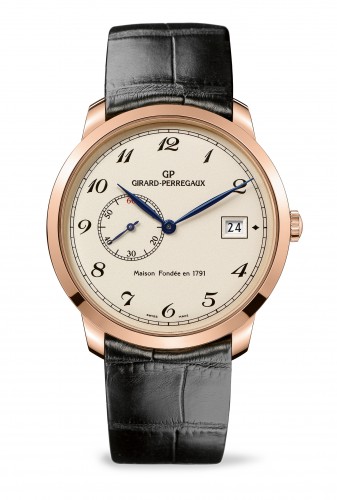
It is an exemplar of purity of line and form, totally alluring.
The simple, painted, black italicized Arabic numerals sweep around the face, the 3 replaced by a slightly curved diamond lozenge in order to accommodate the simple date aperture which is simply and effectively outlined in black with black numerals.
The simple railway track at the outer circumference of the dial marks off the minutes.
At 9 o’clock the small second dial balances the date display. Again simple Arabic numerals in tens count the seconds but a little touch of colour, the 60 is red.
The other touch of colour is the hands, slender, blued-steel, dauphine.
Other details, simply and unpretentiously presented are the Girard-Perregaux name and logo and the important “Maison Fondée en 1791”
The case
Admire that slender silhouette. It is graceful, with a curved back which affords comfort to the wearer as it rests on the wrist. It is only 8.69 mm in depth and a modest 38 mm in width, 2mm less than the 2011 model.
It is presented in pink gold. The bezel is beautifully chamfered, polished, smooth, flowing around the face, quite beguiling in its simplicity.
The fine knurled crown set conventionally at 3 o’clock, the knurling facilitating its use and bears the legend “GP”.
The movement
1993 through 1994 saw the creation of miraculous ultra thin calibres. The graceful case enfolds such a movement.
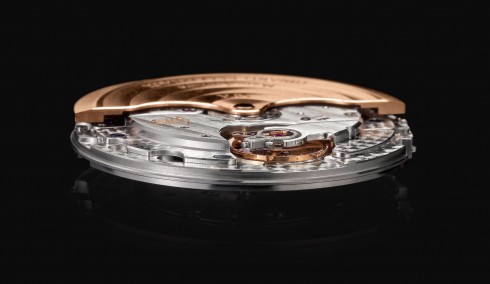
The GP3300 is automatic winding. It has 28 jewels and 28, 800 vph. The power reserve is 46 hours.
The movement is not on show because of the solid case back but were we able to view it, we could admire the main plates and bridges finished and decorated with Côtes de Genève on the bridges, circular graining of the plates, a feast for the eyes which we can still imagine. There would be bevelled edges softening the lines, all hand polished and attention paid to every detail.
Other features
The strap is alligator. Straps are often elaborate in their composition, their detailing, their stitching but this is not stitched and is unadorned and thus has a quintessential elegance. The buckle is pink gold. This watch eschews ostentation.
Conclusion
This is a noble watch yet it has a graceful simplicity. Confident of its place in the upper echelons of the watch making hierarchy it does not have to flaunt itself. It manages to be classical and modern, traditional and yet at the cutting edge in design and technical specification. It rises above changing fashion and is an embodiment of the best of haute horology.
Technical specification
- Model: Girard-Perregaux 1966 Small Second
- Reference: 49526-52-111-BK6A
- Case: 18-carat pink gold; 38.00 mm diameter; 8.59 mm height; water resistant to 3 bar (30 metres); sapphire crystal to front.
- Functions: Hours; minutes; subsidiary seconds; date.
- Calibre: Self-winding; Frequency 28,800 vph (4 Hz); power reserve 46 hours; 28 jewels.
- Calibre Reference: GP3300 movement
- Strap: Alligator strap with pink gold pin buckle
- Limited edition of 100 timepieces