
Grand Seiko Starry Night SBGW314J Watch Review
The Grand Seiko Starry Night SBGW314J was unveiled at Watches & Wonders 2024, one of nine new releases from the luxury Japanese marque. Drawing on the design codes of the very first Grand Seiko of 1960, this latest watch is said to have been inspired by Van Gogh’s Starry Night painting. Mark McArthur-Christie, a dedicated follower of horological matters and a man with a penchant for dismantling old timepieces, talks vintage watches and cutting-edge know-how.

Grand Seiko at Watches & Wonders 2024
The Grand Seiko team at Watches and Wonders 2024 must have got through by mainlining caffeine. The team of watchmakers they left behind in Shizukuishi are probably still slumped at their benches with takeaway ramen packaging overflowing from the break room bins.
Indeed, what was presented at the annual watch fair wasn’t a couple of case variants, the odd new dial or a different strap. No. The firm showed five three handers (all with different dials, two of which are fitted with the new Caliber 9SA4 movement), two GMTs (with different movements), a GMT chronograph, a Platinum Spring Drive (with a Caliber 9R01 movement) and the completely barking (not in a Birch way) White Kodo with a constant force tourbillon and blue sapphires instead of ruby movement bearings. That’s a whopping nine models in total!
Grand Seiko’s first watch (1960)
Doing things the easy way isn’t the Grand Seiko way and never has been. When the first GS came off the bench at Suwa Seikosha in December 1960, the idea was to ‘…build a watch that would be as precise, durable, easy to wear and beautiful as humanly possible.’ Back then, the GS team equipped this model with a wholly new movement; the Caliber 3180.

Grand Seiko Caliber 3180
The Grand Seiko Caliber 3180 was a manual wind, 18,000 vph (2.5 Hz), 25 jewel, chronometer grade movement that, unusually, hacked. In terms of both longevity and accuracy, the watchmakers were leaving nothing to chance. For example, the mainspring barrel ran in jewelled bearings top and bottom and the train jewel bearings were retained with minute lyre-shaped clips. It’s a gorgeous movement to look at and to work on.
Accurate to +12/-3 seconds a day – a heck of a feat at the time – and, perhaps unsurprisingly, the Caliber 3180 was the first Japanese movement to meet the standard of excellence of the Bureaux Officiels de Contrôle de la Marche des Montres at Neuchâtel. Grand Seiko had, very understatedly but determinedly, arrived.
Grand Seiko Starry Night SBGW314J – a modern take on the 1960 model
Despite subsequently releasing various horological fireworks, including the highly innovative Spring Drive and the 9F quartz movements, this latest GS is very much a case of back to basics. That’s in no sense disparaging, rather the contrary. The Starry Night is a return to the stripped back, everything-you-need-and-nothing-you-don’t simplicity of that first GS.
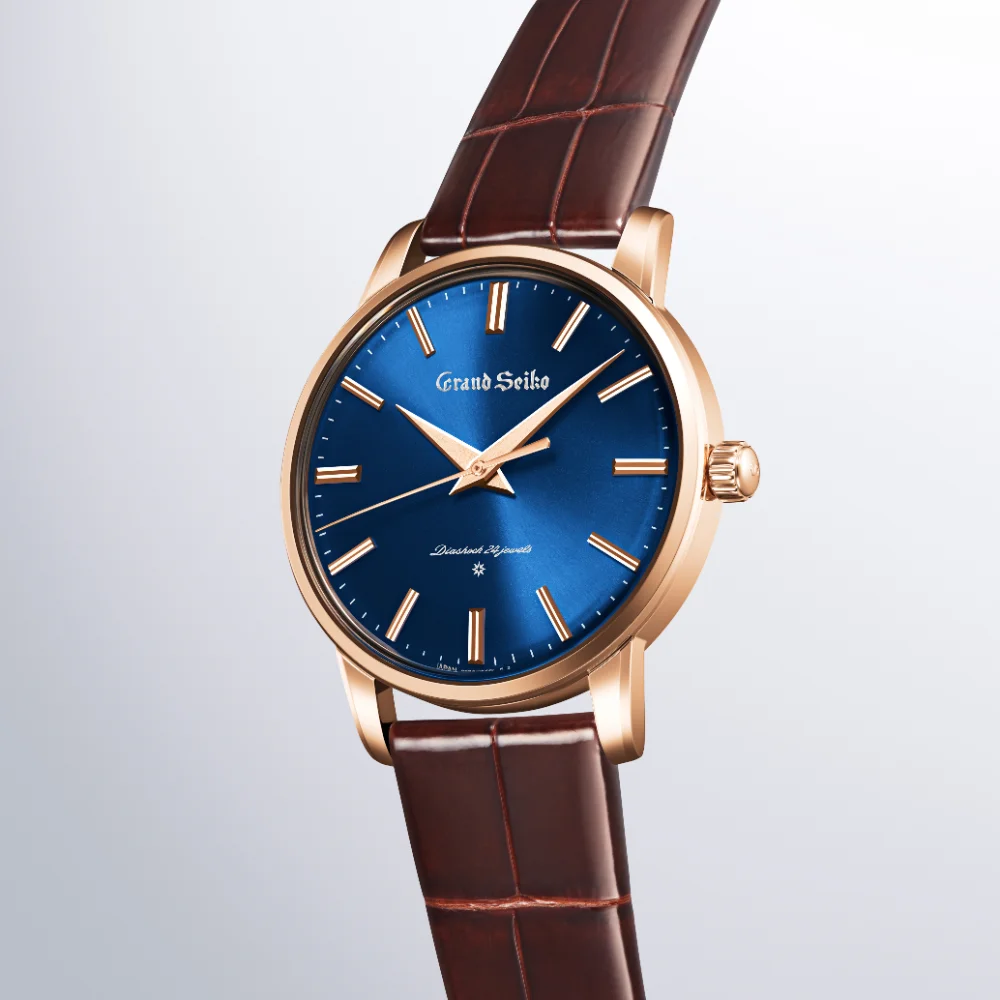
There are a few differences though, as you’d expect. A 35 mm case diameter is too small for modern fashion (although it works splendidly well for most ‘normal’ wrists), so Grand Seiko has added 3 mm to take it up to a contemporary 38 mm dress watch size. At 11 mm thick (near as dammit) it’s got enough height and heft to let you know it’s there. That makes it a little thicker than some dress watches but why should you just wear this for best? It would make a cracking everyday wearer as Grand Seiko originally intended with the 1960 model, even if the original rolled gold case has had quite the upgrade, now executed in solid 18ct rose gold. Bonus points for using six screws to hold the caseback in place rather than a seal-shearing screw back. That helps at least to make it splash-proof, although you’re unlikely to wear a watch like this when you’re cleaning the car, let alone swimming.

Size and material aside, there’s no doubt about this new watch’s pedigree. High mirror polishing on all the case surfaces, the faceted dauphine hands, the proportions and design – firmly ticks all the GS boxes. And it really is a case of ‘less is more’. There’s no fuss or frippery anywhere, yet details keep drawing your eye back.
The obvious draw is the dial. It’s finely sunray-brushed from the pinion outwards but also flecked with minute silvered grains; you need to get very close to see them. Without the brushing you could almost think it was aventurine rather than a finished metal dial. Grand Seiko describes it as ‘Hoshizukiyo’ – a starlit or starry night. Looking at the watch in profile, you can see the dial is convex domed and the hands follow its curve. There’s a ‘special dial’ star mark at 6 o’clock.
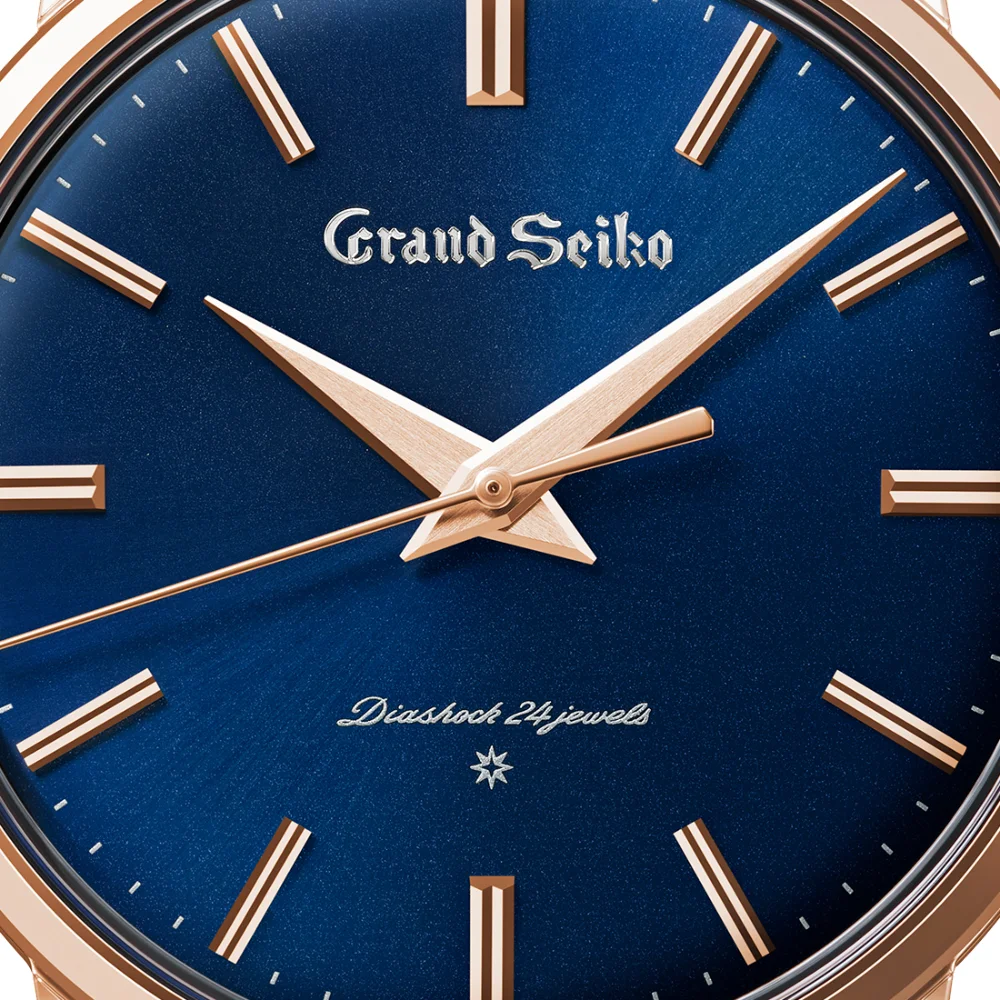
The detail obsession carries on with hands and dial markers. How much finishing can you pack into one minute hand? If you’re GS, you’ll straight grain the horizontal surfaces, you’ll facet the edges (four of them), and then you’ll mirror polish them. There’s no lume, but in anything but full darkness you won’t struggle to read the time.
All of the applied gold markers look, at first glance, to be identical. But that wouldn’t fit the GS way, so peer closely and you’ll see the 12 o’clock marker differs from the other hour markers, while 3, 6 and 9 are different again. Each marker – less than 0.5 mm high – still has 10 facets. It’s detail within the overall simplicity like this that makes Grand Seiko addictive. Every time you look you see something new despite the apparent simplicity. The double domed sapphire crystal gives everything plenty of air and light.
Where the case has had a makeover, the movement is very different thanks to modern materials and production techniques. The only similarities are that the original and the new watch are both hand-wound and feature 24 jewels.
Grand Seiko Caliber 9S64A
Where the Calibre 3180 used two plates and a balance cock, the 9S64A adds rigidity and stability by running the going train and barrel under one large bridge with the balance fixed separately – sturdily too. In this version, GS has gone for a plainer finish than on, say, the 140th Anniversary with its blued screws and gold logo plate, but it’s none the worse for it.
Like everything GS, it’s in-house and the 9S64 makes use of a SPRON510 alloy mainspring and a SPRON610 alloy balance spring that proves robust, durable, highly shock-resistant and happy to shrug off most modern magnetic fields from laptops and motors. The Caliber 9S64 will keep on doing that for 72 hours without a wind.
The escape wheel and pallet lever are intricately shaped using MEMS (Micro Electro Mechanical Systems) technology. This involves using UV-light and a photo-resist to make a minuscule mould which is then gradually filled with nickel phosphorus using a lithographic process. This confers an array of benefits and is discussed at length in our review of the Grand Seiko Mount Iwate Autumn Dusk SBGW303.
Unlike the original Caliber 3180, you can see the Caliber 9S64A through the sapphire case back. It’s worth a look, too. Where the movement on the first GS was workmanlike but still elegant (and hidden behind a caseback), the modern-day movement is rather smarter. The large plate is bevelled with striping running diagonally and features filled gold and black engraved lettering. There’s a nice touch with the scalloping on the new movement’s ratchet wheel matching that of the Caliber 3180.
Grand Seiko is wonderfully precise and clear about how, er, precise the movement is. The brand says it’ll manage a mean daily rate of +5/-3 seconds per day on a six position test over 12 days in a controlled environment. On your wrist, the firm claims +10/-1 seconds per day. If my experience of Grand Seiko is any guide, you may well see better than that.
Grand Seiko Starry Night SBGW314J – straps
The watch comes supplied with two straps which, perhaps oddly, seem to change the character of the watch. You can go trad with the brown crocodile leather or choose the dial-matching blue the watch comes fitted with for a more contemporary look. It would probably work well on a black cordovan too. The triple-folding clasp, like the case, is rose gold and polished.
Grand Seiko Starry Night SBGW314J – closing remarks
Sadly, where watches like the 140th Anniversary Limited Edition came in editions of 350, there will only be 50 examples of the SBGW314J worldwide. There’s never been a better reason to look out your tent and sleeping bag and camp outside your local Grand Seiko boutique.
Further reading
https://www.grandseikoboutique.uk/
Technical specification
- Model: Grand Seiko Starry Night SBGW314J
- Case: 18k rose gold, diameter 38.0 mm, height 10.9 mm, water resistance 3 ATM (30 m), sapphire crystal to the front and sapphire case back.
- Functions: hours, minutes, centre seconds
- Movement: Calibre 9S64, hand-wound movement, frequency 28,800 vph (4 Hz), power reserve 72 hours
- Strap: blue crocodile leather strap with three-fold clasp with push button release. Also supplied with an additional brown crocodile leather strap
- Price: £25,500 (RRP as of 15.7.2024)
- Limited Edition: 50 pieces worldwide – sold exclusively in Grand Seiko boutiques