
Angelus Chronographe Télémètre Watch Review
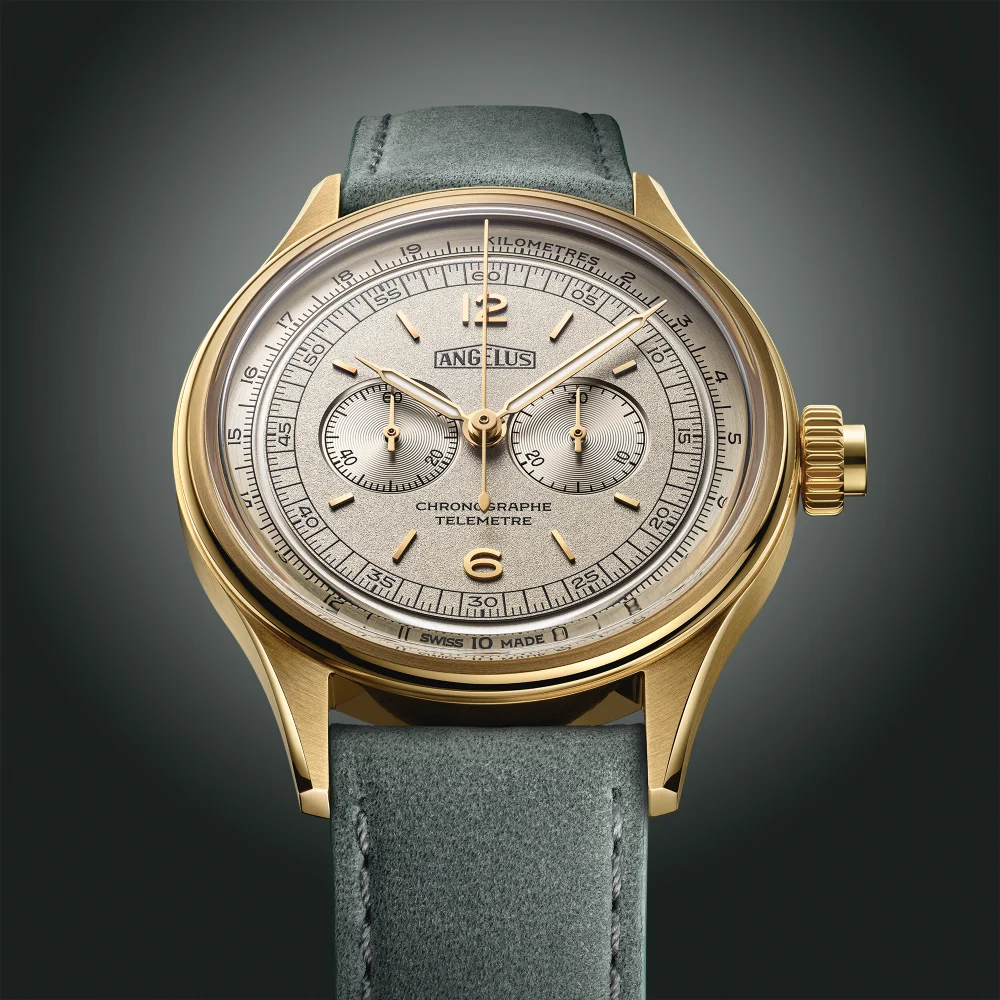
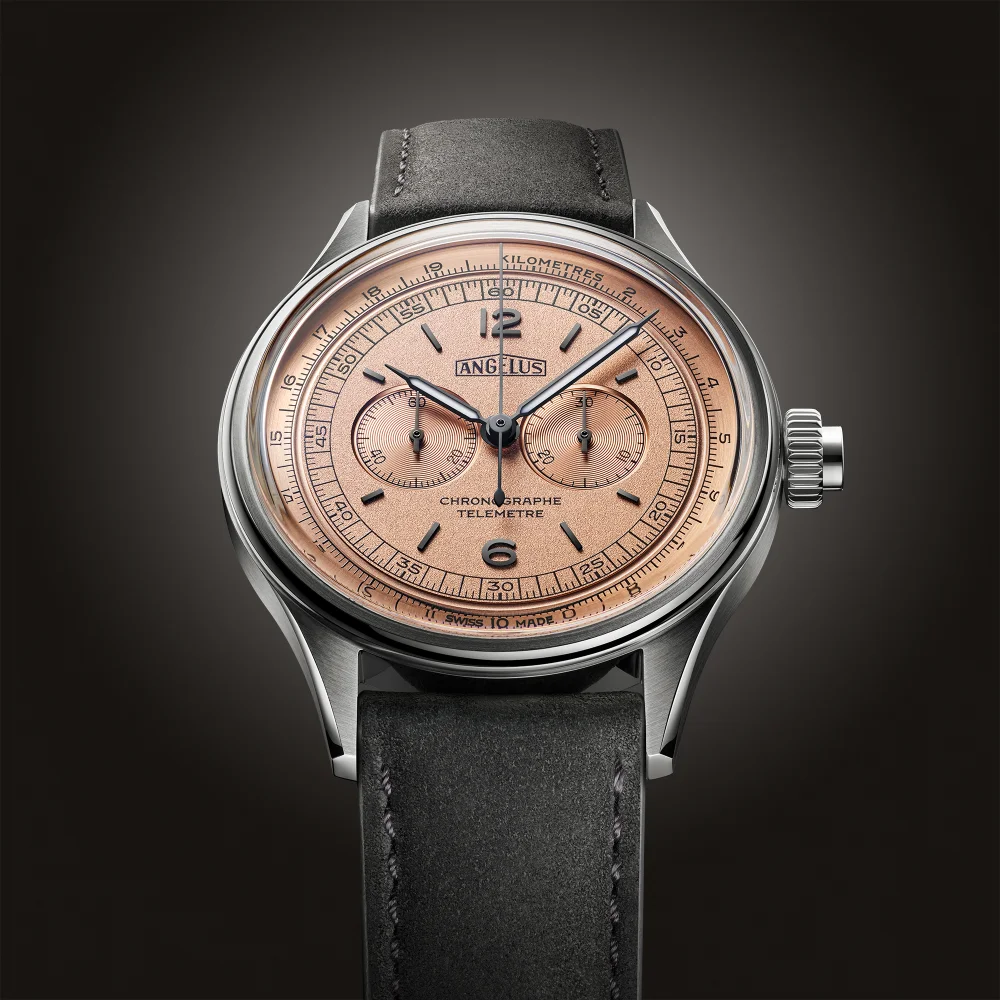
The Angelus Chronographe Télémètre is offered in a choice of three models, two housed in steel and a third model executed in 18-carat yellow gold (3N). All variants are endowed with a bicompax dial, a telemeter scale and a hand-wound movement featuring a highly desirable column wheel and horizontal coupling configuration. US-based Meehna Goldsmith delves into the history of telemeter scales before exploring the specification of this latest monopusher chronograph.
The telemetre scale
In an overly digitised world where everyone is buried in screens, interaction with the real world can fade into the rearview. People are constantly swiping, texting, posting and consulting their SMARTWATCH. There’s no time to appreciate or reflect on what’s actually going on outside of the binary code. The Angelus Chronographe Télémètre is an antidote to the wired blur, reminding you to slow down and experience time right here, right now.

The telemeter scale was first incorporated into chronograph watches between 1910-1915 and found practical application during World War I. By measuring the difference between the speed of light and the speed of sound, the distance to an event could be approximated. But, there must be a visible flash of light and an audible sound for the system to work. For example, it was used in combat to estimate the distance of gunfire. It’s also applicable to events including fireworks or lightning.
Here’s a breakdown of how to get the approximate distance with a telemeter scale: when you see the event, start the chronograph; stop the chronograph when you hear the sound. Read the second hand on the telemeter scale, which is in kilometres, and voila you’ve got the measurement.
The first brand to hit the market with a chronograph paired with a telemeter was Longines, followed by Omega, Breitling and Heuer. And then there was the smaller, niche brand Angelus, which was also defining and shaping the market during the 1930s and 1940s.
Though not as high profile as the other players, Angelus watches from this period are coveted by collectors for their legit cred. The brand introduced technical innovations such as the monopusher chronograph with the button in the crown around 1925, beating most of the big brands to the punch. Then came the Chronodato, the first chronograph wristwatch with a calendar, released in 1942. Those telemeter watches weren’t just sideline players in the military theatre either, they also saw combat, proving a crucial tool during WWII.
Angelus is reborn in 2011
The quartz crisis took down many brands and that included Angelus, which couldn’t weather the storm. In 2011, this sleeping beauty was raised from slumber by La Joux-Perret, which bought the dormant trademark. La Joux-Perret took its sweet time developing the identity of the modern Angelus brand.
In 2015, after four years of development, the U10 Tourbillon Lumière made its debut. Interestingly, it was a new direction from Angelus’s vintage pieces. The U10 Tourbillon Lumière was futuristic, architectural and bold in design. It also showed off a high complication to demonstrate technical expertise, while at the same time announcing how Angelus wanted to be perceived in the market. From 2015 to 2022, Angelus showcased its innovations and sci-fi flavour with the release of the U20 Ultra-Skeleton and U30/U50/U41 models.
Angelus Chronodate (2022)
In 2022 came a delightful surprise. The Chronodato, renamed the Chronodate, poked its head out from the archives with a cool swagger. While the vibe was the same as the original, the aesthetics had a glow up with a new dial layout and carbon composite or titanium case measuring a hefty 42.5 mm with angular lugs and modern geometry. In 2023, Angelus established La Fabrique, a pillar dedicated to reviving and honouring Angelus vintage designs, kicking off with the Chronographe Médical x Massena LAB. One year later (2024), the Vitesse joined La Fabrique.
Angelus Chronographe Télémètre (2025) – introduction
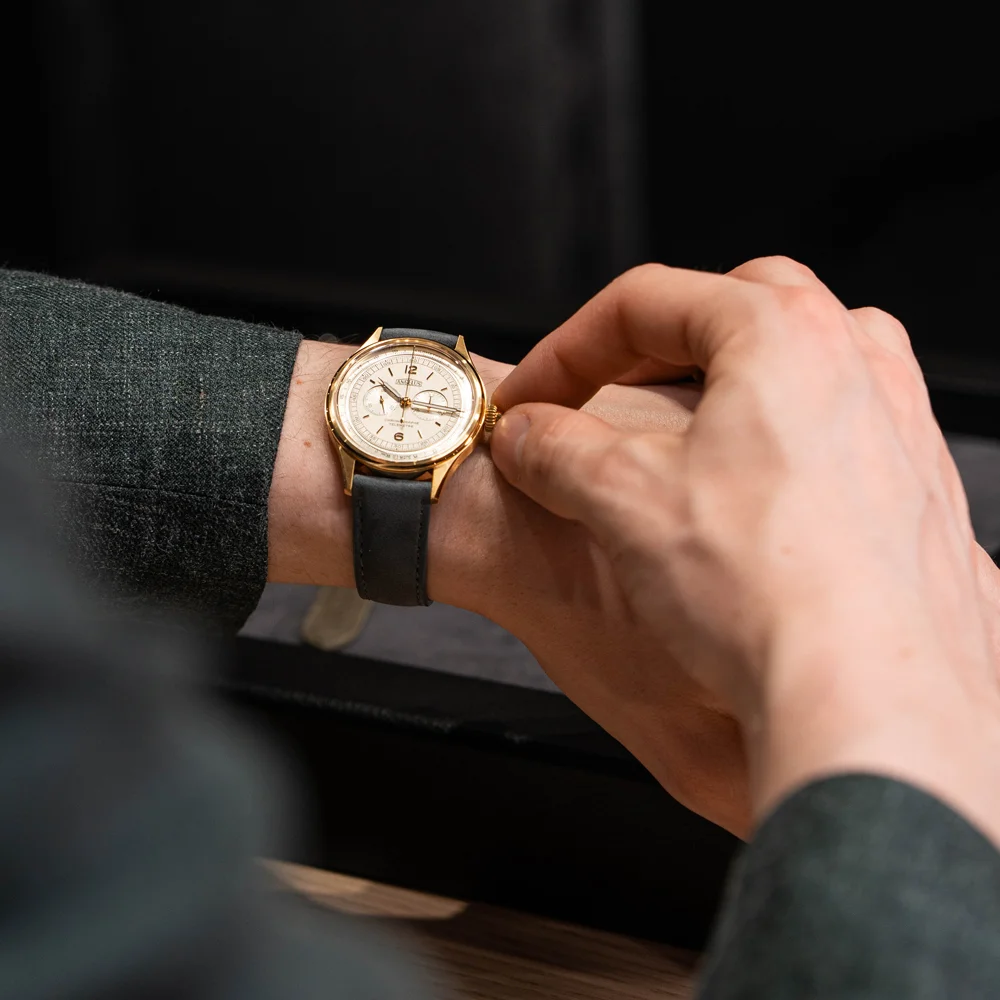
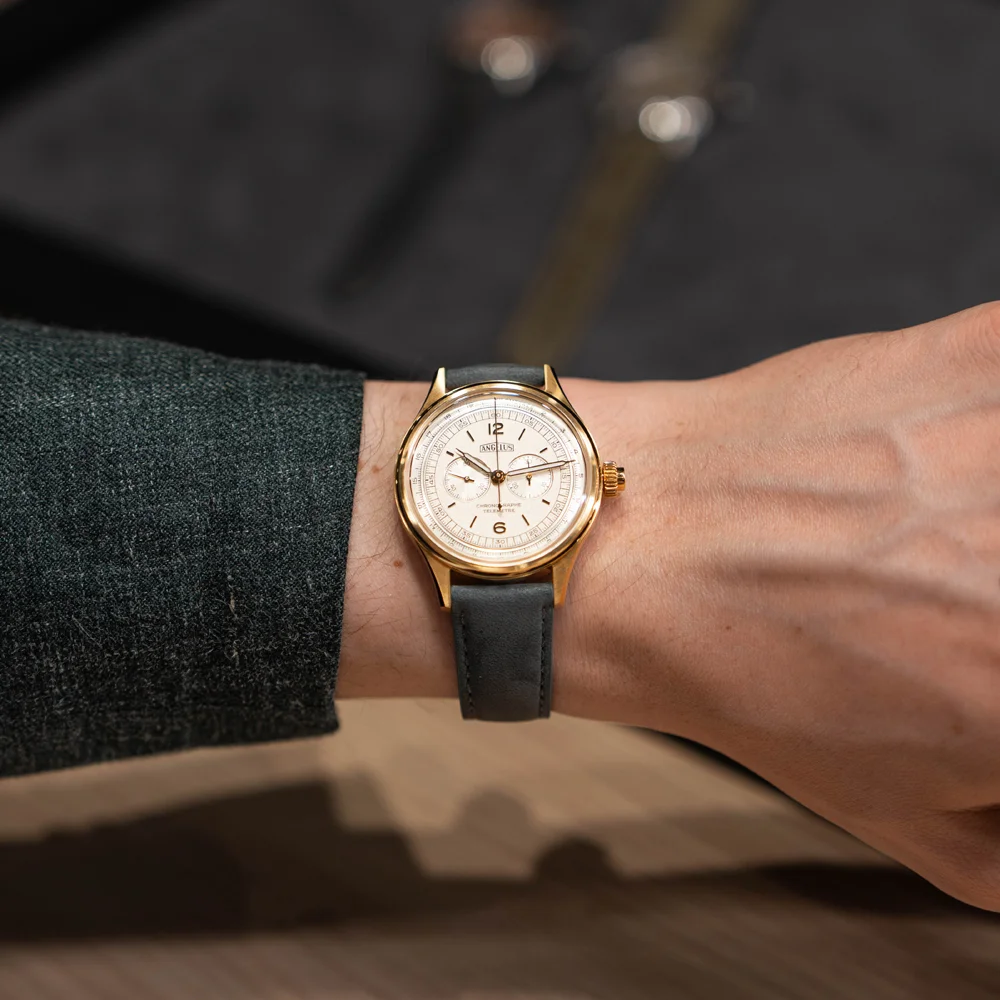
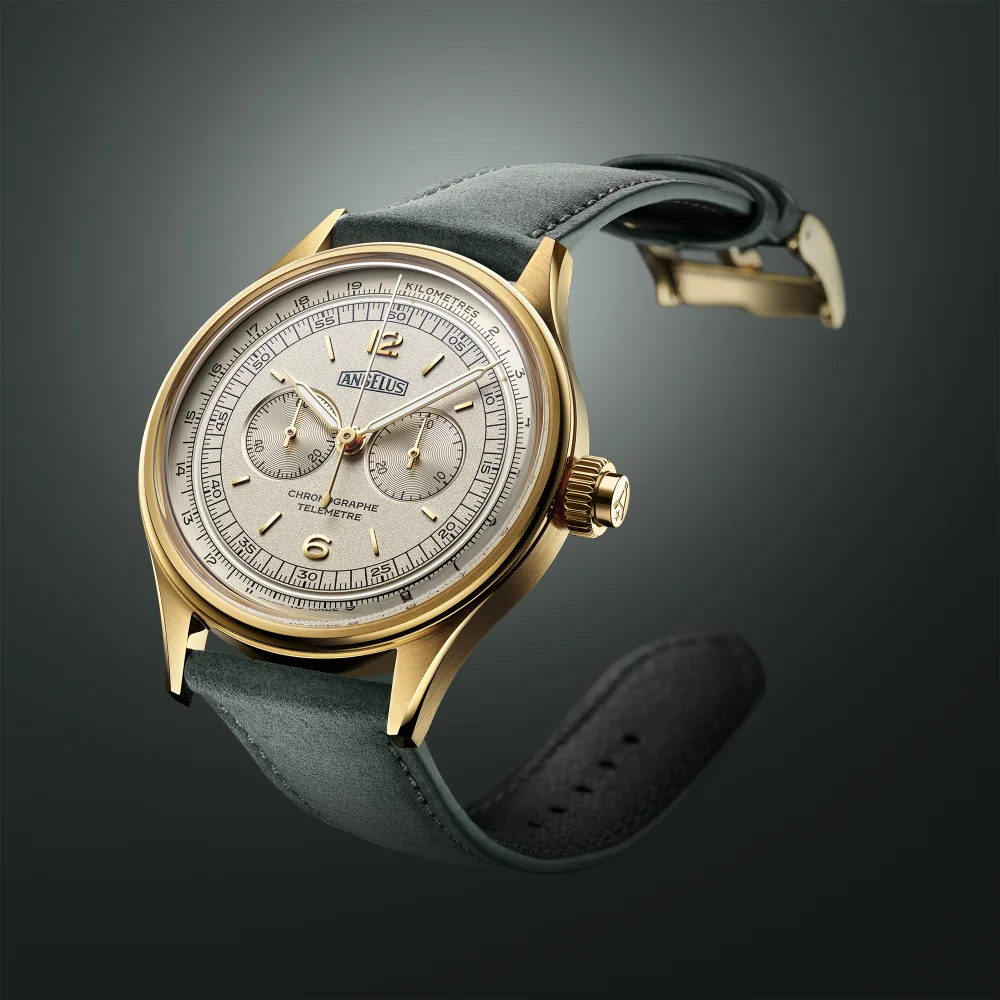
For 2025, Angelus dipped again into its rich history. This time It pulled up the curtain on the Chronographe Télémètre. While the Chronodate had a neo-vintage vibe, the Chronographe Télémètre stays true to the original WW II monopusher in a 37 mm vintage size, a smart move in the age where bulky, big statement pieces are no longer in favour. And, it hit the sweet spot for those collectors who pined for the historical heyday of the originals.
From tip to toe, the modern Chronographe Télémètre might be mistaken as the original when first noticed. The case middle presents curves that elegantly mesh with the lugs. To highlight the distinctive lugs, the polished and plunging edges dip at the top, flowing into a twisted shape on the flanks.
Angelus Chronographe Télémètre (2025) – dial
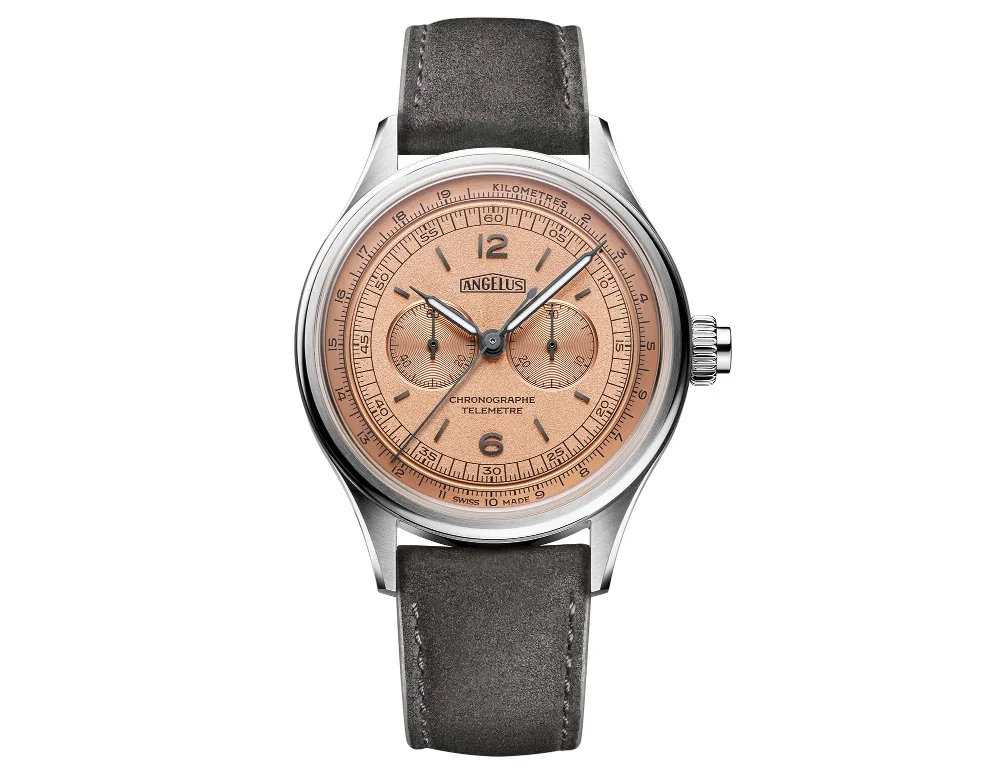
The dials offer a selection in three colours: a rosy bronze and a titanium grey for the stainless steel cases, while the yellow gold timepiece comes in a dusty white. Complementing the dials is a satin-finished flange that ties into the case finishing and also contrasts with the grained finish in the middle of the dial, allowing the eye to catch the details of each. Reinforcing the differentiation is a diamond-polished thread separating the two areas.
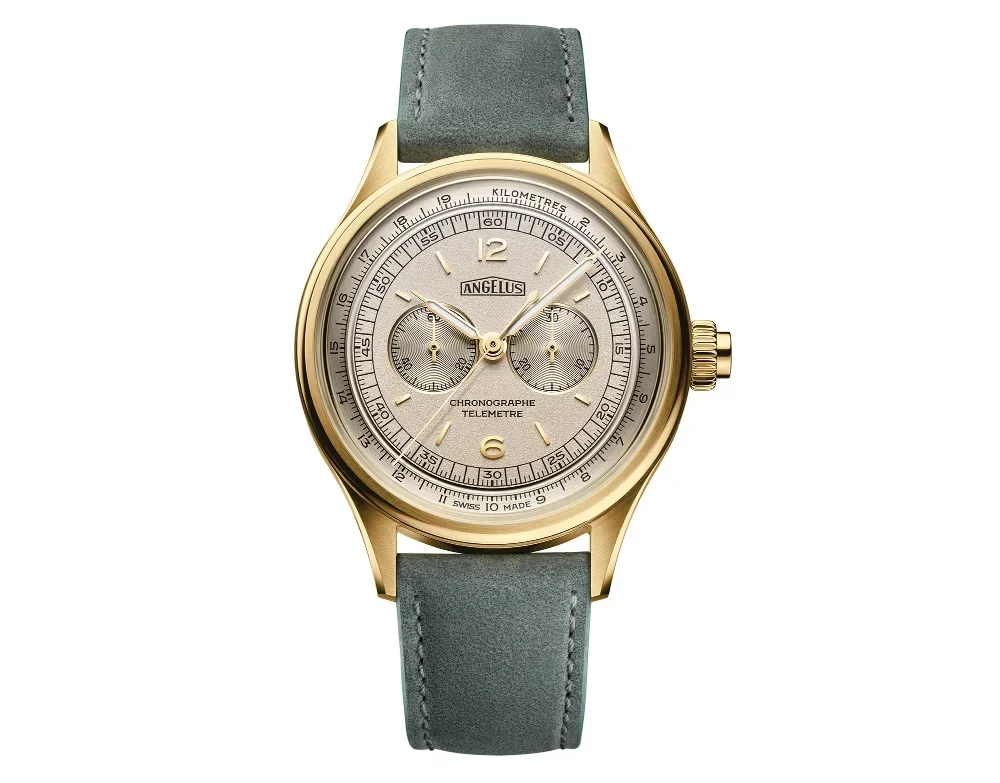
The counters are snailed while the 30-minute scale features a circular brushed finish. Applique hour-markers and Arabic numerals are dressed up in a black rhodium treatment or 3N gold finish. The domed crystal protecting the dial allows a better view and is also a hat tip to the original. The look becomes complete with a calfskin leather strap in steel blue, anthracite grey or sage green, depending on the dial selected. To match the case, the pin buckle is composed of stainless steel or 3N yellow gold.
Angelus Chronographe Télémètre (2025) – A5000 calibre
Where the new Télémètre differs from the original is the rebuild under the hood, which stays true to the construction. The in-house, hand-wound A5000 calibre chrono movement, with a 42-hour power reserve, of course, has an integrated mono-pusher. Just like the chronographs from the 1940s through early 1970s, the A5000 incorporates a column wheel with a horizontal clutch.
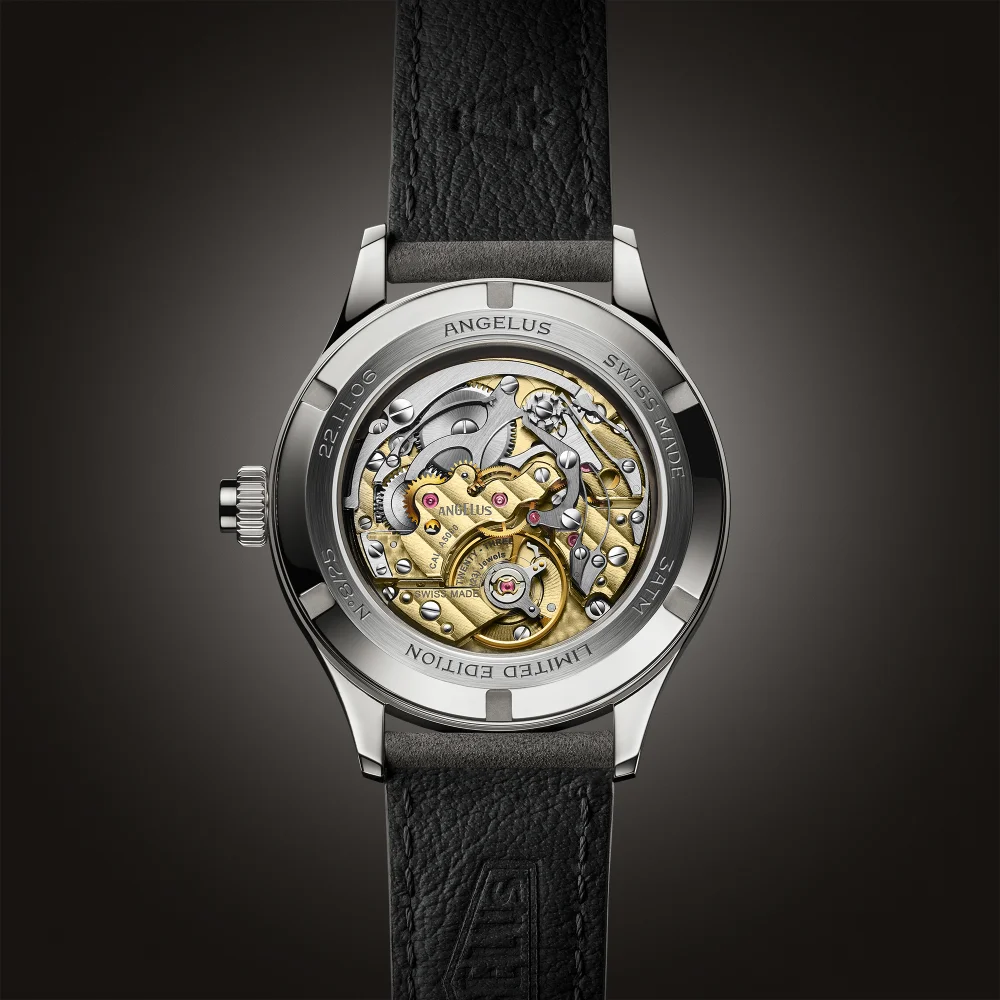
The movement also gets the spa treatment with an upgrade from the more utilitarian finish of the original, starting with the two-tone finish. The 3N golden finish of the mainplate and circular-grained bridges contrasts with the chronograph function glowing in palladium. The movement also upscales with Côtes de Genève on the bridges, circular-grained chamfered wheels and polished screws.
Closing remarks
The Chronographe Télémètre comes in a limited edition of 15 gold timepieces and 25 stainless steel renditions for each colour variant, making a total of just 65 pieces. It recalls a nostalgic time in history when tool watches were essential equipment. Perhaps, equally important, the Chronographe Télémètre offers a way to have a sensory experience with time in a modern world. It serves to emphasise the importance of listening, watching and interacting with intention.
Further reading
https://www.angelus-watches.com
Technical specifications
- Model: Angelus Chronographe Télémètre
- Reference: 0CHC.QI01A.V010Q (gold with white dial)
- Reference: 0CHC.SP01A.V010S (steel with rose dial)
- Reference: 0CHC.SG01A.V010S (steel with grey dial)
- Case: diameter 37.00 mm, height 9.25 mm, water resistance 3 ATM (30 metres) sapphire crystals to the front and back
- Functions: hours, minutes, 30-minute chronograph 20 km telemeter scale
- Movement: Calibre A5000, hand-wound movement, frequency 21,600 vph (3 Hz), contains 23 jewels, power reserve 42 hours
- Strap: calfskin, steel blue, anthracite grey or sage green. Fitted with a pin buckle, 18-carat yellow gold (3N) or stainless steel
- Limited Edition: 15 timepieces (gold with white dial), 25 pieces (steel with rose dial) and 25 pieces (steel with grey dial)
- Price: steel – CHF 17,900 including VAT (RRP as of 24.7.2025)
- Price: gold – CHF 32,300 including VAT (RRP as of 24.7.2025)