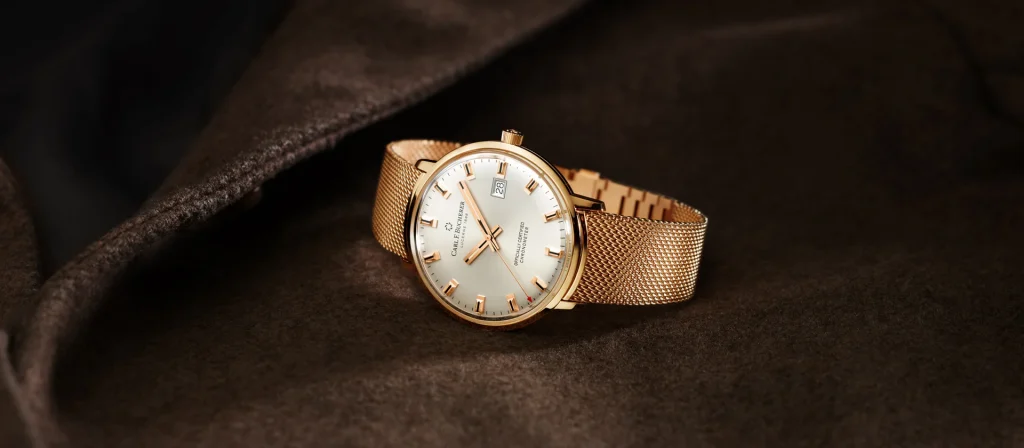
£10000 to £20000

In the world of watches, prices can exceed £1 million and, when it comes to vintage models or unique pieces, feverish bidding within the most prestigious auction houses can even see watches sell for over £10 million. Learn more about the factors that command a higher price point below.

Explore our in-depth reviews of watches for £10000 to £20000 here on Escapement Magazine.

  • Case material: In addition to premium grades of stainless steel and Grade 5 titanium, horophiles may succumb to the allure of an 18-carat gold watch. This noble metal is alloyed with other elements to improve its wear-resistance and alter its appearance, e.g. white gold, yellow gold and rose gold.
  • Métiers d’Art: There are numerous examples of Métiers d’Art, including hand-engraving, marquetry (wood or straw), gem-set dials or cases, miniature painted dials and Damascus dials. 
  • Complications: Within this price segment, expect a highly-specified chronograph (column-wheel and vertical coupling), possibly with additional functionality e.g. split-seconds (AKA, ‘rattrapante’) or flyback. There are also some interesting calendar watches in this segment, including annual calendars and even some perpetual calendars. In 2024, Frederique Constant, a Maison that has always been known for delivering  value, released a sublime limited edition perpetual calendar in collaboration with Peter Speake.
  • Finissage: The finest watches feature movements endowed with a variety of finishes, many of which are imparted by hand. Movement bridges will often be decorated with Côtes de Genève and feature bevelled edges (aka ‘anglage’). The chassis of the movement, termed the ‘mainplate’, will be adorned with a motif of overlapping circles known as perlage. The best movements within this price segment will also feature polished jewel and screw sinks, and may even include gold chatons.
  1. A Grand Feu Dial: Will never fade with the onset of years and its lustre is cherished by watch aficionados.Its creation involves applying a layer of enamel (composed of silica and crushed oxides) to a dial blank, placing it in an oven and subjecting it to a firing process (circa 800°C). Once removed, the dial is allowed to cool, a new layer of enamel is applied to the surface and the process is repeated. A Grand Feu dial will be formed of several layers. In 2025, Girard-Perregaux launched a version of its legendary Laureato model featuring a glorious Grand Feu enamel dial.
  2. A Hand-Guilloché Dial: Involves using a rose engine lathe (aka ‘guillochage machine’). The dial blank is affixed to a rotating head, secured in a vertical position. The artisan presses a cutter against the dial blank, while at the same time turning the rotating head using a hand-operated wheel. The path of the cutter is determined by a rosette or cam, imparting a specific dial pattern. Chronoswiss, an independent watch brand based in Lucerne, has gained a reputation for democratising this artisanal technique.