
Ferdinand Berthoud Chronomètre FB RES Watch Review
The Ferdinand Berthoud Chronomètre FB RES was recently unveiled at Watches & Wonders 2024. This highly-precise exemplar of Haute Horlogerie features a fusee-and-chain transmission, a Maltese stopworks, a remontoir d’égalité and several additional refinements that confer rate stability and incredible chronometric performance. Angus Davies looks back at the brand’s history and former models before exploring this latest creation in minute detail.
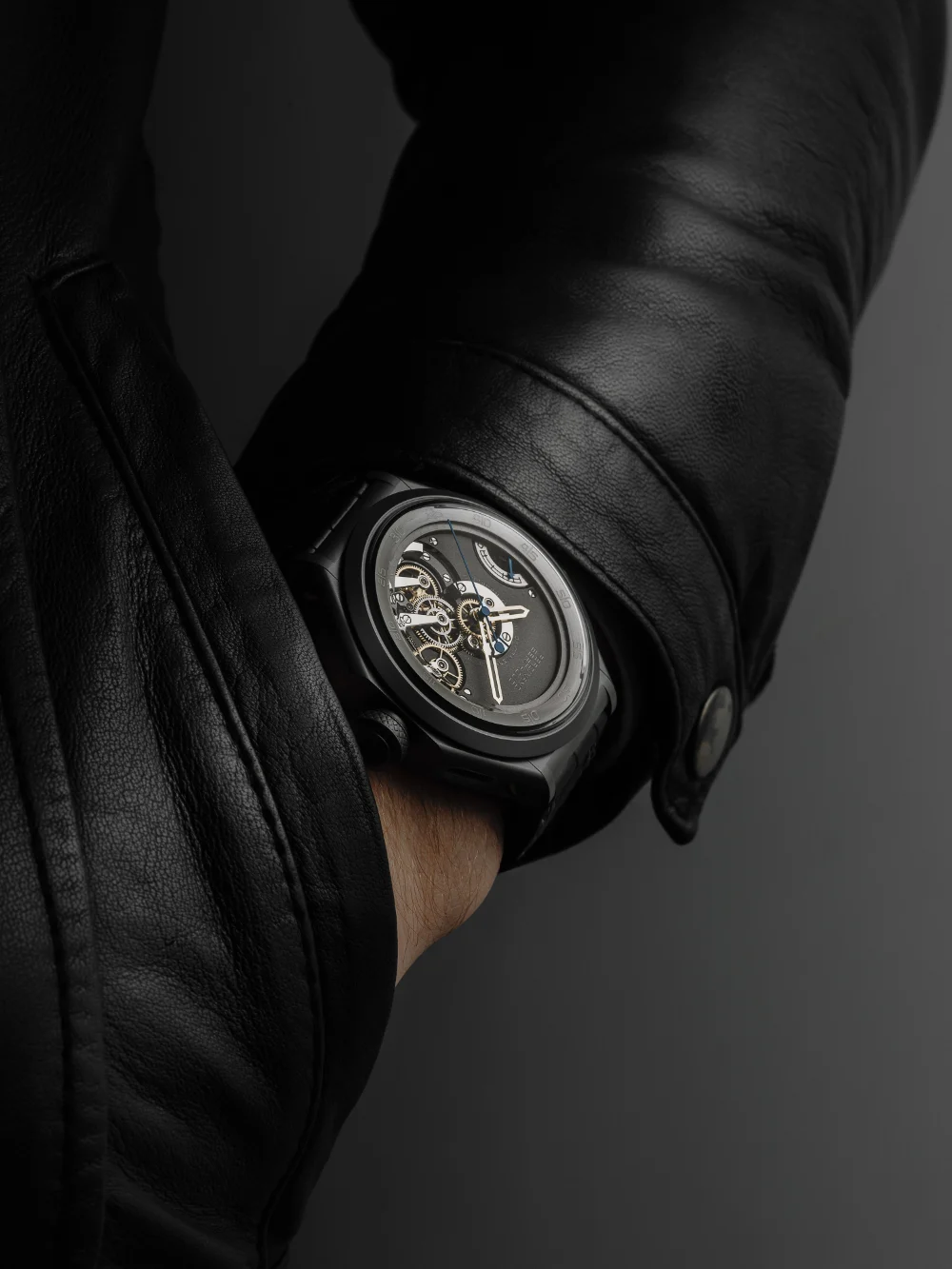
Image – Chronomètre FB 1RES.4
The importance of precision
To be late is a sign of rudeness, suggesting your time is more important than that of others. As a child, it was always impressed upon me to ‘be on time’. Inevitably this has led to me being early for everything. For most of my life, I assumed this was the polite thing to do until a few years ago when I visited Tokyo and was invited to a social event. Arriving 10 minutes early, my local guide informed me that I needed to wait nearby as it would be impolite to arrive before the stated time. Despite being exposed to the inclement weather, I acceded to his request, waiting before entering the venue at the stated time. Quite simply, for some individuals timing and precision are of paramount performance.
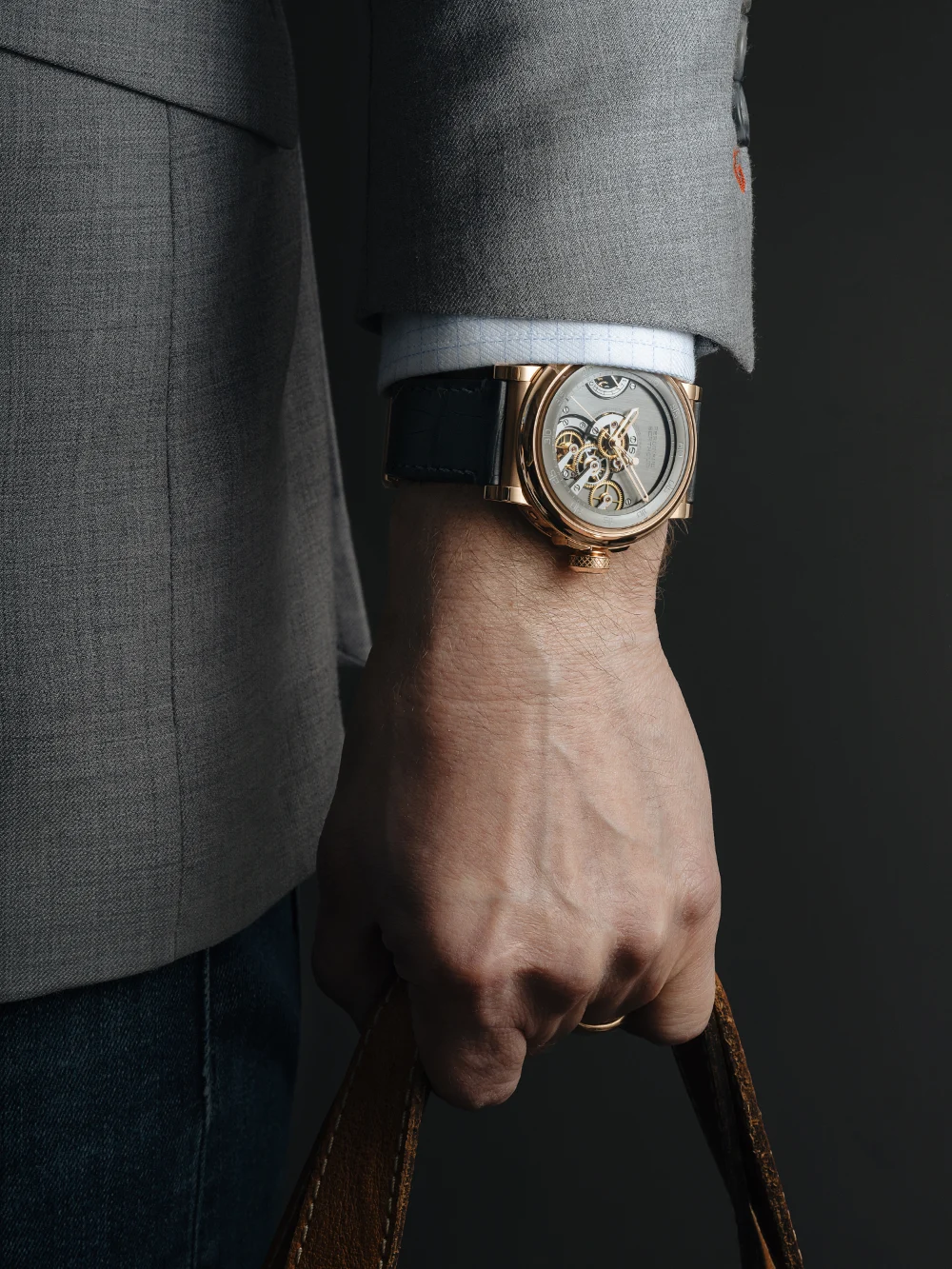
Image – Chronomètre FB 2RES.2-1
Marine chronometers
However, while social etiquette places much value on punctuality, precision was of greater importance back in the 18th century. Marine chronometers, highly precise timekeepers, proved essential when navigating potentially treacherous seas. The English watchmaker John Harrison (1693-1776) and later his compatriot, John Arnold (1735-1799), specialised in making increasingly accurate marine chronometers.
On the opposite side of the English Channel, Swiss-born Ferdinand Berthoud (1727-1807), a master watchmaker, based in Paris, was also very active in the development of marine chronometers. A Fellow of the Royal Society (1764), Berthoud later became ‘Watchmaker-Mechanic to the King and to Navy’ (1770).
In 1760, Berthoud, a man of remarkable intellect, published a two-volume horological treatise, ‘Essai sur l’horlogerie: dans lequel on traite de cet Art relativement à la Navigation, en établissant des principes confirmés par l’expérience’. Three years later (1763), the King of France tasked Berthoud with examining John Harrison’s H4 Marine Timekeeper. Unsurprisingly, Harrison refused Berthoud’s request to view the H4.
In terms of safely navigating the seas, this period in 18th century history was similar to the so-called 20th century ‘space race’ (1957-1969) an era when the USSR and US sought supremacy of the celestial world. Back in the 18th century, England and France, two nations who were often at war, continuously strived to produce ever more precise marine chronometers. The capacity to pinpoint a vessel’s precision was of utmost importance, potentially affording one side supremacy at sea.
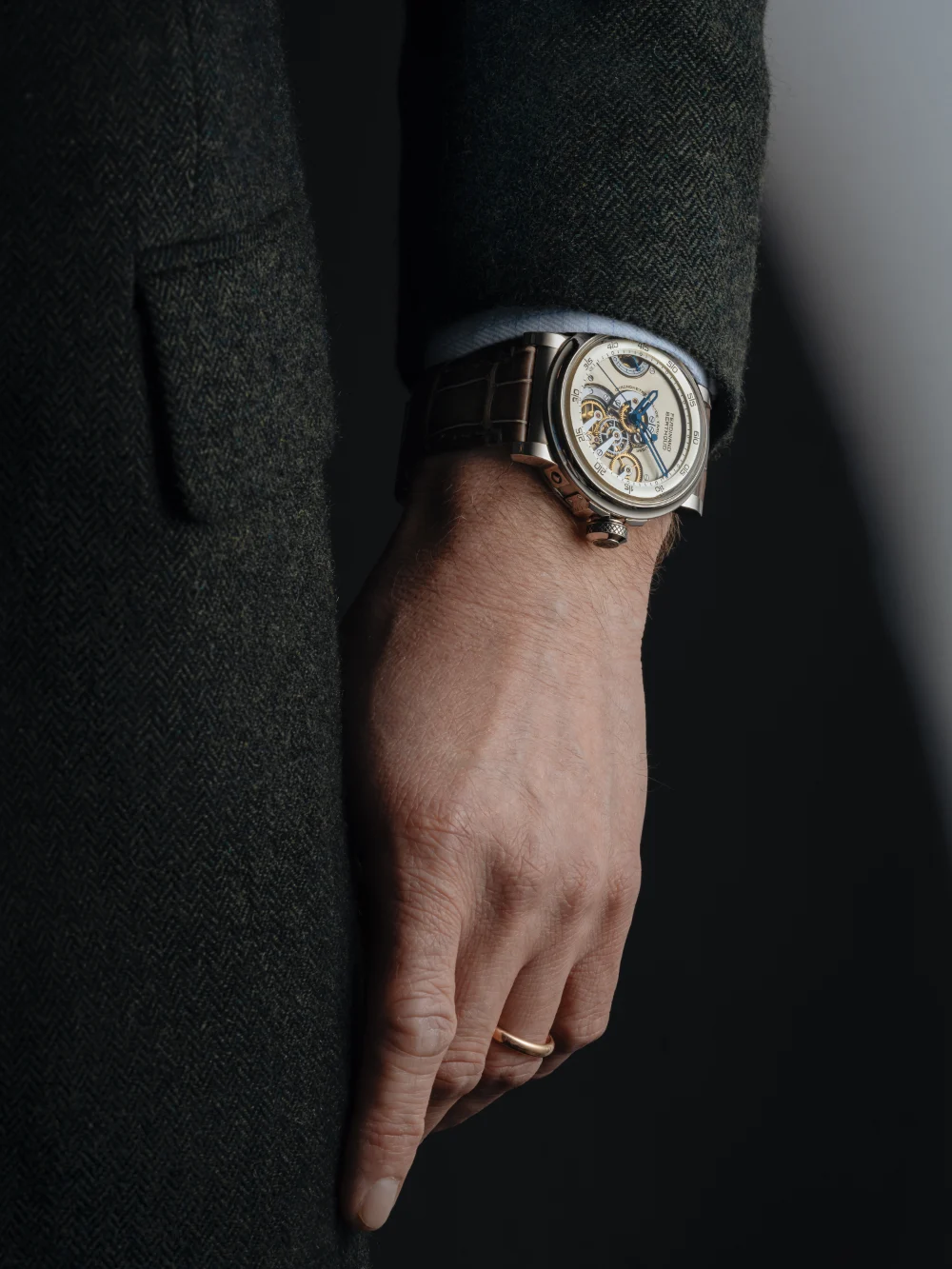
Image – Chronomètre FB 2RES.1-1
Berthoud – a family dedicated to the pursuit of precision
Throughout his life, Berthoud’s quest for superior chronometry never diminished. He later passed the baton to his nephew Henry, but due to Henry’s premature demise, Ferdinand would subsequently hand the reigns to his other nephew, Pierre Louis (1754-1813). In turn, Pierre-Louis’s sons, Jean-Louis Berthoud (1793-1880) and Charles-Auguste Berthoud (1798-1876) entered the watchmaking profession. Three generations of Berthoud watchmakers all dedicated to the making of highly precise timekeepers.
Karl-Friedrich Scheufele, Co-President of Chopard and an avid collector of horological artefacts, acquired the Ferdinand Berthoud name in 2006. Mr Scheufele has always been passionate about matters of chronometry; hence the revival of the Berthoud name was very important to him. After expending much time working behind the scenes with a team of specialists, he revived the name Chronomètre Ferdinand Berthoud in 2015. To coincide with the relaunch of the brand, the firm simultaneously unveiled its inaugural models, the Chronomètre FB 1.1 and the Chronomètre FB 1.2, an identical watch, save for its black dial and rose gold case.
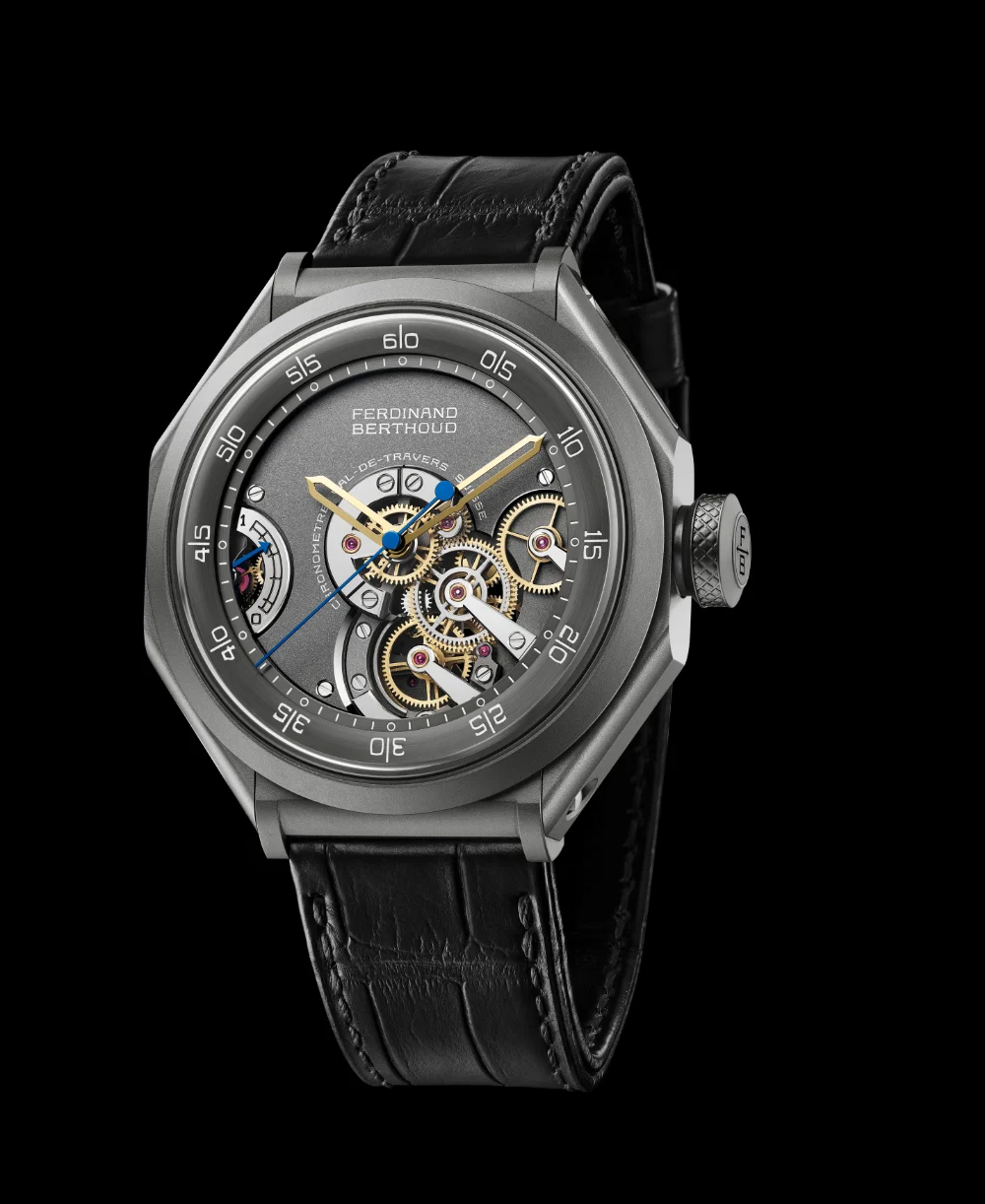
Image – Chronomètre FB 1RES.4
Chronomètre FB1.1
Limited to just 50 pieces, the exalted specification of the Chronomètre FB 1.1 provided a foretaste of what was to come. Housed in a white gold octagonal case, the design was intended to evoke thoughts of a gimbal-mounted marine chronometer. Watertight portholes graced the flanks of the case, reinforcing the maritime theme while also affording views of the beautifully executed movement, the Calibre FB-T.FC.
The Chronomètre FB 1.1 featured 1,120 movement components. Its construction, clearly inspired by historical clocks, featured pillar-type architecture. The model was endowed with a series of features designed to augment precision. The inverted tourbillon negated the adverse influence of gravity on the rate. Interestingly, the brand united this high complication with a direct-drive centre seconds hand.
Unusually, the watch was endowed with a fusee-and-chain transmission incorporating a 790-piece chain wrapped around a cone-shaped fusee.
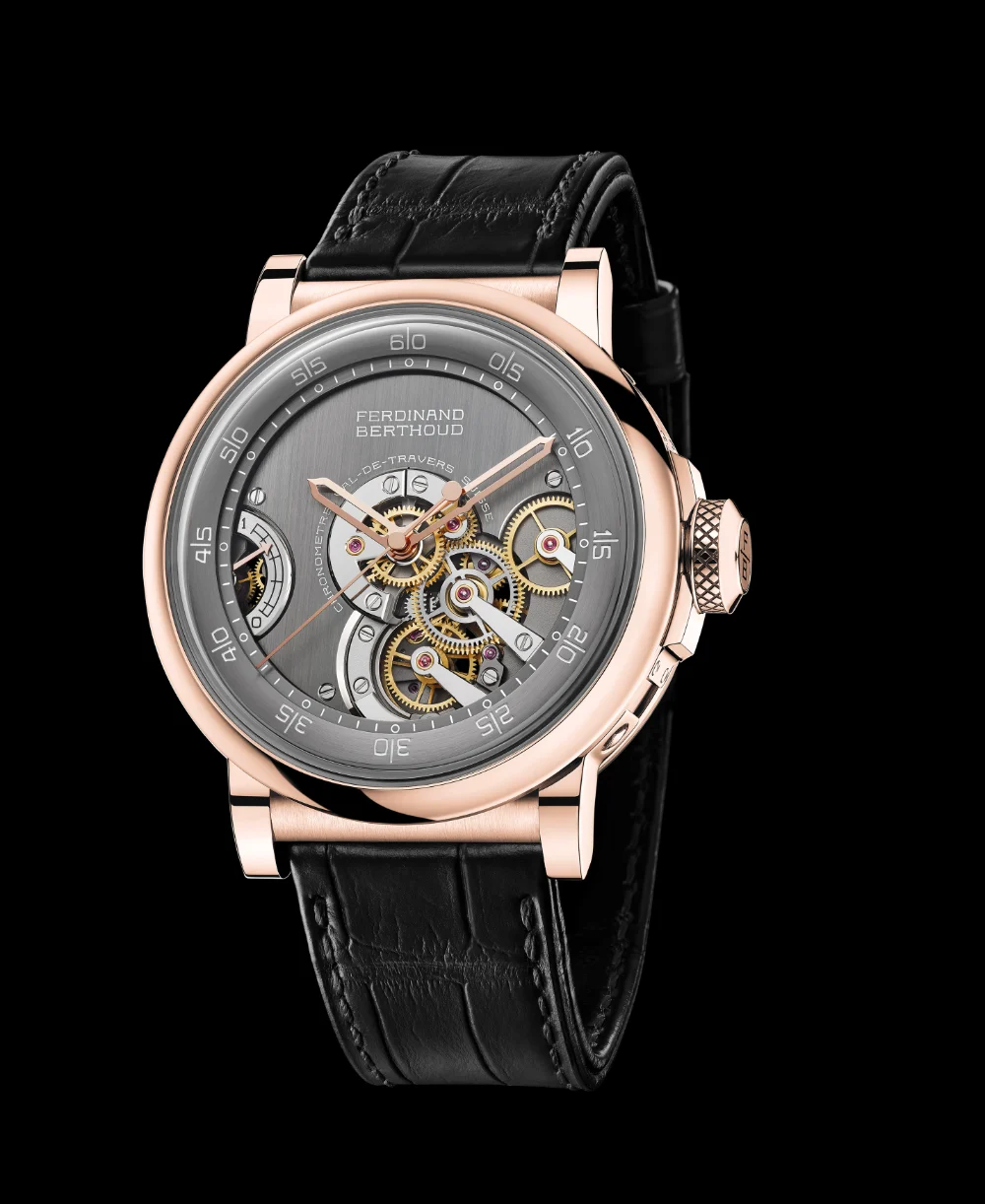
Image – Chronomètre FB 2RES.2-1
With this mechanism, as the power in the barrel diminishes, the fusee requires less force to rotate. As result, irrespective of the status of the mainspring, the force serving the escapement remains constant ie the mechanism delivers superior rate stability.
Another refinement found on the Calibre FB-T.FC was the inclusion of a Maltese stopworks atop the barrel. This feature only allows the barrel to rotate when the force serving the escapement is within the optimum range. When the force is insufficient to deliver precise operation, the Maltese stopworks prevents the barrel rotating further, causing the watch to stop.
With the advent of the Chronomètre FB 1.1, Mr Scheufele showed his determination to create a horological tour de force. Other movement highlights included a free-sprung balance, a hand-shaped Philips terminal curve, an ingenious power-reserve display with a cone and feeler system and superb hand-finishing. Moreover, the movement was COSC-certified.
The Chronomètre FB 1.1 set in place the foundations for what has since become an impressive portfolio of timepieces, each delivering exceptional chronometric performance.
Chronomètre Ferdinand Berthoud – creating a post-dated legacy
The Chronomètre FB 1.1 went on to win the prestigious ‘Aiguille d’Or’ at the GPHG in 2016. No doubt buoyed by securing this coveted award, as well as receiving a plethora of plaudits from watch aficionados, the Maison went on to release several new references.
Some models shared much in common with the Chronomètre FB 1.1 but were executed in different metals, such as the Chronomètre FB 1.4-3, or featured additional artisanal touches as in the case of the Chronomètre Oeuvre d’Or FB1.2-1. However, other references featured alternative dial designs and/or functions. For example, the Chronomètre FB 1R.6-1, a regulator, was inspired by Berthoud’s Marine Clock No.7. The minutes were presented on a dedicated dial at 12 o’clock and the hours were shown in an aperture at 2 o’clock. Despite having a power-reserve display, it looked very different from that of its forebears and resided at 10 o’ clock. The Chronomètre FB 1R.6-1 won the ‘Chronometry Prize’ at the GPHG 2019.
The Chronomètre FB 1L.1 featured a large hand at the base of the dial that arced over a track indicating the age and phases of the moon. Furthermore, the dial included a display at 4 o’clock showing a representation of the moon waxing and waning. By positioning the power-reserve indicator to the rear of the watch, the Maison mitigated dial clutter while still delivering the same functionality.
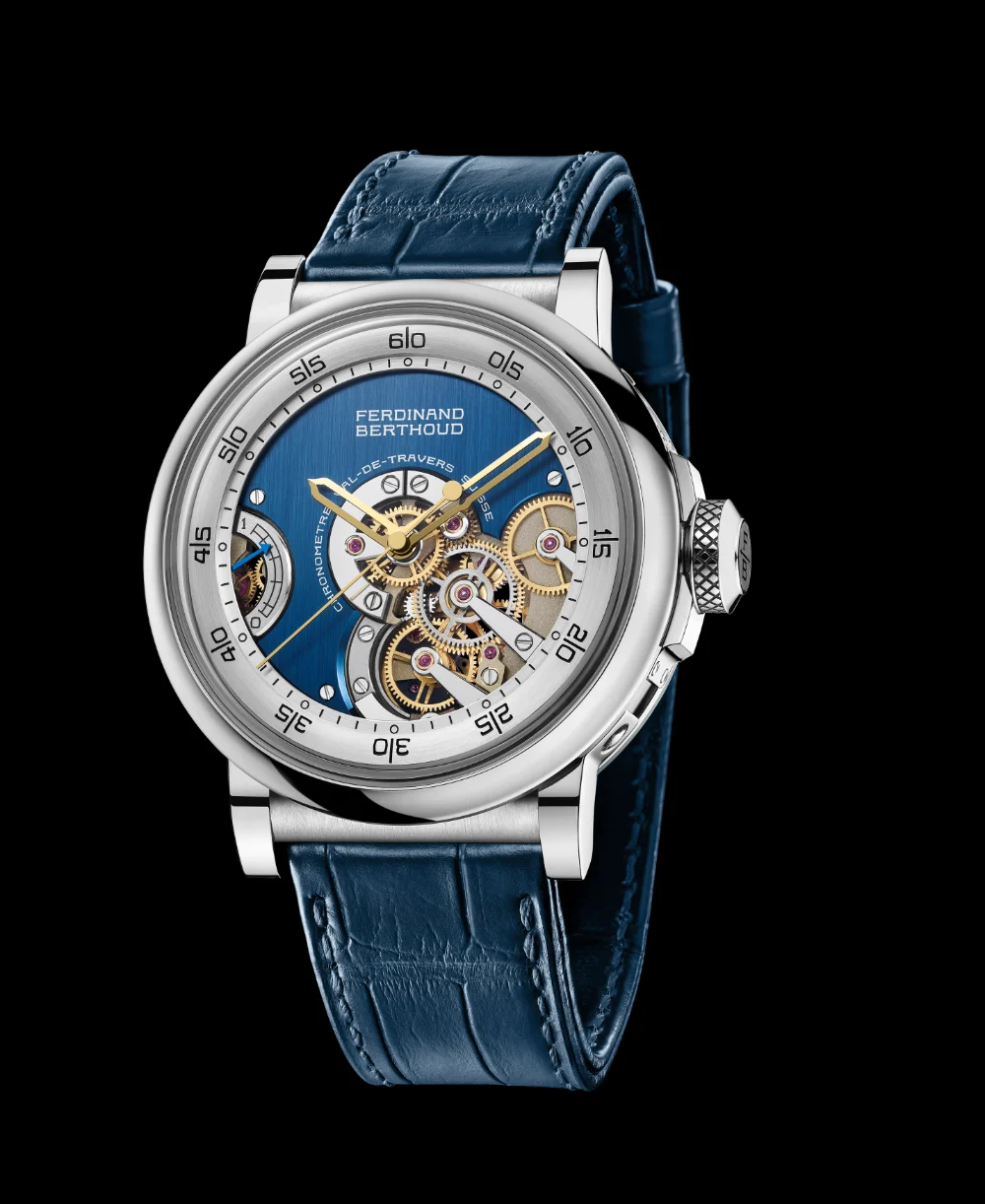
Image – Chronomètre FB 2RES.6-1
Chronomètre Ferdinand Berthoud Chronomètre FB 2RE – notably different
Up to this point, each reference featured a tourbillon, fusee-and-chain transmission and Maltese stopworks, but in August 2020 the Maison released the Chronomètre FB 2RE, a watch endowed with a new movement (Calibre FB-RE.FC) that eschewed the tourbillon in favour of a one-second remontoir d’égalité. This latter mechanism regulates the torque from the mainspring as it passes through the gear train. This force serves a lightly tensioned spring which, in turn, sends a precise pulse of energy to the escapement every second. The remontoir d’égalité, once again, enhances rate stability. In this instance, the mechanism also drives the central seconds hand, causing it to advance in discrete steps (dead-beat seconds).
The Chronomètre FB 2RE was blessed with other distinguishing features. Measuring 44 mm in diameter, it eschewed the brand’s octagonal case in favour of a round housing, a first for the company and a characteristic referenced with the number ‘2’ in its name. Upholding FB tradition, the dial featured the firm’s distinctive dagger-shaped hands, albeit these were set against a lustrous Grand Feu enamel backdrop. The Chronomètre FB 2RE won the ‘Chronometry Prize’ at the GPHG 2019.
At this juncture, the modern-day Maison had produced an extensive body of work. New releases shared some elements in common with earlier models; a policy which ensured that, even with the advent of a new reference, former models would still retain eye-appeal, thereby cleverly sidestepping obsolescence. Indeed, when the company released the Chronomètre FB 1RS.6, despite sporting an eye-catching openworked dial it still bore a close resemblance to the former Chronomètre FB 1R.6-1.
More recently, the Swiss marque has unveiled the Chronomètre FB 2RSM.2-1 and the Chronomètre FB 2T.
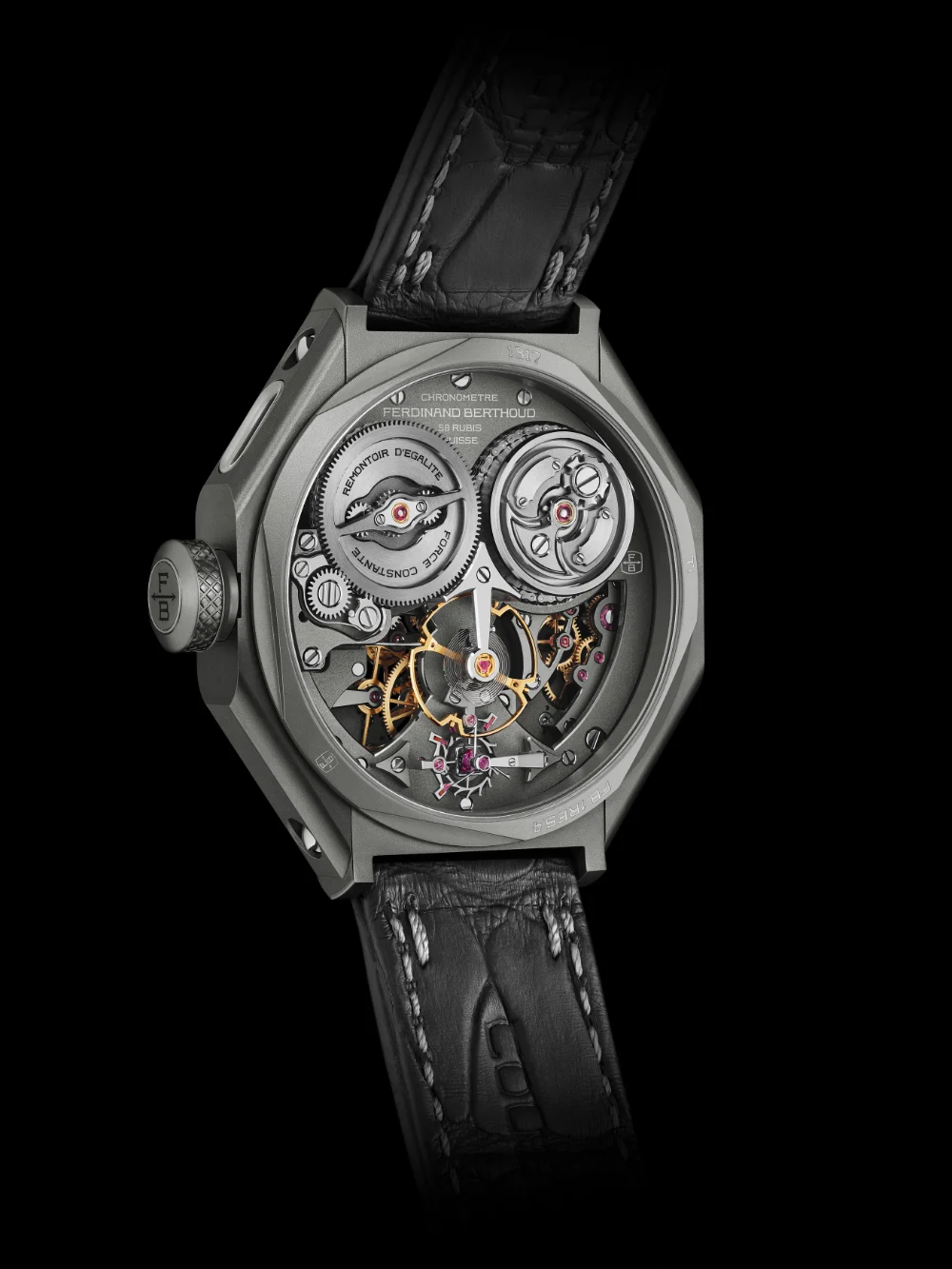
Image – Chronomètre FB 1RES.4
Chronomètre Ferdinand Berthoud – always COSC-certified
All of the Maison’s timepieces are COSC-certified chronometers. It has been a self-imposed requirement since the release of the inaugural FB 1.1 back in 2015. This policy did prove a challenge when the company wanted to create a watch, the Chronomètre FB 3, equipped with a cylindrical balance spring. Drawing on the talents of its craftspeople and watchmakers, Chronomètre Ferdinand Berthoud conceived the Calibre FB-SPC, incorporating a cylindrical balance spring equipped with two handcrafted terminal curves.
The product of exhaustive research and development, the movement within the Chronomètre FB 3 represented a departure from what had gone before. Indeed, unlike its forebears, the Calibre FB-SPC eschewed the brand’s beloved tourbillon, fusee-and-chain transmission and Maltese stopworks or, indeed, the remontoir d’égalité found on the Chronomètre FB 2RE. However, despite its obvious differences, the movement still passed the scrunity of the COSC, culminating in the award of chronometer certification. The model also won the ‘Chronometry Prize’ at the GPHG awards in 2023.
For a movement to achieve COSC chronometer certification, the average daily rate must be between -4 to +6 seconds. However, Ferdinand Berthoud seeks a far higher degree of precision with most movements achieving an average daily rate between -2 to +3 seconds.
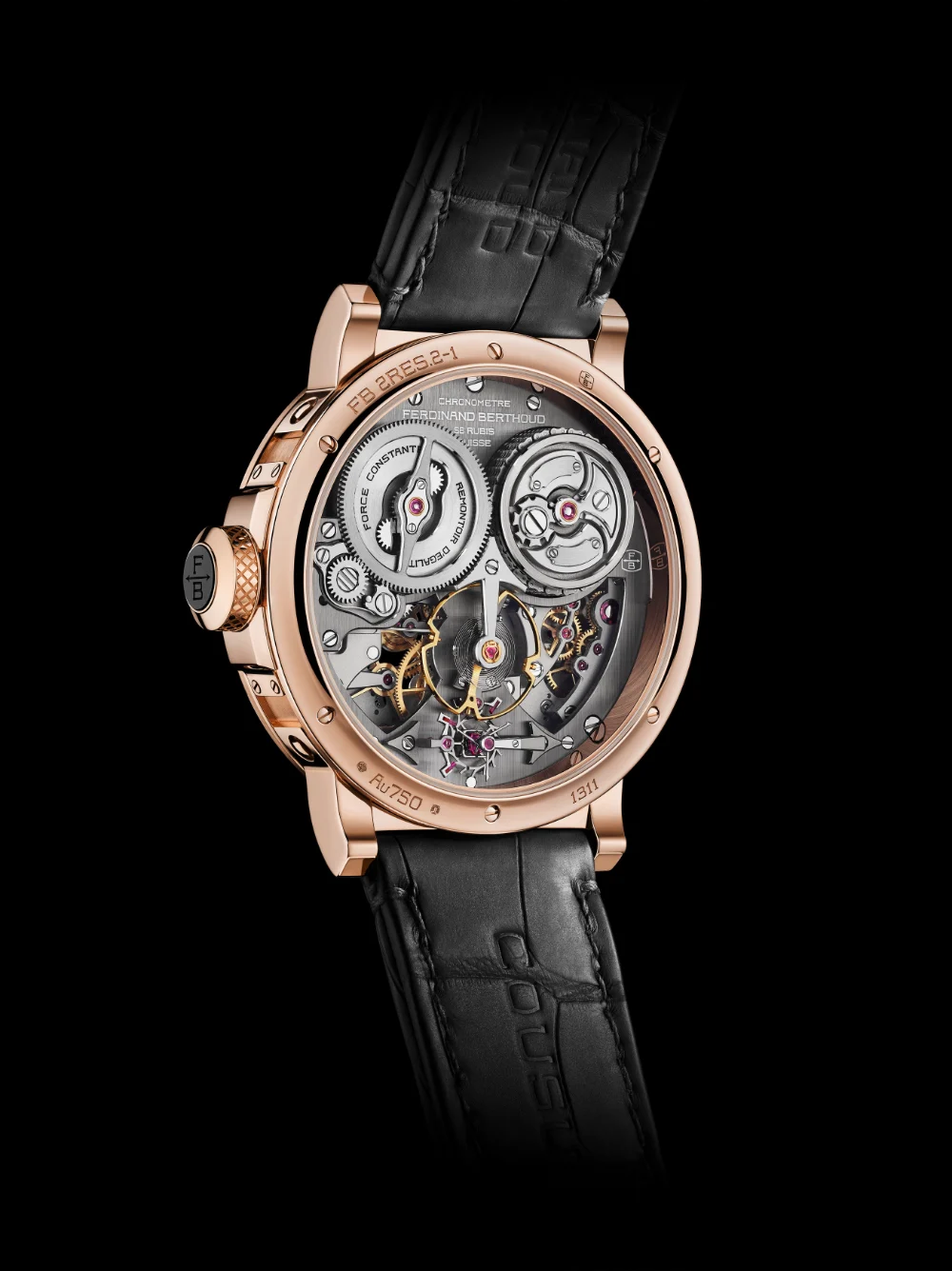
Image – Chronomètre FB 2RES.2-1
Ferdinand Berthoud Chronomètre FB RES – introduction
In April 2024, Ferdinand Berthoud unveiled a new collection of models equipped with an evolution of the Calibre FB-RE.FC fitted to the aforementioned Chronomètre FB 2RE. The new Calibre FB-RES.FC, once again, in common with all of the Maison’s watches, is a hand-wound movement. Like the 2020 release (the FB 2RE), the Chronomètre FB RES employs a fusee-and-chain transmission, Maltese stopworks and one-second remontoir d’égalité. Likewise, front of house, the new model features three central hands, articulating the hours, minutes and seconds.
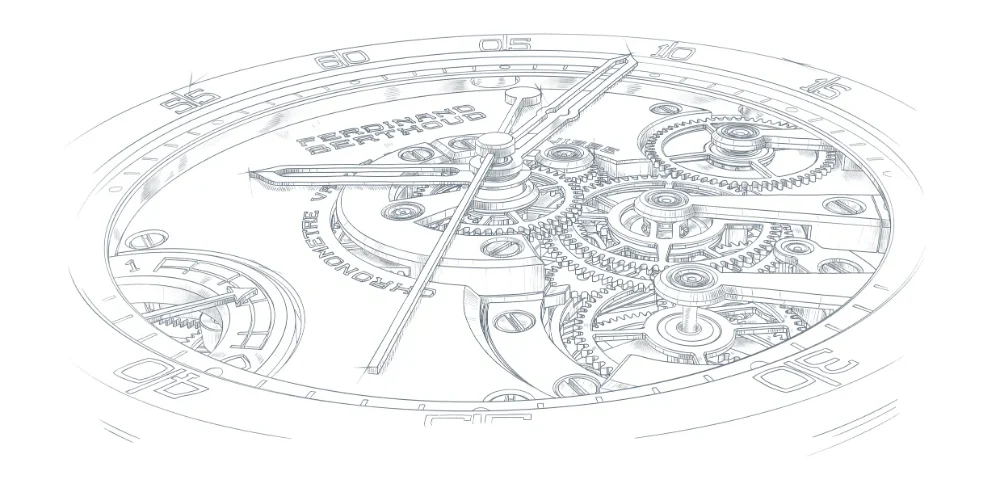
Where this new timepiece differs from its forebears is that, courtesy of the skeletonised dial, it reveals more of the movement’s thought processes. Moreover, the model delivers an unprecedented degree of customisation options, including the case material, a choice of octagonal or round housings and a myriad of movement and bridge variants. Indeed, the Maison has created an online configurator. Similar to the systems offered by several prestigious car marques, the would-be wearer can while away the hours vacillating over the execution of the bridges and mainplate or the colour of the inner bezel ring. The Swiss firm states that ‘more than 200 variations can be simulated’ using the online configurator.
Often watch companies talk of limited editions, restricting availability of models to a finite number; however, at Chronomètre Ferdinand Berthoud, things are done a little differently. It is the movement, the Calibre FB-RES.FC that is limited; in this case 38 pieces only. Having expended huge sums of money developing a new movement, most watch firms look to recover the R&D costs by making vast numbers of calibres over several years. The approach taken by Chronomètre Ferdinand Berthoud is very unusual and confers a degree of exclusivity seldom found in the watchsphere.
Without further ado, let’s take a look at some of the product highlights that make Chronomètre FB RES an exceptional timekeeper.
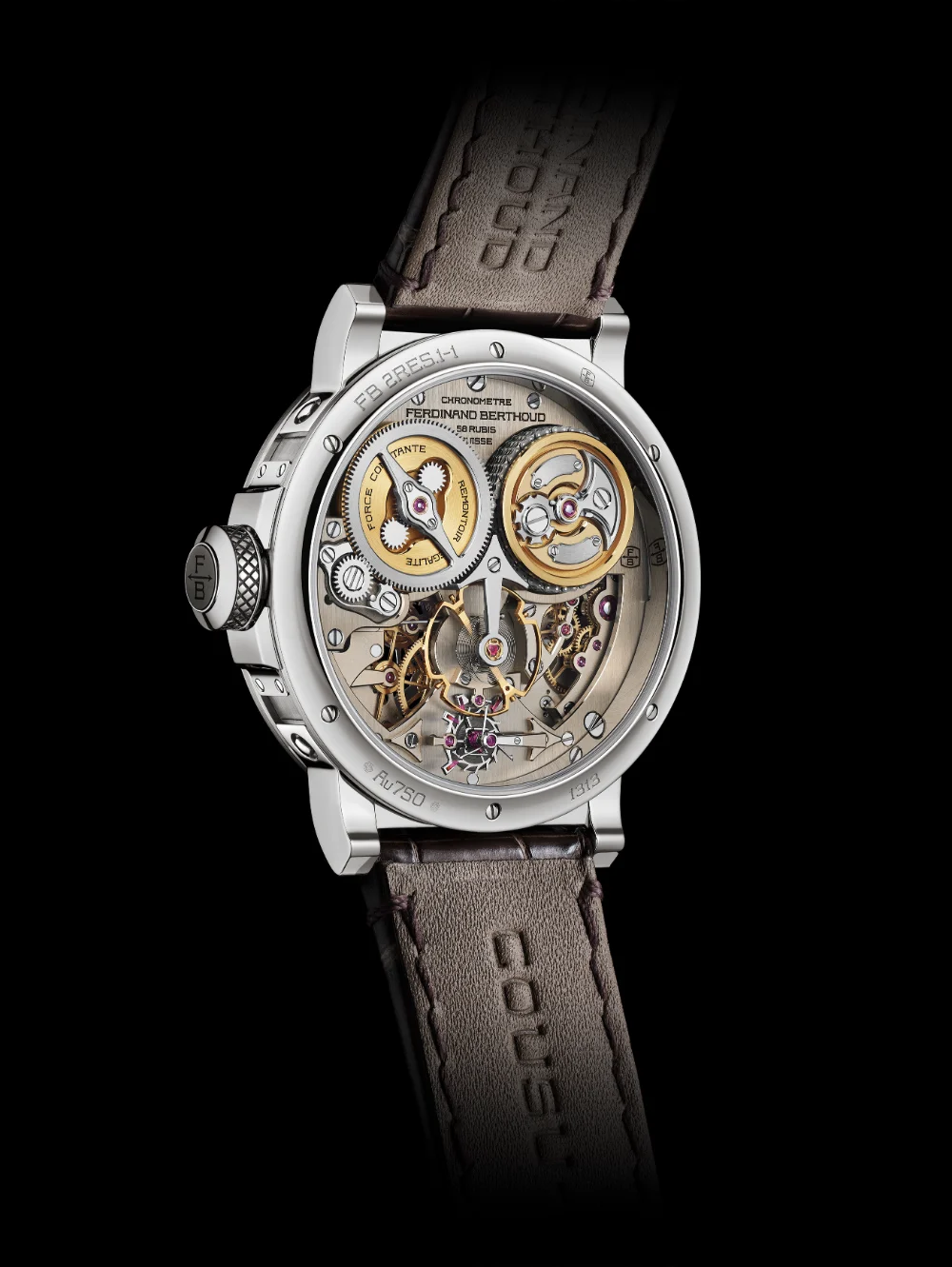
Image – Chronomètre FB 2RES.1-1
Ferdinand Berthoud Chronomètre FB RES dial
The word ‘dial’ is loosely applied in this instance as it is actually the underside of the mainplate. Openworked dagger-style hands express the hour and minutes, while a centre seconds hand avec counterweight circumnavigates the display. A track positioned on the inner bezel ring facilitates precise reading of the minutes and seconds. Adjacent to 9 o’clock, the status of the mainspring is shown with a neat, openworked power-reserve indicator.
Three finger-like, mirror-polished cocks dominate the south-easterly region of the dial, supporting various golden hues. The dial is punctuated with small gaps adjacent to the wheels that provide glimpses through the movement.
When configuring the FB RES, the would-be wearer can choose from satin-brushed or sandblasted finishes, three different dial hues as well as three different colours for the inner bezel ring.
The chevee sapphire crystals, positioned to the front and rear, allow light to flood the interior of the watch, hence, irrespective of the chosen combination, readability is assured.
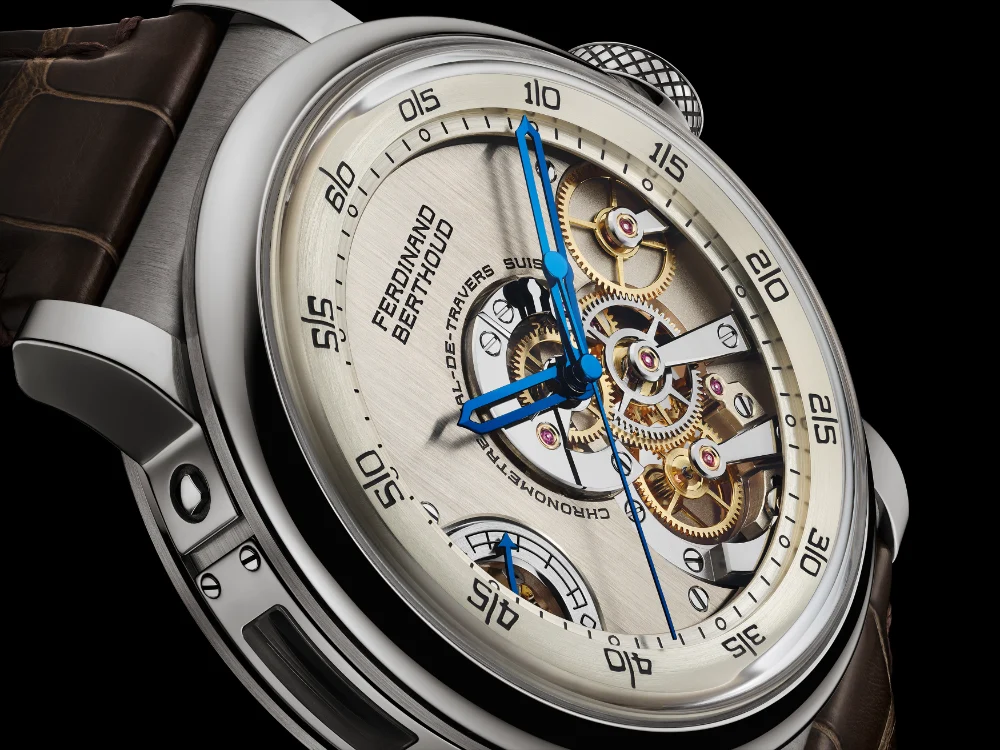
Image – Chronomètre FB 2RES.1-1
Ferdinand Berthoud Chronomètre FB RES case
As stated earlier, the Maison has indulged horophiles with unprecedented choice; round or octagonal housings and numerous case materials. Indeed, prospective clients will need to scroll through the various material options, including 18-carat rose gold, 18-carat yellow gold, 18-carat white gold, stainless steel, titanium and ceramised titanium. The round case is also available in platinum.
Both case shapes measure 44 mm in diameter; however, the round case is a smidgen thicker than its octagonal counterpart (14.30 mm versus 14.26 mm). Another subtle difference is the octagonal case has two portholes whereas the round case has only one caseband window, located at 10 o’clock.
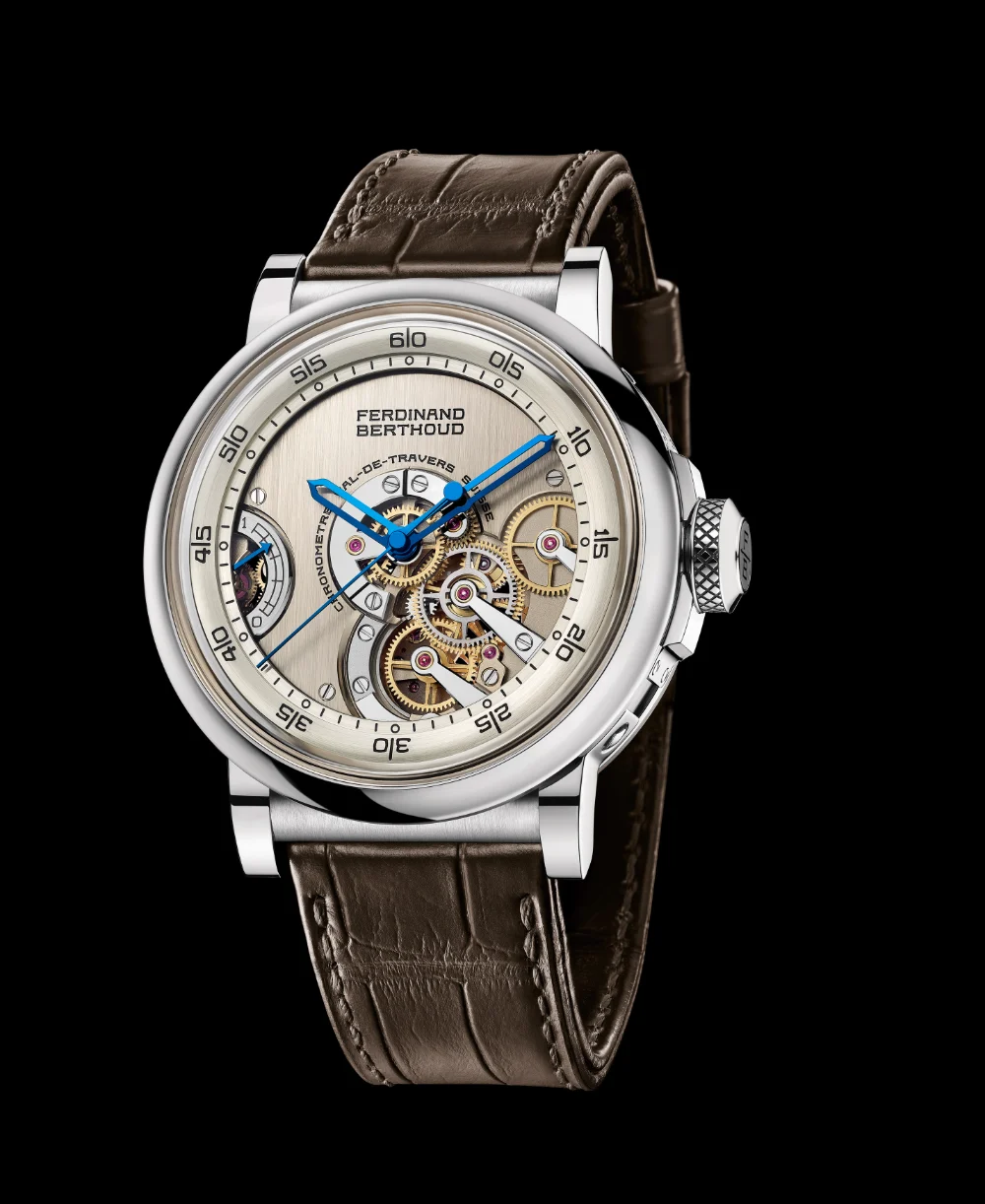
Image – Chronomètre FB 2RES.1-1
Chronomètre Ferdinand Berthoud Calibre FB-RES.FC – finishing
Crafted in the Fleurier-based atelier, each movement incorporates a high quotient of hand-finishing. It’s a world where files of differing coarseness are used to bestow bridges and cocks with 45° bevelled edges. Gentian wood and diamantine paste are then skilfully applied to endow each facetted edge of the nickel silver with a resplendent gleam. The brand states that ‘all the angles of the wheels and their bridges, as well as those revealed at the heart of the 9 o’clock power-reserve display, represent more than two linear metres filed and polished by hand.’
At Watches & Wonders 2024, while cradling an example of the Chronomètre FB RES in my hands, I appraised the finissage at close quarters; everything is ultra-refined and befits the term ‘Haute Horlogerie’. Indeed, I would suggest the finishing on the Calibre FB-RES.FC is probably the finest I have ever seen.
Chronomètre Ferdinand Berthoud Calibre FB-RES.FC – mechanical highlights
The raison d’etre for the creation of a Ferdinand Berthoud watch is to achieve a level of precision seldom found with mechanical watchmaking. Consistent with the notion of luxury, the brand does not subscribe to the notion of ‘ok’, it continuously seeks a degree of perfection few watch aficionados have even considered. Allow me to elaborate on some of the mechanical highlights found on the Calibre FB-RES.FC and explain their relevance.

Image – The key movement components
Fusee-and-chain transmission
As previously mentioned, the Calibre FB-RES.FC is endowed with a fusee-and-chain transmission in common with all of the Swiss firm’s watches, save for the Chronomètre FB 3.
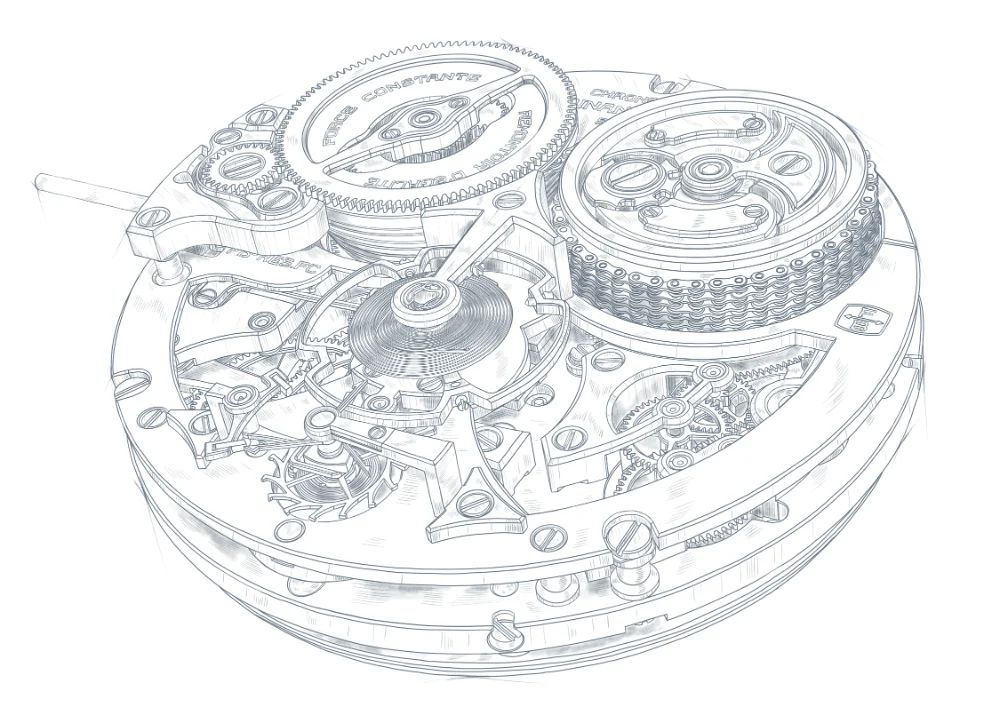
The fusee and chain is a constant force device which ensures that the energy passing through the gear train, ultimately serving the escapement, remains linear whether the mainspring is fully tensioned or near exhaustion. This complex mechanism confers rate stability with the amplitude of the balance varying little (see later).
Maltese stopworks
If the energy from the mainspring is plotted on a graph over a period of time with the stated power reserve expressed in hours, the line should ideally be perfectly horizontal. However, in most cases, the barrel will deliver too much energy when the mainspring is fully tensioned and insufficient energy as the mainspring nears exhaustion.
The Maltese stopworks ensures that only the optimum range of the power-reserve is used, preventing the mainspring supplying too much or insufficient energy to the gear train and, by default, the escapement.
One-second remontoir d’égalité
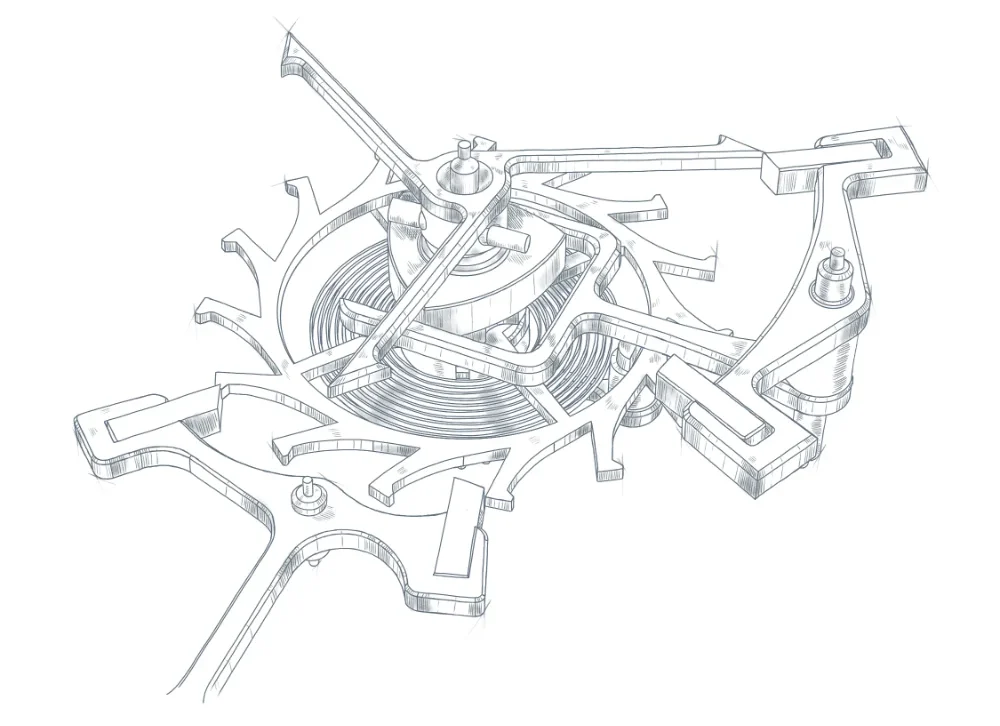
A mainspring is a highly-tensioned spring and will provide much energy; however, the variation in energy from fully tensioned to near depletion will be significant. Its characteristics are very different from that of a balance spring which is lightly tensioned and is designed to harness only small amounts of energy.
The remontoir d’égalité is another constant force device. Positioned in between the gear train and the escape wheel, it also employs a lightly tensioned spring, similar in nature to the balance spring. The spring accumulates energy and once every second pulses the escape wheel with a uniform dose of energy.
As stated earlier, the remontoir d’égalité is linked to the centre seconds hand, causing it to jump every second.
Variable-inertia balance
Most mechanical watches employ an index-regulator to alter the rate, causing the watch to run faster/slower. The rate is adjusted by moving the index (raquette) towards or away from the stud (the means used to affix the balance spring to the cock), altering the effective length of the hairspring, making the watch run faster or slower.
With a variable inertia balance, the effective length of the hairspring is fixed and the rate is adjusted by moving weights affixed to the balance wheel. Adjusting the position of the weights alters the balance’s moment of inertia, making the watch run faster/slower.
It is more time-consuming to regulate a variable-inertia balance; however, the system offers several benefits. The spring develops more concentrically, the rate can be set more precisely and, should the watch be subjected to a shock, it is less likely to need remedial regulation.
Ferdinand Berthoud has added a couple of additional refinements to the balance on this watch. Firstly, the inertia weights fitted to the balance wheel are set in-board, mitigating air turbulence and thereby aiding precision. Secondly, the balance spring features a Philips terminal curve which also causes the balance spring to develop more concentrically, augmenting isochronism.
Stop seconds device on balance
Clearly, the Calibre FB-RES.FC can deliver incredible precision; however, to make this relevant to the would-be owner, it is important that they are able to set the time precisely. The Chronomètre FB RES has a stop seconds device fitted to the balance, allowing the wearer to synchronise the watch with a reference clock.
Ferdinand Berthoud Chronomètre FB RES – closing remarks
In the world of Haute Horlogerie, where excellence is the order of the day, the Ferdinand Berthoud Chronomètre FB RES is highly unusual. Indeed, it is rare for a watch to be equipped with one constant force device let alone two.
By uniting a fusee and chain with a remontoir d’égalité, Ferdinand Berthoud has made life difficult for itself. It takes one month alone to regulate the movement; however, the benefits justify the firm’s protracted efforts.

Image – Running time
The rate is linear over its stated 50-hour power-reserve. The balance has ‘an average amplitude of 301°, varying only slightly throughout its running time (standard deviation=2°). And, lastly, ‘over the entire duration of the power reserve, the readings taken show discrepancies of less that 0.5 seconds on average from the benchmark GPS clock optical measurement’.
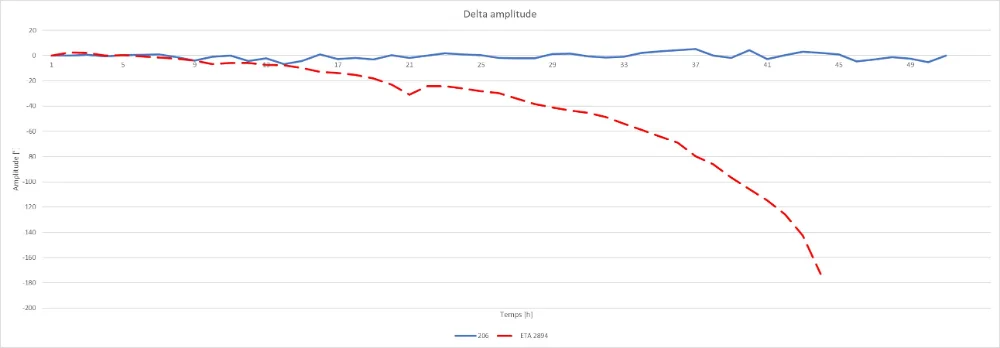
Image – Amplitude variation
The Ferdinand Berthoud Chronomètre FB RES has met the requirements of the COSC and the Fleuritest. The seal of approval from both independent organisations provides additional assurance for prospective clients.
Beyond its functional qualities, the FB RES is beautiful to behold and exquisitely finished by hand. In the rarefied world of luxury, the watch also allows watch obsessives the opportunity to personalise their watch to their own tastes.
But ultimately, all roads lead to chronometry. The Ferdinand Berthoud Chronomètre FB RES is arguably over-engineered and finessed to the nth degree. Two constant force devices may be considered excessive, but it is consistent with the legacy of Ferdinand Berthoud, a man who devoted his life striving to create increasingly accurate timekeepers. I am sure that if were alive today, he would applaud the making of this latest Ferdinand Berthoud reference.
Further reading
https://www.ferdinandberthoud.ch/
Technical specifications
- Model: Chronomètre FB 1RES.4 – octagonal case in ceramic coated titanium fitted with two transparent sapphire portholes, diameter 44 mm, height 14.26 mm, water resistance 3 ATM (30 m), sapphire crystal to the front and exhibition case back.
- Model: Chronomètre FB 2RES.1-1 – round case in ethical 18-carat white gold with one transparent sapphire porthole, diameter 44 mm, height 14.30 mm, water resistance 3 ATM (30 m), sapphire crystal to the front and exhibition case back.
- Model: Chronomètre FB 2RES.2-1 – round case in ethical 18-carat rose gold with one transparent sapphire porthole, diameter 44 mm, height 14.30 mm, water resistance 3 ATM (30 m), sapphire crystal to the front and exhibition case back.
- Model: Chronomètre FB 2RES.6-2 – round case in stainless steel with one transparent sapphire porthole, diameter 44 mm, height 14.30 mm, water resistance 3 ATM (30 m), sapphire crystal to the front and exhibition case back.
- Movement: Calibre FB-RES.FC, hand-wound movement, frequency 18,000 vph (2.5 Hz), 58 jewels, power reserve 50 hours, components=1,200 (including chain)
- Strap: Hand-sewn leather strap made paired with a length-adjustable double-blade folding clasp (pin buckle available on request)
- Price: Starting from CHF 217’000.- (depending on the case material)
- Limited to 38 movements